An industrial startup can share an engine core between two products. It cannot assume those products share a customer, a delivery schedule or a financing model. Boom's effort to sell power equipment into AI infrastructure is a particularly sharp test of that distinction: an aerospace development program attached to a new energy business, each expected to strengthen the other.
Crusoe and Boom ended their turbine launch partnership, Crusoe confirmed to TechCrunch. That is the new reporting behind this examination. The documents reviewed here do not establish a failed performance test, a settlement amount or the current status of every associated supplier order. Those unanswered questions matter. Commercial risk and technical risk can interact without being the same thing.
The original architecture of the business was explicit. In December 2025, Boom announced more than $1.25 billion in Superpower backlog and a Crusoe order for 29 turbines, described as 1.21 gigawatts. It also announced a closed $300 million financing round. The company intended power-business revenue to help finance certification and delivery of its Overture airliner. That made industrial sales part of the aircraft's funding strategy, not simply a side project.
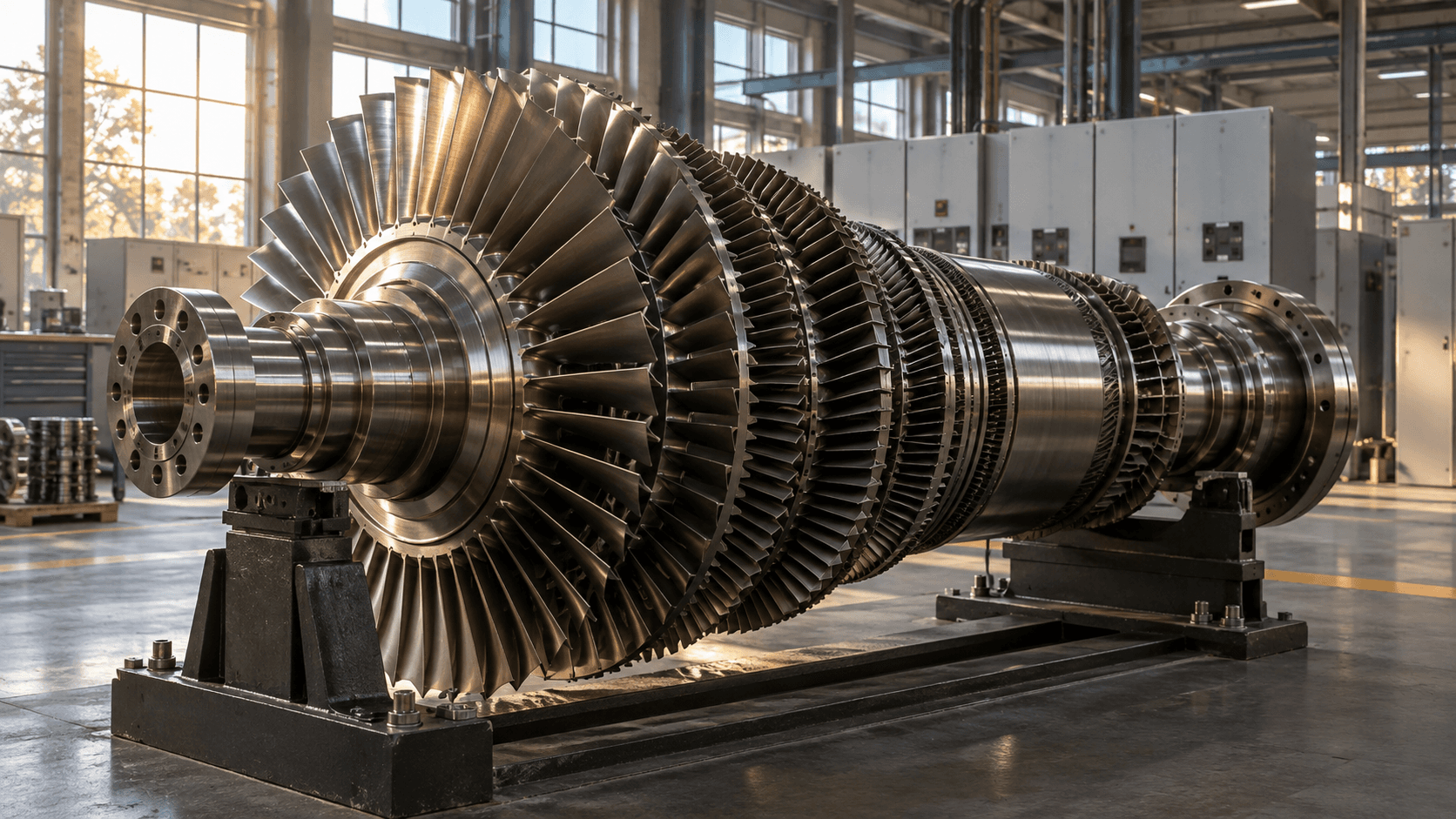
Boom described Superpower as a 42-megawatt natural-gas turbine using technology shared with its Symphony aircraft engine. Its advertised advantages included waterless operation and full output above 110 degrees Fahrenheit. Those are manufacturer claims, not independently verified operating results presented in this report. The distinction is especially important when comparing equipment that has a compelling specification with equipment a customer can accept into service.
The technical relationship is more concrete than the phrase 'jet engine for a data center' suggests. In his December explanation, Boom founder Blake Scholl described a shared high-pressure compressor and high-pressure turbine core. For the stationary product, extra compressor stages and a separate power turbine connected to a generator take the place of the aircraft engine's fan. Fuel nozzles also differ for natural gas and aviation fuel.
That is reuse of a central technology, not an unchanged engine dropped into a different building. Scholl argued that operating hours on the ground could improve confidence in the aviation core. His account also outlined an internal foundry and machining capability. Both ideas have an intelligible engineering rationale. Neither account establishes aircraft certification, a commercial fleet's maintenance cost or the production yield of a scaled factory.
The strongest version of the strategy is therefore worth taking seriously. A company could learn about common components while selling into a market different from aviation. It could spread development effort over more than one application. But that advantage depends on the common work actually being reusable. If separate requirements consume most of the effort, an apparent shortcut becomes two demanding product programs competing for the same people and capital.
There was already a supplier layer beneath Boom's public sales pitch. In February, Baker Hughes announced an order for 25 BRUSH electric generators, accompanying voltage regulators and electrical cubicles. Together with six previously ordered generators, it described 31 firm orders totaling 1.3 gigawatts, with deliveries planned from mid-2026 through 2028. Its announcement explicitly connected the equipment to Boom's Crusoe commitment.
Read those figures carefully. Baker Hughes described the aggregate generator orders separately from the 1.21-gigawatt customer program. They are not two ways of reporting precisely the same scope. Nor does a supplier's announced delivery schedule establish that every machine has arrived. The February release is evidence of a manufacturing commitment at that time, not a current inventory report or proof that associated contracts now have identical status.
This is where diligence needs to get less theatrical and more useful. Which commitments can be reassigned? When does a customer accept a machine? What performance demonstration releases the next payment? Who carries equipment if a project changes? These are questions an evaluator should ask, not terms disclosed in the agreements reviewed here. A backlog number cannot answer them by itself, even when the number is large.
Crusoe's other announcements provide a useful counterweight to the idea that its power strategy rested on one technology. In June, it announced a roughly 750-megawatt arrangement with Bergen Engines. The underlying split was approximately 438 megawatts under contract and another 310 megawatts in a letter of intent. Treating the entire headline as equally firm would erase a material distinction in the company's own release.
That agreement concerned natural-gas generating sets for multiple American locations, with deliveries phased through 2027. The package also included Marelli Motori alternators and Piller power-stabilization technology intended to handle rapid demand changes. This is evidence of a broader procurement approach. It does not establish that Bergen is replacing Boom at a particular campus, that the machines are interchangeable or that the announced capacity is already operating.
The stabilization component points to an easily missed operating issue. Buying enough rated generation is not the same assignment as keeping a computing load well supplied through changes in demand. A procurement comparison should test the combined arrangement: generating equipment, electrical interfaces, controls and the intended workload. Comparing two headline megawatt figures alone would leave the behavior of the actual system largely unexamined.
Crusoe's July announcement with ON.energy addressed that different layer directly. The companies proposed deploying five gigawatts of AI UPS capacity across multiple campuses, with commissioning beginning in 2026 and extending into 2027. They described a medium-voltage system installed between power sources and the data center, intended to isolate GPU load swings and keep equipment operating through voltage disturbances. These remain attributed product and deployment statements.
The five-gigawatt figure must not be added to generation orders as though it describes another power plant. It is a rating for the proposed UPS deployment, not a disclosure of five gigawatts of new fuel-burning generation. Nor is a power rating a statement of stored energy. Without an energy quantity and operating conditions, that headline cannot tell a reader how long a facility could run independently.
Storage brings yet another job into view. Canary Media reported in March that Crusoe's Form Energy agreement covered 120 megawatts and 12 gigawatt-hours of iron-air storage, with initial deliveries expected in 2027. Its reporting described reserved production and purchase terms, not an operating installation. It also cautioned that the capacity was not necessarily destined for one site and was not established as an Abilene deployment.
Those two units explain why the distinction is useful. Dividing 12,000 megawatt-hours by 120 megawatts gives 100 hours at the nominal power level. That arithmetic describes the relationship between the announced ratings; it is not a guarantee of a particular campus's runtime. A storage system's role in a project still has to be evaluated against the load and the conditions of the eventual installation.
Canary's separate reporting on Crusoe's Nevada work with Redwood Materials illustrates the importance of measurement boundaries. It reported 99.2 percent operation for the solar-and-reused-battery microgrid, while a Crusoe spokesperson put data-center uptime at 99.9 percent with grid backup. Those figures are not interchangeable: the computing service and its local energy source have different boundaries. They should not be turned into a simplistic ranking of battery technologies.
Taken together, these examples suggest a more disciplined way to compare an energy portfolio. Generation supplies power. Storage moves available energy across time. Power conditioning addresses the quality and behavior of that supply. A project may need all of them, but that does not make their nameplate ratings additive. The useful commercial unit is a dependable operating arrangement for a defined workload, not the sum of impressive announcement numbers.
Capital adds another set of boundaries. On September 17, Crusoe announced the initial closing of an anticipated $3.9 billion Series F at a $30.9 billion post-money valuation. Its release reported more than $140 billion in total contracted value and over six gigawatts of gross contracted capacity, including one gigawatt delivered and operational. These are company-reported figures, and the funding language does not say the entire anticipated round had closed.
Contracted value is not recognized revenue. Contracted capacity is not the same as commissioned capacity. A valuation is not money available to spend. Maintaining those distinctions is not pessimism about the company. It is how a reader avoids treating commercial demand, construction progress and financial resources as one metric. None of those aggregate disclosures tells us the economics or legal terms of a specific equipment commitment.
For builders, the practical response is to separate the evidence into stages. A technical evaluation should ask for relevant operating data and a defined acceptance test. A project evaluation should identify integration work, delivery dependencies and maintenance responsibility. A commercial evaluation should establish who pays as those milestones are reached. Passing one stage should not silently count as passing the others.
There is also a reasonable argument for trying unfamiliar suppliers. Refusing every unproven entrant can make a buyer dependent on whatever established capacity is available. The answer is not to prohibit technical ambition. It is to structure the exposure so that a promising experiment and a critical production requirement are not mistaken for the same commitment. That principle applies whether the equipment is a turbine, a battery or a new kind of computing system.
Boom's proposed combination of industrial power and aviation deserves to be judged as a business architecture with testable dependencies. Common hardware can be leverage; projected income from a second business can also become a dependency. The next useful evidence is not another sweeping description of the AI opportunity. It is equipment accepted by customers, documented operating performance and commercial commitments whose status can be understood. That is how an ambitious industrial thesis becomes something another builder can rely on.
LaunchPad positionAssess equipment acceptance, integrated operating performance and commercial exposure separately. Generation, storage and power conditioning are different capabilities, not interchangeable megawatts.
This report draws on the linked primary sources and reputable reporting. Company statements are treated as claims until independently demonstrated.