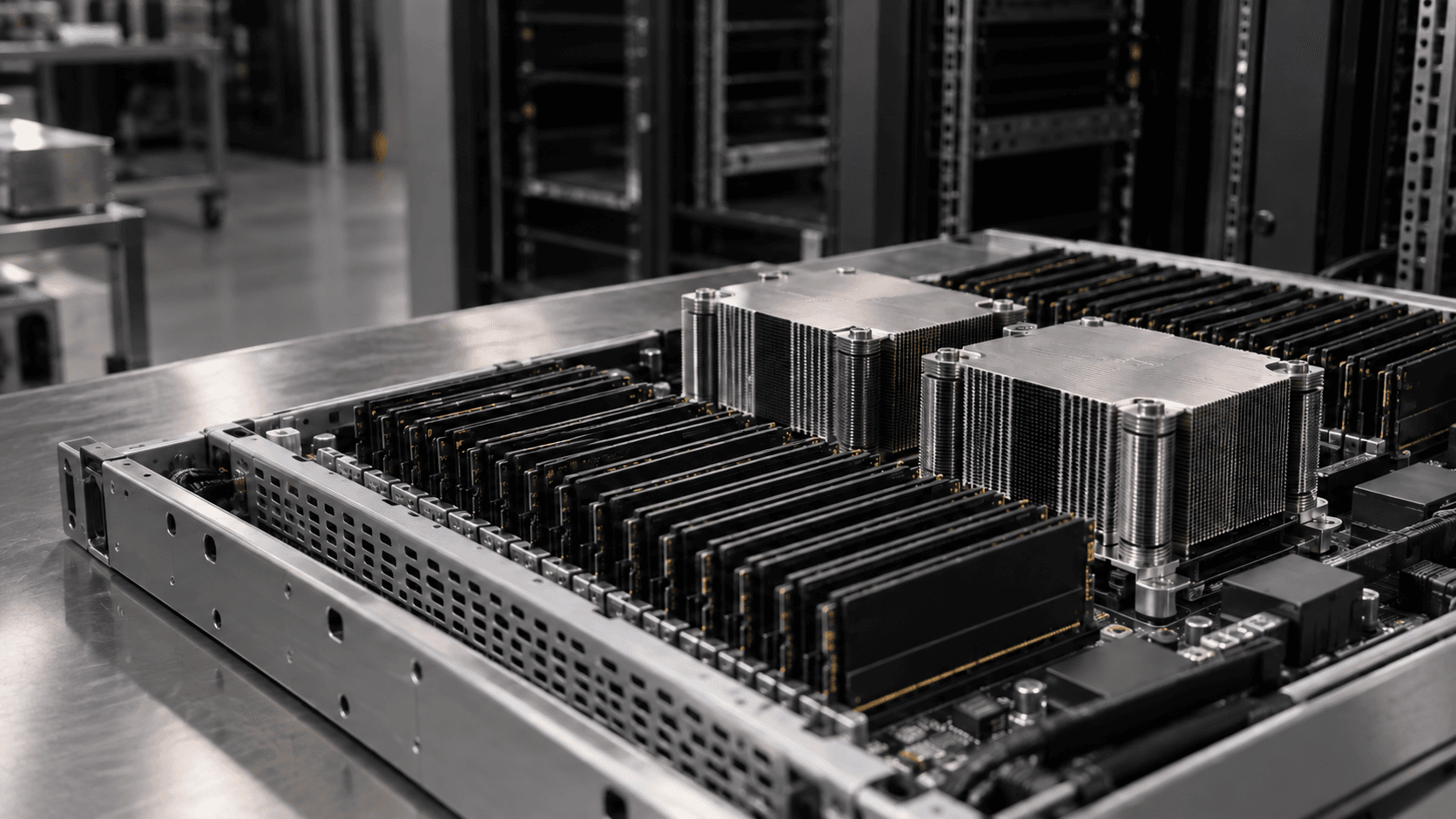
Akamai's next chapter comes with a warehouse bill before it comes with the revenue. Its expanded Anthropic agreement puts ordinary computing infrastructure at the center of an enormous AI commitment: processors, memory, execution environments and the software that keeps them useful. The important question is how a signed order becomes a working service, and who carries the cost while that happens.
On September 24, Akamai announced an $11.6 billion commitment over seven years to support Anthropic's growing CPU workloads. The companies could expand the relationship by another $9 billion on mutually agreed terms. That makes roughly $20 billion a potential outcome, not the amount currently committed. Reuters independently reported the base agreement; neither that report nor the announcement verifies future delivery.
The distinction between CPU capacity and model-training capacity matters. This announcement does not establish that Anthropic is replacing accelerators with conventional processors or moving all its inference to Akamai. It establishes demand for a different part of the computing stack. Treating every AI infrastructure contract as interchangeable obscures what the customer actually needs the machines to do.
Akamai estimates approximately $5.5 billion in capital expenditure associated with the base commitment. It also expects an additional $1.7 billion of capital spending in 2026, including securing memory, without changing its revenue guidance for the year. That is a substantial sequencing problem: procurement starts paying its bills before the new service becomes a substantial contributor.
The company's investor presentation places service initiation in late second-quarter 2027, with estimated revenue of $150 million to $300 million that year. It projects the full contracted revenue rate by the end of 2028, followed by approximately $1.7 billion annually. These are management's estimates, not completed operating milestones or a guarantee of the final collection schedule.
That schedule explains why dividing the headline commitment by seven produces a poor model of the near term. A contract can be strategically transformative while contributing little during construction and commissioning. The delivery ramp, rather than the announcement date, determines when the promised scale starts showing up in operations. Anyone evaluating the arrangement should keep the build period visible instead of smoothing it out.
The September 24 filing adds contractual boundaries. The project plans were signed September 18, and their seven-year terms begin on their respective service start dates. Payment commitments depend on delivery and service availability, with specified termination rights. Among them are provisions concerning uncured breaches and, subject to conditions, material outages. A signed agreement is stronger evidence than a discussion, but it is not unconditional cash.
The hardware commitment is already concrete in another respect. The same filing says Akamai authorized Jabil to purchase approximately $1.7 billion of memory components. Akamai pays the corresponding supplier invoices when Jabil receives them; the components are held on consignment pending use. That disclosure identifies an inventory arrangement, not proof that the purchased memory has become productive cloud capacity.
Inventory creates a different exposure from a running service. A component can have been paid for without yet supporting a customer workload. The execution question is whether procurement, assembly and deployment remain aligned with service delivery. This is why the memory purchase deserves attention alongside the revenue number. It makes the transition from commercial ambition to physical obligation easier to see.
The agreement also gives Anthropic a route to participate in its supplier's equity value. As SiliconANGLE reported, the warrant concerns nonvoting convertible preferred stock representing up to approximately 5% of Akamai's common stock, with an exercise price equivalent to $111.33 per common share. Roughly 2% is associated with the base commitment; the remainder depends on additional commitments. Those potential interests should not be described as an already completed 5% ownership stake.
The filing specifies that the initial tranche vests upon the first payment under Project Plan 3, subject to conditions, and that exercise requires cash. Akamai's presentation separately says the fair value of the initial expected tranche reduces revenue and is reflected in the announced $11.6 billion figure. Simply subtracting it again would misread the company's presentation.
The commercial logic is understandable: a customer making a large commitment can share in the value that commitment helps create. The counterargument deserves equal weight. Equity participation does not make the service free, eliminate dilution or guarantee delivery. It changes the distribution of potential upside while leaving the underlying machines and operating obligations very real. Calling this either effortless alignment or automatic financial trickery would skip the actual terms.
Akamai's existing business provides useful scale. In its second-quarter results, the company reported $99 million of Cloud Infrastructure Services revenue, up 39% from a year earlier. Total quarterly revenue was approximately $1.1 billion, including $604 million in security and $396 million in delivery and other cloud applications. The latter category declined 6% year over year. These are historical results, not the future mix promised by this agreement.
That mix makes the expansion more consequential than another large account win in an already dominant business line. The proposed cloud revenue stream is significant against the reported starting point of Cloud Infrastructure Services. At the same time, the company still has other businesses to operate. A large new customer's needs cannot be evaluated only through the sales organization; they become a capital-allocation and execution question across the enterprise.
The second-quarter release reported $4.616 billion in cash, cash equivalents and marketable securities at June 30, alongside $326 million in quarterly operating cash flow. Those snapshots should not be mistaken for today's available funding or compared mechanically with a multiyear spending plan. They do, however, show why timing matters. A serious analysis needs the evolving financing and cash-flow picture, not just a subtraction between two headline totals.
To understand why CPU infrastructure belongs in this story, look at Anthropic's published agent architecture. Its April engineering account separates the session log, the harness that coordinates model and tool calls, and the sandbox where code executes. Those are distinct jobs. Producing a model response is only one activity inside an agent that also opens files, runs software and preserves a recoverable history.
Anthropic describes moving its harness out of the execution container so that a failed container can be treated as a tool failure, rather than destroying the entire session. It also describes provisioning containers only when they are needed. These are the company's architecture claims, not a disclosed map of the new Akamai deployment. They explain the class of infrastructure problem without pretending to reveal the contract's private workload allocation.
The practical implication is that useful agent capacity cannot be measured solely by how many model requests a system can serve. Imagine a coding task that generates a change and then runs a test suite. The response and the test consume different services. More capacity for one stage does not automatically remove a delay in the other. That example illustrates the distinction; it is not evidence of a particular bottleneck inside Anthropic.
Security adds another operating requirement. Anthropic's sandboxing documentation describes filesystem restrictions and controlled network access for executing commands. Its account of Claude Code on the web also describes a proxy that checks Git operations and handles authentication outside the sandbox. These mechanisms place work around the model invocation. They should not be confused with a promise that arbitrary generated code has become harmless.
Running many such environments means the service has to preserve the intended boundaries as well as provide computing resources. A faster task is not useful if its permissions are wrong, and a stopped process is not necessarily a recoverable session. The architecture makes those concerns separable enough to investigate. It does not make them disappear. Procurement of more servers and design of a dependable agent service remain related but different achievements.
Anthropic's May announcement of self-hosted Managed Agent sandboxes shows a further distinction: tool execution can run in infrastructure the customer controls while the agent loop remains on Anthropic's side. The customer can choose resources and the runtime environment. This is an important counterweight to the idea that agent growth must place every additional computation into one vendor's cloud.
That flexibility makes blanket demand extrapolation risky. A team might run a build near its private dependencies, use managed execution elsewhere, or reserve different environments for different tasks. The published architecture supports separation; it does not establish what share of future work follows each path. The Akamai commitment is evidence of a specific commercial decision, not a universal ratio between agent adoption and CPU consumption.
Anthropic's separate self-hosted Claude Code explanation describes fixed runners and on-demand runners that start as sessions arrive. It also draws a data boundary worth preserving: repository checkouts and build artifacts remain on the provisioned infrastructure, while conversation content and tool results are sent to Anthropic for inference. Where code executes and where information travels are not the same question.
For builders, that means a capacity plan should describe the actual workload, not merely count agents. A long-running test, an idle session and a brief file operation should not silently become identical units in a spreadsheet. This deal makes the surrounding infrastructure commercially visible. It does not supply a shortcut for sizing somebody else's product, nor does it establish that a bigger infrastructure bill necessarily buys a better user outcome.
The next evidence should be operational: components arriving, service starting, the revenue ramp appearing in reported results, and the delivery obligations being met. Akamai has disclosed a large commitment with unusually tangible consequences for hardware procurement and ownership economics. The opportunity is substantial. The work now is to turn that commitment into dependable capacity without confusing the size of the order with the quality of the execution.
LaunchPad positionFollow delivered capacity and reported revenue. Contract value, inventory, operating performance and potential equity ownership are separate milestones.
This report draws on the linked primary sources and reputable reporting. Company statements are treated as claims until independently demonstrated.