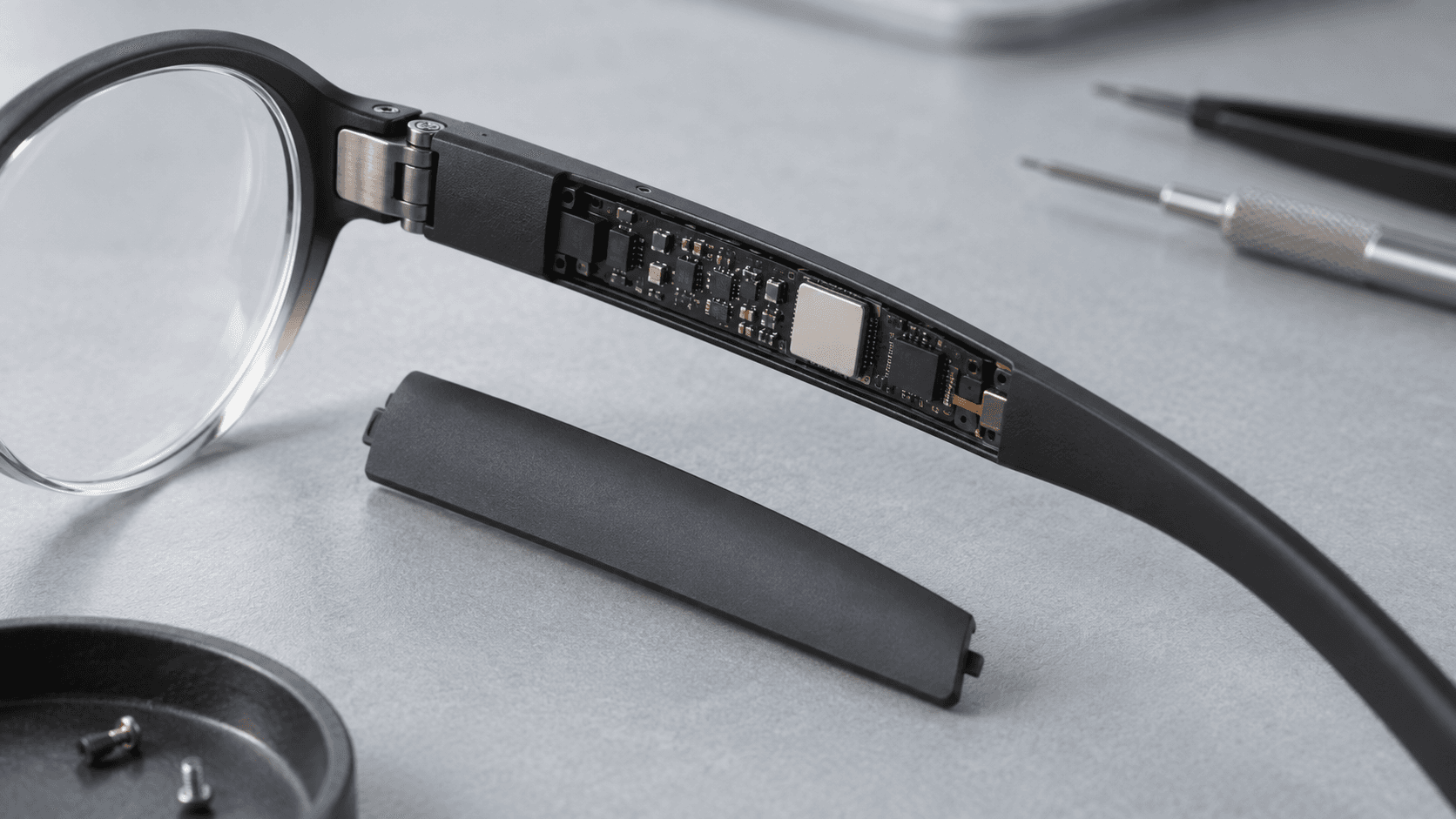
An AI model sitting beside your temple has to earn the space it occupies. The wearer gets no value from an impressive parameter count if the answer arrives too late or the battery runs out. That makes PrismML's smart-glasses demonstration worth examining at the level of memory allocation and runtime software. The most revealing details are in the footnotes, where a broad efficiency pitch becomes a specific, testable engineering result.
PrismML announced its Snapdragon Summit demonstration on September 23. Its two-billion-parameter vision-language model combines a 1.7-billion-parameter, one-bit language model with a 0.3-billion-parameter, four-bit vision encoder on Snapdragon AR1 Gen 1. TechCrunch separately reported the demonstration and noted that commercial glasses running PrismML had not been announced.
According to PrismML's footnotes, Qualcomm tested a four-gigabyte configuration at a 1,024-token context using an internal QNN SDK with one-bit kernels. Language-model weight memory was 0.43 GB versus 1.66 GB for the four-bit comparator. Generation was 15.36 versus 7.44 tokens per second. These are vendor test results, not measurements we reproduced.
PrismML's separate quality comparison used its language model against a four-bit Qwen3 1.7B model on named language, reasoning and instruction benchmarks. It does not establish the accuracy of an entire wearable visual assistant. That distinction is particularly important when a headline combines model size, speed and intelligence into one apparently universal improvement.
The memory claim needs a careful noun. Weight memory is not total system memory. If the language model becomes smaller, that is useful space made available to the rest of a design. It is not evidence that the complete device now consumes a quarter of its previous memory or lasts four times longer on a charge. The reported comparison does not supply either result. Keeping the denominator intact is the difference between understanding an engineering improvement and laundering it into a product promise.
One-bit also needs translation. PrismML's public Bonsai 1.7B model card describes a sign bit for each weight, with a shared scaling value for each group of 128 weights. With that scaling overhead included, the representation works out to 1.125 bits per weight. The information has not vanished into a magical zero-cost format. It has been represented more compactly, with additional information needed to interpret the packed values.
The same card distinguishes parameter storage from the file someone downloads. Its GGUF parameter allocation is listed at 0.24 GB, while the file is approximately 0.25 GB because it also includes the tokenizer, chat template and metadata. Those figures describe that public artifact. They should not be substituted for the Snapdragon test's allocation, and neither should be presented as the peak memory of a working pair of glasses. Different packaging and execution paths deserve their own measurements.
There is another easily missed boundary between the public download and the demonstration. PrismML's standalone 1.7B documentation lists text as the modality and publishes an Apache 2.0 license. Its advertised maximum context is 32,768 tokens, extended from a native 8,192 using YaRN. That does not mean the glasses experiment tested that context length, nor does downloading the text model reproduce the new vision-language system.
For developers, this is less an objection than an instruction about where to begin. The accessible language model can support exploration of local text workloads. A visual product requires the appropriate image-processing components and integration as well. Treat an experiment with the public model as its own experiment, with its own inputs and runtime. Do not quietly borrow the demonstrated device's capabilities for a different package just because both carry the Bonsai name.
The execution software is part of the technology. PrismML's format guide describes GGUF for the llama.cpp ecosystem and MLX for Apple hardware. More consequentially, it warns that a runtime without suitable low-bit kernels may reject a model or expand its weights to a higher-precision form, losing the intended savings. A small download is therefore not enough. The computation has to preserve the advantage after the file is loaded.
That creates a meaningful distinction between distributing model weights and delivering a supported hardware path. PrismML documents one-bit support in sufficiently recent llama.cpp builds, while the Summit measurement used Qualcomm's internal software configuration. These are different deployment routes. Neither a familiar file extension nor the presence of an AR1 chip alone demonstrates that a particular retail device can run the showcased system with the reported performance.
PrismML's troubleshooting guidance makes the operational consequences concrete. For unexpectedly slow generation, it tells users to inspect precision handling, hardware placement, the selected binary and context length. Those instructions concern its documented local-computing tools, not a failure we observed in the glasses. They nevertheless explain why two people can load related weights and get different outcomes: the runtime can be doing materially different work beneath an apparently identical prompt.
A careful prototype report should record that work. Identify the model artifact, runtime version and hardware path, then separate cold startup from an already-loaded interaction. Keep the input length with the speed result. Otherwise, a comparison can accidentally reward a shorter prompt, a different execution backend or an already-warm session rather than the compression technique itself. This is a proposed comparison method, not a claim that the published test made those mistakes.
The growing conversation has a memory bill of its own. Hugging Face's cache documentation explains how a key-value cache reuses intermediate attention information rather than recomputing it for every generated token. That can improve generation efficiency, but the retained state occupies memory. Depending on the model and cache strategy, longer sequences can increase the allocation substantially. Compressing weights and managing that state are separate tasks.
Hugging Face also documents cache quantization and the possibility of a latency penalty when a short context already fits comfortably in memory. Smaller is not automatically faster at every point in an inference pipeline. This is general technical context, not evidence that the Snapdragon demonstration uses Hugging Face's implementation. The relevant lesson is that memory should be measured during the actual interaction, including the state that accumulates after the first answer.
Speed has a similar accounting problem. Hugging Face's inference-benchmarking guide separates processing the input, generating subsequent tokens, time to the first token and completion of the full response. An output rate describes only a slice of the experience. A person asking about something in front of them cares about the interval between asking and receiving a useful answer, not merely how quickly text arrives once generation is underway.
Applied to a hypothetical visual assistant, the measurement should start before the picture has been interpreted and end when the answer can actually be consumed. If the answer is spoken, include that stage too. An excellent decoder can coexist with a frustrating pause elsewhere. The point is not to dismiss a faster language model. It is to preserve its genuine contribution while finding the remaining delay instead of assuming the entire interaction improved by the same ratio.
Qualcomm's AR1 product brief helps show why that wider view matters. The platform includes a neural processor alongside CPU and graphics resources, image-signal processing, audio capabilities and wireless connectivity. It is designed for a collection of activities, not solely text generation. A specification sheet also describes what a platform can support, not the exact components, battery or operating behavior of every device built around it.
The brief lists platform security foundations, including a root of trust and a trusted execution environment. These are relevant building blocks, but their presence should not be converted into a blanket privacy verdict. For a proposed application, local inference answers where one computation happens. It does not, by itself, explain whether images are retained, whether diagnostic data leave the device, or whether a fallback request goes to a remote service. Those are separate product choices that need explicit answers.
There is real leverage in making local processing possible. A team could design a bounded feature that remains useful without a network request for each inference. But that is a product opportunity, not proof that every feature should be forced onto the device. A larger remote model may be the better choice for a task the local one cannot perform reliably. The worthwhile comparison is complete task performance under the intended constraints, not ideological loyalty to either architecture.
Consider a deliberately narrow prototype: describing an object on request, rather than continuously interpreting everything the wearer sees. The evaluation should include unfamiliar objects, poor framing and cases where the system ought to admit uncertainty. Then repeat the workload long enough to observe power use and thermal behavior. No outcome from such a test is established by the Summit announcement. It is the kind of evidence needed to decide whether the engineering gain translates into a feature people should trust.
That leaves PrismML in an interesting position. The demonstration gives device builders a concrete efficiency result to investigate, and the public model documentation exposes several of the mechanisms and deployment constraints behind the broader approach. It does not yet settle commercial availability, sustained wearable performance or visual reliability. The next product should make those distinctions easier to inspect, not bury them under another claim that the future of computing has arrived.
LaunchPad positionMeasure the complete workload. Weight storage, active context, response latency and sustained power use are different parts of the wearable design.
This report draws on the linked primary sources and reputable reporting. Company statements are treated as claims until independently demonstrated.