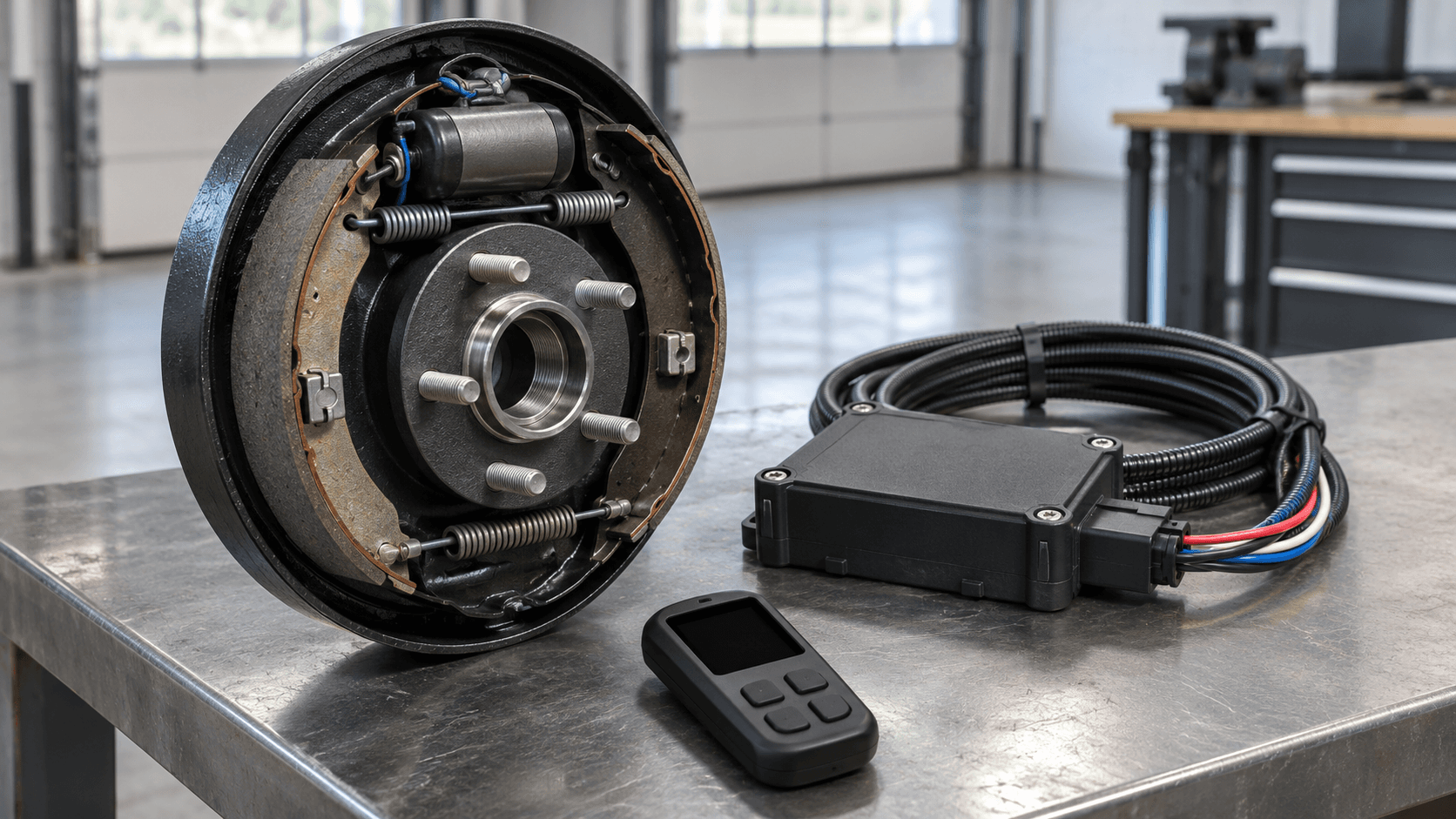
A security update that strands the driver's existing remote is also a hardware migration. That is the practical complication inside a new Elecbrakes vulnerability disclosure: protecting a brake controller requires more than putting corrected software on a download server. The manufacturer has to get the owner, controller, phone app and replacement remote through the transition together. Its free exchange program addresses a real compatibility problem. Its advice about when to make that transition deserves closer scrutiny now that the vulnerabilities are public.
CISA's November 19 advisory identifies three flaws involving unauthenticated brake commands, command replay and firmware updates. It lists EB2 firmware through 3.0.4.2.0, VM1 versions before 1.3.4.2.1 and all ELBC2000 versions as affected. The agency directs owners to install EB2 3.0.4.4.3 or VM1 1.3.4.2.1 through the Elecbrakes app. No fix is listed for the discontinued ELBC2000. CISA says it has received no reports of known public exploitation specifically targeting these vulnerabilities. That establishes an actionable product advisory, not evidence of a wave of attacks or a documented crash.
The design matters because wireless control and normal braking perform different jobs. Elecbrakes describes the EB2 as trailer-mounted and the VM1 as vehicle-mounted. Its technical FAQ says ordinary proportional braking uses the wired brake-light signal, measured deceleration from an onboard accelerometer and saved response settings. With power maintained, normal braking does not require a live Bluetooth connection. The app and remote provide adjustments and a manual override that can engage the trailer brakes independently of the towing vehicle. A controller can therefore tolerate losing its legitimate wireless interface while still exposing a dangerous command path to an unauthorized one.
CISA describes an in-range Bluetooth Low Energy device influencing braking without authentication or pairing. The replay flaw concerns commands without freshness or integrity protection, including a last command retained across sessions. The update flaw may permit unauthorized firmware modification. These are adjacent-radio vulnerabilities. Treating them as arbitrary attacks from anywhere on the internet would misstate the threat. Treating proximity as permission would make the opposite mistake. The relevant boundary is who can cause an action when they can reach the radio.
Patrick Forck and Jeremy McCarthy of Element Digital report notifying Elecbrakes on May 18 and receiving a firmware fix on July 6, seven weeks later. They credit the engineering response. Their account describes the corrected brake-control path as authenticated, encrypted and cryptographically bonded, with initial pairing gated by a physical brake-pedal sequence. That is a meaningful design change: establishing control requires an action outside the radio conversation. The researchers say their testing used their own hardware in private or closed settings. These are attributed findings, not our independent reproduction.
The current V3 remote product page provides a useful customer-facing cross-check. Elecbrakes says owners first enable the remote in the app, then authenticate it using the brake-pedal process in its guide. Subsequent connections are automatic. It also says a controller connects to one interface at a time, either the remote or smartphone. This makes ownership transfer between interfaces an explicit operating step. For a manufacturer designing a similar product, the acceptance test should include the first connection, reconnection and switching interfaces. A smooth demonstration of one already-paired phone is too narrow to establish those boundaries.
NIST's IoT capability catalog separates authentication, authorization, roles and interface control. Those distinctions help frame the engineering review here. An interface might identify a device yet give it excessive authority; it might protect configuration while exposing actuation; it might allow an old authorized device to retain access after replacement. A review should ask separately who may connect, inspect state, change settings, command physical output and install software. For example, a documented ownership-transfer test should confirm that a previous owner's remote loses authority after reassignment, while the new owner can complete the supported setup without weakening authentication. This is an application of NIST's engineering framework, not a claim that its catalog is an Australian vehicle regulation or that the advisory establishes a legal violation.
The migration cost is unusually tangible. Elecbrakes' exchange page says older EBR remotes become incompatible with the updated EB2 and VM1 wireless framework. It offers owners a V3 replacement without charging for the remote or shipping. The phone app remains available during the exchange. Owners who already have a V3 still manage their controller updates separately. Possessing the new accessory is therefore not, by itself, evidence that the controller is patched. A support workflow that closes the case when a replacement parcel ships could record completion before the vulnerable firmware has changed.
That creates two sensible but different customer-service goals: preserve the driver's familiar controls and complete the security update. The exchange page tells people travelling with an old remote they can finish their trip, then arrange replacement and update. CISA recommends installing the corrected firmware. The vendor's compatibility advice explains a reason an owner might wait; it does not establish that waiting removes exposure. Owners needing help with that conflict should use Elecbrakes support to arrange a supported transition. The published material does not justify an improvised workaround or a blanket assurance that postponement is harmless.
The current remote page also says response settings should be adjusted while stationary. Its physical controls provide access to braking programs and manual override, while the controller retains normal braking behavior if the wireless connection drops. Those operating distinctions should survive every update notice. Customers need to understand which function becomes unavailable when an old remote stops working and which behavior remains on the controller. Otherwise, the word incompatible can be read either as a minor accessory inconvenience or a total braking failure. Neither interpretation should be left to guesswork during a safety-related migration.
NIST's manufacturer communication guidance explicitly includes update urgency, recommended installation timing, dependencies and possible side effects. Applied to this case, a strong notice would put the security reason, controller version, remote compatibility and supported exchange sequence in one place. It would explain how to confirm installation, not merely how to start it. The proposed measure of success is an owner who can identify the device's resulting state and available controls. Download counts, app notifications and replacement orders would each answer only part of that question. They should not substitute for confirmation that the controller runs corrected firmware.
There is a second boundary inside the update mechanism itself. The researchers say they did not install malicious firmware or extract the bootloader. They report that the fixed version restricts entry to update mode through an authenticated, bonded connection, while the distributed firmware image remained unsigned at their prepublication check. They attribute a plan for signing in the next app release to Elecbrakes. That prospective improvement must not be reported as shipped. Nor does the limited experiment establish that an attacker successfully installed persistent malicious code. The distinction prevents a possible consequence from becoming a claimed demonstration.
NIST's software-update catalog asks for authorized installation and verification that updates come from valid sources. These are separate review questions. Restricting who can begin an update addresses access to the installation process. Checking the update artifact addresses what that process is allowed to install. A product team should document the protection supplied by each and test their interaction, including the recovery path when an update fails. The present disclosure supports examining those boundaries; it does not supply evidence for certifying the whole corrected implementation. A future signing release would need its own version, availability and verification evidence.
The ELBC2000 leaves a different operational problem. Its absence from the current sales range cannot serve as evidence that installed units have disappeared. For owners of a model with no listed fix, a general instruction to update does not complete the support task. Our view is that the next useful vendor communication would name a responsible support route, the available interim options and a dated remediation decision. That is a request for a concrete plan, not a prediction that a software patch is feasible for this hardware or that a replacement campaign has been announced.
For builders, the budget question is visible without inventing a recall bill. Elecbrakes has chosen to fund accessory exchanges for the supported migration. Product planning should allow security changes to consume hardware support, fulfilment and customer-service capacity as well as engineering time. Maintaining compatibility at any cost can preserve an unsafe trust assumption; breaking compatibility without a workable transition can leave customers on the older system. The design review should ask how an authentication change reaches an owner who relies on a physical remote and seldom uses the phone app. That is a product requirement worth deciding before an urgent release.
This assessment rests on the agency advisory, the researchers' account, manufacturer documentation and NIST's published capability guidance. No independent reproduction or additional independent reporting was located in the searches for this edition. The open questions are specific: verified installation across affected devices, delivery of the promised signing change and a remedy for the older controller. Closing them would require evidence about deployed products and supported customer actions. The immediate lesson for connected-hardware teams is to make the migration part of the fix, with completion defined at the device the customer actually uses.
LaunchPad positionVerify the installed controller version and the supported remote transition separately. A replacement accessory is not proof of a completed security update.
This report draws on the linked primary sources and reputable reporting. Company statements are treated as claims until independently demonstrated.