The next jump in transatlantic connectivity is not another app. It is a second path for light inside a strand of glass. Meta's planned Petal cable puts that idea into an unusually ambitious infrastructure project: more capacity across an ocean without simply doubling the physical system. The engineering deserves attention. So does the gap between an announced design and a network carrying real traffic.
Meta announced Petal on September 21, targeting one petabit per second across approximately 7,000 kilometers between the United States and France. Service is expected in 2029. These are project targets, not measurements from an operating route. Meta describes Petal as a first-of-its-kind transoceanic deployment. We should evaluate that claim as the company's stated ambition until construction, commissioning and actual service establish the result.
A September 22 joint announcement assigns the responsibilities: Meta will finance and operate the system, NEC will handle overall design and construction, and Sumitomo Electric will supply the two-core fiber. Orange is supporting the French landing plans. Data Center Dynamics independently reported the project and its planned service date, but its coverage does not establish that the cable has passed an end-to-end operational test.
The unit matters. One petabit per second is 1,000 terabits per second, a statement about data transfer rate rather than stored information. It is also a whole-system capacity target. It should not be read as the speed a household, company or individual application will receive. Getting from aggregate infrastructure capacity to a useful service requires decisions about equipment, allocation and connectivity beyond the cable itself.
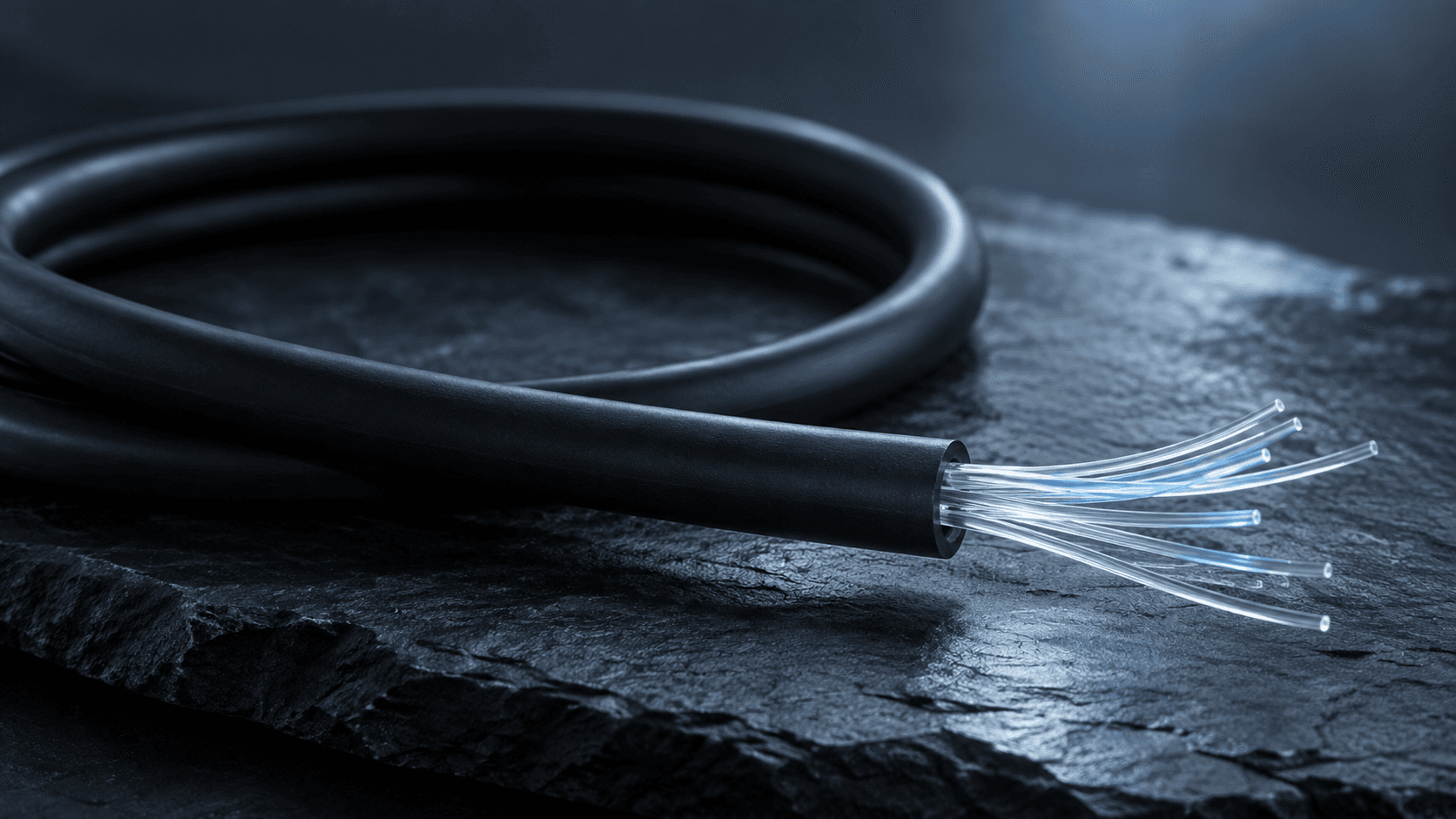
The physical idea is less mysterious than the headline sounds. The partners describe two optical paths within each fiber rather than one. Their planned system provides 48 pairs of spatial channels. Those are core pairs, not 48 pairs of separate physical fibers. Keeping that distinction straight matters because the point of the design is to add transmission paths without treating every additional path as another independent glass strand.
Meta's engineering account specifies 24 physical fiber pairs using two-core fiber. It identifies signal loss and interference between the cores as central manufacturing challenges. In plain English, putting two channels close together is useful only if the light remains sufficiently strong and the channels sufficiently separate to carry information reliably. The extra path has to survive the realities of the material, not just fit into a diagram.
That is part of a broader shift in how the industry seeks capacity. Alcatel Submarine Networks describes spatial division multiplexing as an approach combining more fiber pairs, lower-power optical channels and shared pumping arrangements in repeaters. ASN is useful here as a source on the design philosophy, not as a named Petal supplier. The objective is an efficient complete system, rather than extracting the most impressive number from one fiber.
The strategic lesson is that parallelism changes the optimization problem. If a designer spreads work across more paths, the best operating point for each path need not be its individual maximum. That does not remove constraints; it moves the question to the combined result. For a cable owner, capacity delivered for the available electrical power and construction cost is more meaningful than an isolated laboratory record.
Repeaters are where Petal's new fiber meets established amplification. Meta says its design separates each two-core fiber into single-core paths inside the repeater, amplifies those paths and combines them again afterward. The interface is called fan-in/fan-out. Meta also says the design stays within power-feeding equipment limits rated up to 18 kilovolts, rather than requiring the surrounding ecosystem to qualify equipment for a higher voltage.
The engineering choice is to change the transmission medium while retaining a workable amplification and power architecture. That does not establish a service record. Our assessment will remain provisional until the finished system can be judged through operation and maintenance, rather than through a description of how its parts are intended to fit together.
The joint announcement adds a separate resilience feature: reduced repeater power consumption intended to enable feeding the system from a single end. That addresses a power-supply problem. It should not be confused with protection against every physical cable fault. A design can improve its ability to remain powered under a particular failure condition while still needing another route when the transmission path itself is unavailable.
The word capacity also needs unpacking before anyone turns the announcement into a market forecast. TeleGeography distinguishes potential capacity, possible with the relevant terminal equipment installed, from lit capacity that has actually been equipped for operation. Its industry overview explains that owners often add that equipment gradually instead of realizing the system's full potential on the first day.
Petal's announcement does not establish its opening-day lit capacity or utilization. That leaves important commercial questions unanswered, but not necessarily alarming ones. A large design envelope can provide room for incremental growth. What would be misleading is to treat that envelope as evidence that customers are already consuming the entire amount, or that the full target represents immediately available wholesale supply.
This distinction protects against two opposite mistakes. Calling every announced terabit a glut ignores when capacity becomes usable and who needs it. Calling every new system essential ignores whether the relevant users will pay for, or internally justify, the capacity it offers. Our assessment would separate the physical capability from the deployment plan and the actual traffic requirement before drawing a conclusion about either abundance or shortage.
Ownership is another part of that equation. TeleGeography describes major content providers as substantial investors in new cables alongside the traditional carrier and consortium models. Petal fits that broader pattern through Meta's stated funding and operating role. For readers, the implication is not that a private cable automatically becomes a public utility. It is that an application company's infrastructure choices can reach far below its visible products.
The physical risks remain stubbornly ordinary. ITU's submarine cable backgrounder identifies accidental fishing and anchoring, along with natural hazards such as earthquakes and underwater landslides, as important vulnerabilities. It cites more than 170 cable repairs worldwide in 2025, based on International Cable Protection Committee data. That is a global repair count, not a prediction about Petal or a measured failure rate for two-core fiber.
More information flowing through a common physical route does not create another physical route. If an organization needs continuity, it must ask what happens when that shared route is lost. The additional optical paths may expand throughput, but their coexistence inside one cable is precisely why they should not be counted as geographically independent backups. Capacity and diversity belong on different lines of the planning document.
That distinction is consistent with ITU's July 2026 announcement of international resilience recommendations. The priorities include geographical diversity, infrastructure redundancy, improved risk monitoring, predictable permitting and better preparedness. These are broader recommendations for the cable ecosystem, not a Petal-specific approval or a guarantee of compliance. They put the discussion where it belongs: beyond the fiber and into the institutions that keep networks recoverable.
Repair readiness is therefore part of the product, even though it is unlikely to appear in the most glamorous launch graphic. For a network buyer, we would want a clear account of alternate capacity, operational coordination and the process for restoring a damaged system. That request does not presume a particular weakness in Petal. It recognizes that a faster working cable and a recoverable network solve different parts of the same problem.
Construction has its own dependencies. ITU notes that submarine cable delivery can take more than two years and can be affected by permitting, environmental requirements, seabed conditions, weather and coordination across jurisdictions. Petal's expected 2029 service date should be read in that context. A target provides a planning horizon; it does not mean every permission, installation step and acceptance milestone has already been completed.
On the French side, Meta says it is working with Orange on an Atlantic landing. The ocean span is only part of the journey. We would want future updates to distinguish marine progress from the readiness of the facilities and onward connections that make the cable useful. Announcing capacity should not blur the remaining interfaces at either end.
The efficiency argument is plausible but deserves a defined boundary. Meta says the design doubles capacity without a proportional increase in power or physical infrastructure. That is a design claim, not a published all-in operating-cost comparison or a completed environmental assessment. A fair comparison would specify what is being delivered and include the equipment and operations required to deliver it, rather than awarding credit solely for the larger headline rate.
There is a constructive counterargument to chasing maximum capacity in one system: an operator may value a different geography or recovery option more than another increment of throughput along an existing corridor. The correct answer depends on the network being built. Petal can be a meaningful advance in transmission density without being the right answer to every connectivity problem. Infrastructure gets better when those distinctions survive the sales pitch.
For builders, Petal shows why apparently mature infrastructure still offers room for consequential invention. Fiber design, optical interfaces, amplification and power feeding have to work together; the improvement is at their junctions. The milestone to watch is not another repetition of the petabit number. It is a commissioned system that delivers the promised capability within a credible operating and recovery plan. That would be a substantial achievement, with no need to pretend it has happened already.
LaunchPad positionDistinguish designed capacity from equipped capacity, and optical parallelism from geographic redundancy. Petal remains a planned system, not an operating performance result.
This report draws on the linked primary sources and reputable reporting. Company statements are treated as claims until independently demonstrated.