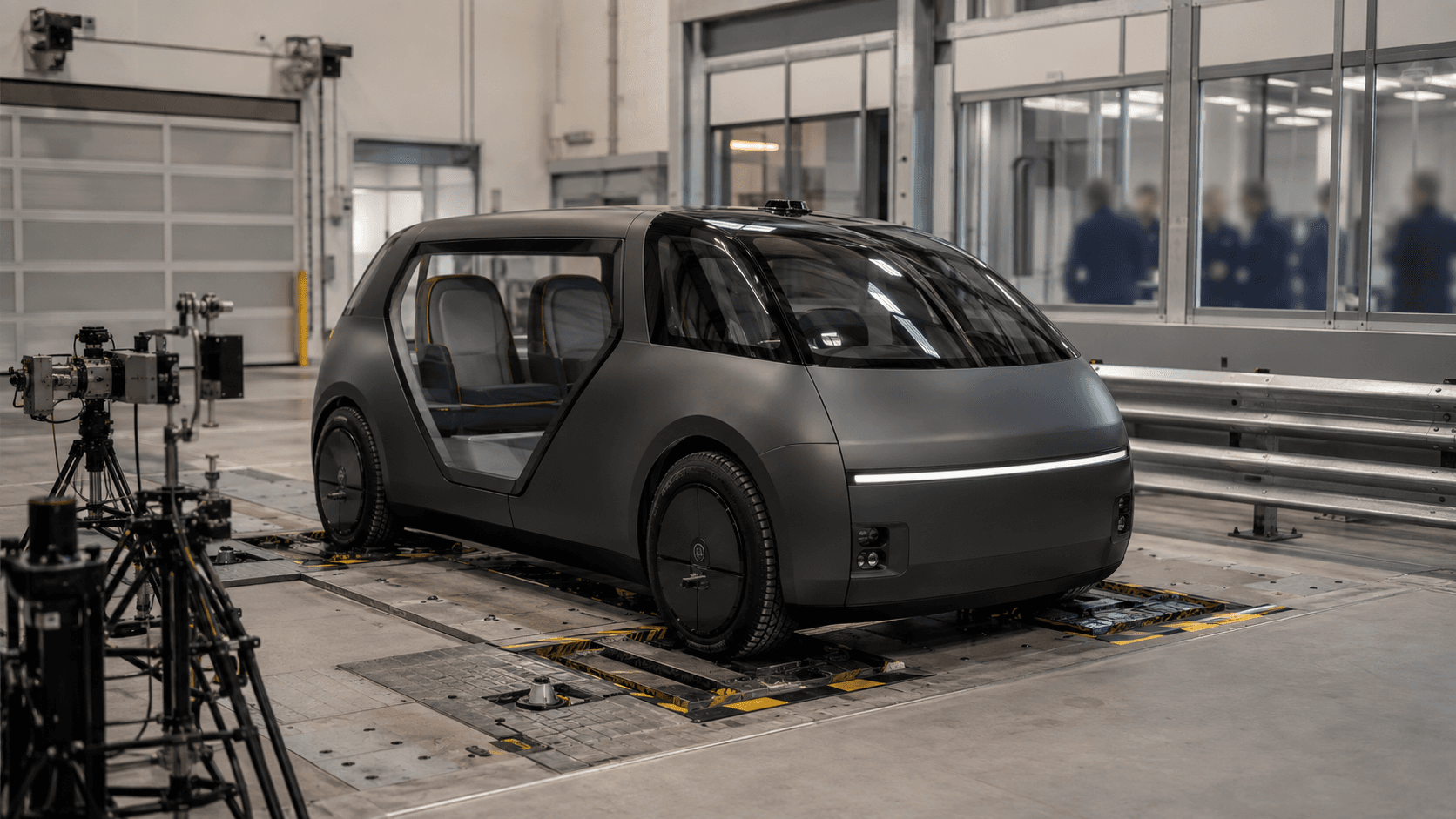
Tesla's Cybercab did not run into a mystery regulation. It ran into a public test of how the company read the existing rulebook. On September 4, the National Highway Traffic Safety Administration opened an Audit Query into Tesla's claim that the purpose-built vehicle complies with every applicable federal motor-vehicle safety standard. The timing is sharp because commercial driverless service in Austin had started one day earlier. The inquiry does not prove the car is noncompliant. It means the agency wants to see the work behind Tesla's answer.
NHTSA says Tesla used self-certification, the ordinary mechanism through which manufacturers attest that a vehicle meets applicable Federal Motor Vehicle Safety Standards. The agency then uses oversight to test that assertion. Its new inquiry will examine the technical data and processes supporting Tesla's certification and whether Tesla decided that particular requirements do not apply to a vehicle without traditional human controls. That wording matters. This is an audit of the certification basis, not a published finding about which specific requirement Tesla failed.
The product makes that interpretation consequential. Associated Press reporting from the September 3 launch describes Cybercabs entering service in Austin without steering wheels or brake pedals, with no way for occupants to take over the driving task. Tesla published a dedicated rider guide that day, confirming that this is an operational passenger product rather than a distant design study. A vehicle designed around permanent machine control cannot be evaluated by pretending a conventional driver is still somewhere inside.
That does not make every old requirement intelligent forever. It also does not permit a manufacturer to treat a proposed rewrite as if it were already law. NHTSA says it is working on eight rulemakings involving equipment such as brake pedals, wipers, lighting, and mirrors. The same announcement states that existing standards remain in force until that work is completed. The Cybercab dispute sits directly inside that transition: the physical design moved faster than the completed regulations, while the legal duty to certify did not vanish.
NHTSA has described the underlying problem plainly. Federal standards were intended to be technology-neutral, but they were written when every road vehicle had a human driver. Tests often refer to human inputs because that was the only practical architecture in view. The agency's March policy address gave braking as an example: a standard can specify stopping performance through a force applied to a physical foot pedal. A machine-operated vehicle still has to stop safely, but a passenger foot pedal may add little value and could create a new path for misuse.
The agency's June proposal for brake systems tries to separate the useful safety outcome from the obsolete interface assumption. It would remove the requirement for a hand or foot brake control in vehicles designed never to be driven by a human, while retaining stopping-distance performance requirements. The proposal would not relax the existing requirements for an automated vehicle that keeps manual controls. It also says physical braking performance and the automated system's decision about when to brake are separate questions.
The formal proposed rule makes the distinction more concrete. For a conventional car, stopping distance is measured from physical force applied to the brake control. For a vehicle without a pedal, NHTSA proposes measuring from transmission of an electronic brake command to the point at which the vehicle stops. It also proposes that primary brake controls be operated by systems onboard the vehicle. The document says passengers should have a way to request a stop, but it does not settle how that request must work or how the automated system must respond.
This is the stronger regulatory direction. Preserve the outcome that protects people, then write a test that fits the new control architecture. A decorative pedal nobody is supposed to use would satisfy the shape of an older interface while doing little to prove that the vehicle stops when its software commands it. But the transition needs public, repeatable rules. If each manufacturer invents its own substitute test and decides privately which provisions are irrelevant, compliance becomes an argument instead of a shared standard.
Some standards have already crossed that transition. In 2022, the Department of Transportation finalized changes to occupant-protection language for automated vehicles without conventional controls. The rule clarified terms that assumed a driver's seat or steering wheel while keeping the same level of crash protection for occupants. It was explicitly limited to crashworthiness. That precedent shows modernization is possible without abandoning the safety objective. It also shows why one completed rule cannot be stretched into blanket permission across braking, visibility, lighting, and every other system.
The most relevant enforcement precedent is Zoox. In 2023, NHTSA opened an Audit Query after Zoox certified a purpose-built, bidirectional vehicle without traditional driving controls. The agency said it would examine the company's technical basis, including any reliance on self-developed test procedures or conclusions that standards were inapplicable because of the vehicle's configuration. That language closely resembles the questions now directed at Tesla. It does not tell us how the Cybercab inquiry will end, because Tesla's evidence and design must be assessed on their own.
TechCrunch reports that Zoox eventually pursued an exemption path for commercial service, but it also notes that Tesla's timeline remains uncertain. The important strategic difference is not that one route is automatically right. It is how much scale and schedule risk each route carries. A broadly accepted certification could support expansion without a narrow fleet exception. An exemption can create a defined legal path while imposing conditions or limits. Betting on the first route increases the value of a technically defensible interpretation and the cost of getting it wrong.
For Tesla, compliance is therefore part of the production architecture. A vehicle program cannot treat the federal test method as paperwork that arrives after the industrial design is locked. Whether a requirement applies affects sensors, actuators, cabin controls, validation equipment, documentation, and potentially the units already built. If an agency rejects a key assumption, the response may require more than rewriting a certification memo. The exact consequence here is unknown, but the dependency should be visible in any serious execution plan.
The audit also should not be confused with a verdict on the automated driving system's behavior in traffic. NHTSA distinguishes minimum vehicle standards from its broader authority over defects that create an unreasonable safety risk. Its proposed brake update similarly separates a brake system's ability to stop from the automated driver's decision to apply it in a real situation. A compliant actuator does not prove competent driving. A disputed pedal requirement does not prove dangerous driving. Those questions can interact, but evidence for one does not settle the other.
Remote support creates another boundary that the product must make legible. NHTSA has described a spectrum ranging from passive monitoring and passenger communication to remote suggestions or direct driving controls. Each design creates different responsibilities and failure modes. The reviewed launch reporting establishes that Cybercab passengers cannot take over manually, but it does not provide a complete, independently verified account of Tesla's remote-operations design. We should not fill that gap with assumptions. The relevant questions are who can intervene, through what channel, and what happens when communications fail.
The commercial service must solve more than vehicle motion. A rider needs a dependable way to identify the right car, enter, secure belongings, request a stop, handle an emergency, and reach support. The Tesla guide's published structure covers riding, the vehicle overview, doors, seats, cabin comfort, emergencies, and specifications. Those headings show the scope of the passenger interface, but they do not independently prove its performance under stress. Operational evidence comes from completed trips, incident handling, response time, and transparent reporting.
AP's launch coverage also highlights a sensor-strategy difference. It describes Tesla's system as camera-only, while Waymo and Zoox supplement cameras with radar and lidar. That is a reported architectural contrast, not proof that one stack is safe and another is unsafe. The burden is to demonstrate performance across the permitted operating conditions, including the cases most likely to degrade the chosen sensors. A simpler hardware stack can improve cost and manufacturability only if the system still meets the required safety and reliability thresholds.
The cleanest way to understand the federal inquiry is as a demand for traceability. Which standard applies, which test demonstrates compliance, which data supports the result, and who approved the interpretation? A company with strong answers should be able to show the chain. Regulators then have to resolve obsolete assumptions quickly enough that compliant innovation does not wait behind rules aimed at a missing human driver. Both sides have a job here. Tesla must prove its reading. NHTSA must turn the transition into standards that competitors can apply consistently.
Cybercab's launch is a real operating milestone, and the Audit Query is a real execution risk. Neither should be inflated into the final outcome. The next signal is not another theatrical ride or a slogan about the future. It is the agency's assessment of Tesla's technical basis, any corrective action or clarification that follows, and the evidence from sustained public operation. A driverless vehicle becomes infrastructure when the safety case, rulebook, and operating system agree on what the machine is allowed to do.
LaunchPad positionPurpose-built autonomy needs standards that test safety outcomes without pretending a human driver remains in control. Until rulemaking catches up, manufacturers still have to prove how their designs comply with the rules in force.
This report draws on the linked primary sources and reputable reporting. Company statements are treated as claims until independently demonstrated.