An advanced reactor becomes a business when the machinery around the reactor becomes repeatable. Somebody has to manufacture the equipment, connect the systems, qualify the work and accept responsibility when a delivery date slips. That is why Samsung C&T joining Kairos Power deserves attention. The interesting part is not another large number attached to nuclear energy. It is the attempt to make a complicated plant deliverable by a coordinated industrial team.
On September 21, Kairos and Samsung C&T announced a binding term sheet covering up to $100 million in direct investment and engineering services. Regulatory approvals remain conditions. This is not a statement that $100 million in cash has already landed. TechCrunch reports that a Kairos spokesperson put the equity portion at $70 million. The distinction matters: engineering support can be valuable without being interchangeable with cash available for every other project expense.
The planned division of work is consequential. Kairos would lead the nuclear island, while Samsung would initially support power-generation systems and the balance of plant. Those responsibilities sit inside an integrated engineering, procurement and construction team. The opportunity is to bring delivery expertise into the design process early. The risk to watch is the handoff between organizations, where a component can meet its own specification yet still create trouble for the system it must join.
Hermes 2 is the immediate test. Kairos announced its groundbreaking in Oak Ridge, Tennessee, on April 17, with Barnard Construction serving as general contractor. Reactor equipment modules are to be fabricated in Albuquerque and shipped to the Tennessee site. That geographic split is an important part of the proposition: move repeatable work into a factory, then assemble the plant from equipment whose production process can improve from one build to the next.
There is already a route to a customer, but it is more specific than a reactor plugged directly into a Google data center. Google's August 2025 description says the Tennessee Valley Authority will buy the electricity, while Google will procure the associated clean-energy attributes through TVA. The regional arrangement supports data centers in Tennessee and Alabama. It joins a developer, a utility and an energy customer rather than replacing the grid with a private extension cord.
Kairos's corresponding announcement set out a plan for a single reactor supplying up to 50 megawatts, targeting operation in 2030. It also connected Hermes 2 to the broader Google agreement aiming for 500 megawatts by 2035. These are development targets. They are not electricity already delivered, and the fleet figure is not the output of this one plant. Keeping those boundaries visible makes it possible to judge progress without changing the scoreboard every time a partner signs on.
The regulatory record needs the same care. The NRC's public Hermes 2 summary records construction permits issued on November 21, 2024. It still describes the earlier configuration of two test reactors, each rated at 35 megawatts thermal. Thermal output measures heat; it is not interchangeable with electricity delivered. The current company plan describes a different configuration. The summary alone does not establish how every subsequent design change has been handled, so it would be wrong to present it as confirmation of the entire revised plant.
Even the dates deserve checking. The September partnership release says the construction permits arrived in December 2024, which differs from the NRC record. More importantly, Kairos's original permit announcement explains that an operating license is a separate approval required before startup. A construction milestone and permission to operate answer different questions. None of the new investment language removes that distinction. There is no need to turn an incomplete public record into either a regulatory victory lap or an allegation of a problem.
The technology is distinctive, but the delivery challenge cannot be reduced to a clever coolant. Kairos describes Flibe as a mixture of lithium fluoride and beryllium fluoride that supports high-temperature, low-pressure operation. Its own explanation also calls for chemistry control and inert-gas systems to limit contact with air and remove impurities. Those are operating requirements, not decorative accessories. The useful question is how reliably the complete process can be controlled over time, not whether one material property sounds reassuring in isolation.
Fuel qualification has its own evidence trail. In July, Kairos said it had completed verification and validation reports for KP-BISON, its fuel-performance modeling tool, including comparisons with irradiation experiment data. It planned to use the work in NRC submissions and undertake further irradiation testing of its final fuel form at NRG PALLAS. Completed modeling reports are progress, but they are not the same thing as a regulator approving every intended operating condition. The company itself identifies additional testing and licensing work.
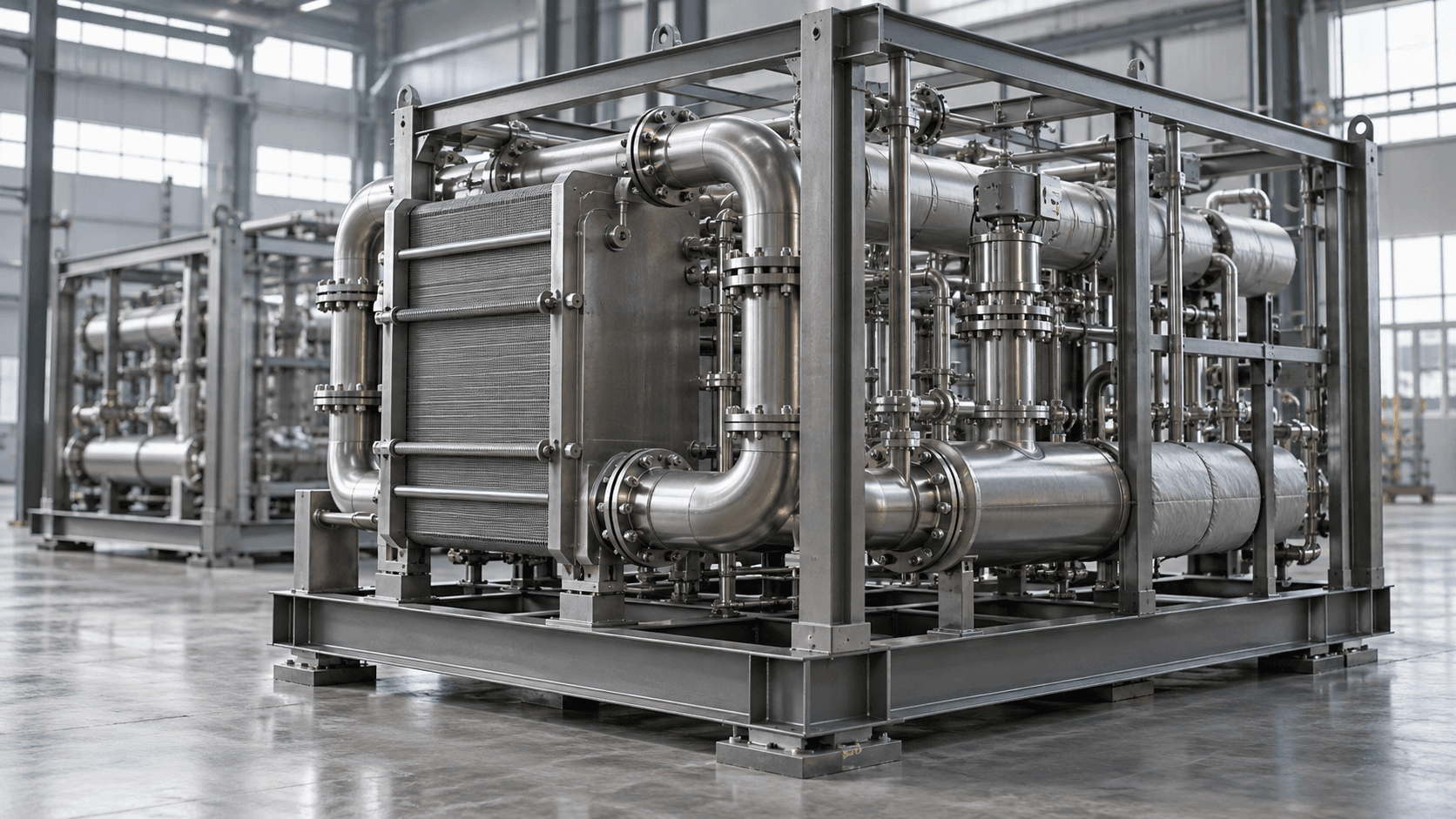
This is where the non-nuclear hardware program becomes more interesting than the usual reactor rendering. Kairos's September account of Engineering Test Unit 2 describes more than 30 equipment skids, with piping, supports and electrical connections packaged around defined functions. One example consolidates chemistry-monitoring functions into a dedicated system. That is a concrete design lesson: changing where equipment sits also changes access, interfaces and the sequence in which people can assemble it.
The same account describes alignment checks, connection work and staged testing, with hot-argon testing still ahead at the time of publication. Those details temper the word modular. A module is not useful merely because a truck can carry it. It must arrive with interfaces that fit, equipment that can be reached and a test sequence that exposes problems before the next stage makes them expensive to correct. The publication has not independently measured Kairos's claimed construction efficiencies.
Another September update reports more than 40,000 graphite moderator pebbles produced and loaded into ETU 2. These are not 40,000 finished nuclear fuel pebbles. The company describes a non-nuclear test system using moderator material and surrogate fuel elements. The manufacturing lesson is still relevant: custom tooling, fixtures and handling methods were developed around a repeatable component. Counting the parts accurately is more useful than upgrading their significance until a factory exercise sounds like a fuel qualification.
Engineering Test Unit 3 addresses a different problem. Kairos says its first phase used a reduced-scale reactor-cavity mockup, including precast shielding elements and remote-handling equipment. The reported work involved Oak Ridge National Laboratory, Tindall and Barnard, with robotic tools intended to explore maintenance access. It was a non-nuclear demonstration. That setting can reveal mechanical and assembly problems without proving performance inside an operating reactor, and the distinction should survive every retelling of the milestone.
The practical importance is maintainability. A plant design should be judged not only by whether its first installation succeeds, but by whether worn equipment can be inspected, isolated and replaced under the conditions the operator will actually face. That is an engineering judgment, not a claim about Hermes 2's eventual availability. A credible delivery review would ask which maintenance procedures have been rehearsed, which remain conceptual and what changes those rehearsals forced into the design.
People and qualified processes are another dependency. The August NuCAMP announcement describes an initial 12-month exploration phase involving Kairos, research institutions, construction partners and education providers. Its agenda includes manufacturing methods that are not yet fully qualified under the relevant industry codes, along with proposed training pathways. Those are plans for building capability, not an announcement that a complete workforce and qualification system are already waiting at the gate.
For founders building physical technology, the implication is uncomfortable and useful. Vertical integration does not mean doing every job alone. It means being deliberate about the knowledge and production steps the company must control, then making the remaining responsibilities explicit. A specialist partner can improve execution without taking ownership of the whole product. The difficult part is specifying how both sides will discover, resolve and pay for problems that cross their boundary.
Samsung's involvement should therefore be evaluated through responsibilities as well as capital. Which design interfaces have named owners? Who accepts a module before shipment, and who accepts it after installation? What happens when a change in one system affects a partner's work? The public announcement does not supply the contracts needed to answer those questions. They are proposed tests of the arrangement, not evidence that the partners have failed to address them privately.
There is also a financial limit to what can be concluded. The disclosed package does not establish the completed plant's cost, the price of its electricity or the size of any remaining financing need. Treating the investment ceiling as a project valuation would be a category error. A buyer evaluating future supply should ask for those economics separately and distinguish a partner's contribution from the funding required to finish, commission and operate the facility.
The strongest case for the approach is that physical demonstrations can turn uncertain design work into specific, correctable problems before a fleet depends on it. The strongest counterargument is that successes in individual tests do not automatically combine into a plant that is cheap, dependable and on schedule. Both positions can be true. The next evidence should show which uncertainties disappeared, which moved elsewhere and whether the integrated system meets its intended requirements.
That suggests a more useful progress report than another collection of logos: track accepted equipment, completed interface tests, qualified processes, licensing decisions and the assumptions behind the current schedule. Keep company-reported progress separate from independent regulatory decisions. Keep the target date visible, but do not make every intermediate event pretend to be its fulfillment. This gives customers and observers a way to recognize real improvement without demanding that an unfinished project already possess an operating history.
Kairos has brought a substantial engineering partner closer to the work of delivering its first grid-connected demonstration plant. The commercial payoff would be a process that can be repeated, with less uncertainty each time, not simply one impressive facility. For now, the agreement strengthens a delivery plan. The proof will come from the equipment, approvals and operating results that plan produces. That is where advanced nuclear stops being a compelling presentation and starts becoming dependable infrastructure.
LaunchPad positionJudge advanced nuclear projects by accepted equipment, qualified processes and licensing decisions, not by treating partnership announcements as delivered electricity.
This report draws on the linked primary sources and reputable reporting. Company statements are treated as claims until independently demonstrated.