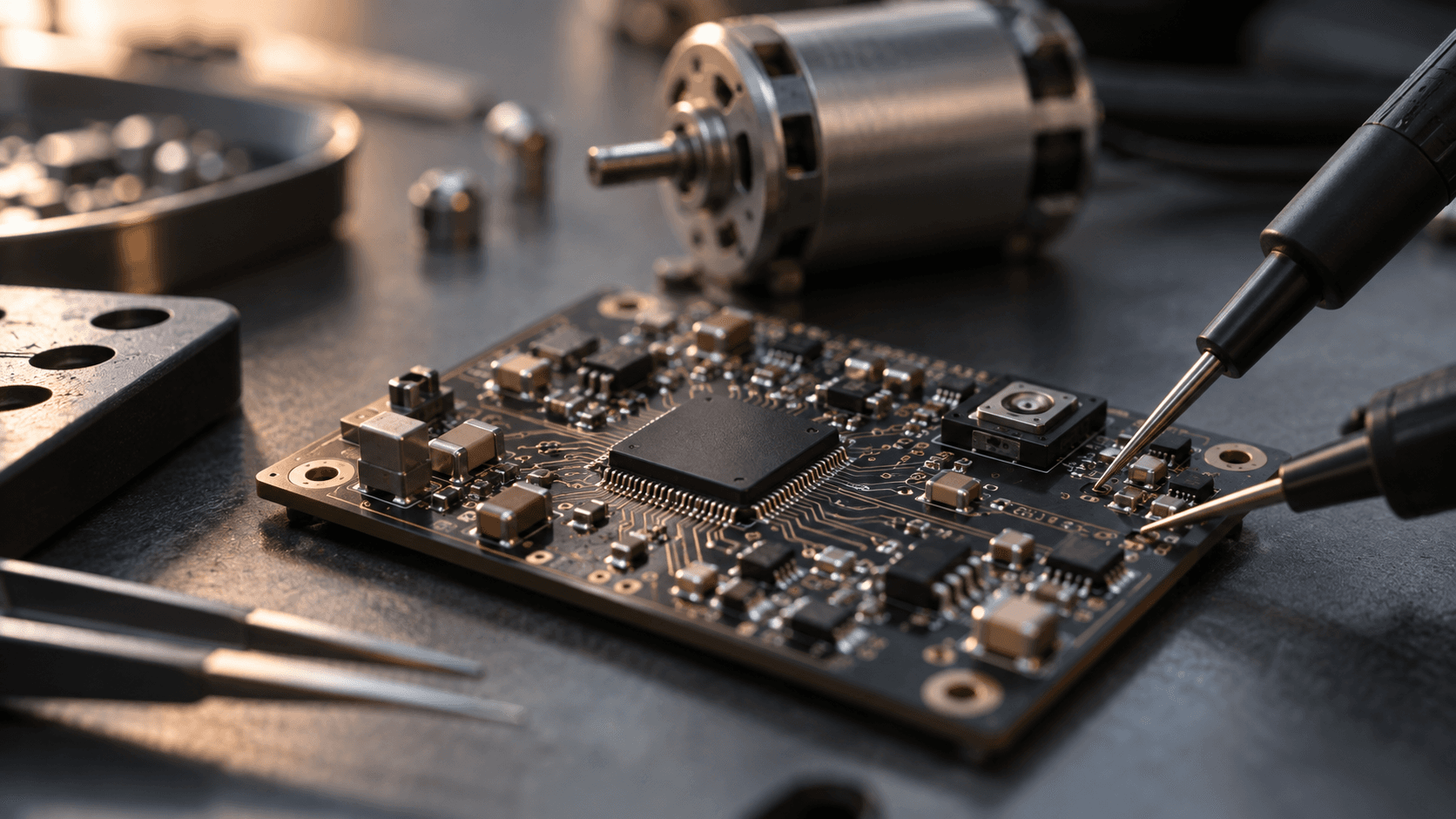
The most revealing part of Analog Devices' agreement to buy Alif Semiconductor is not the acquisition price. It is the distance between a sensor producing a signal and a machine doing something useful with it. That distance contains a lot of engineering: capture, processing, inference, power control, and a decision about what happens when the answer is wrong. Owning more of that chain is a serious ambition. Calling it intelligent does not make the chain work.
On September 9, Analog Devices and Alif announced a definitive acquisition agreement. The disclosed terms are $1.35 billion in upfront cash, with up to $200 million in additional contingent consideration. Both boards approved the deal. Closing is expected before the end of 2026, subject to conditions including the applicable US antitrust waiting period. Dow Jones independently reported the transaction terms. This is an agreed purchase, not a completed transfer of ownership.
ADI describes the strategic destination as Physical Intelligence. Its proposition is to combine analog sensing, signal processing, power, connectivity, and software with Alif's digital processors. That is a company strategy, not a verified claim that an integrated product already delivers all those benefits. The distinction leaves a more interesting question than whether the branding catches on: can a supplier make the complete engineering job easier, rather than simply sell another component that requires integration?
Consider a hypothetical battery-powered vibration monitor attached to a motor. Its useful output is not a stream of impressive classifications. It is a reliable indication that somebody should inspect the machine, delivered without exhausting the battery or creating so many false alarms that the operator ignores it. Start with that acceptance test and the design conversation changes. The model, sensor, sampling policy, and escalation threshold have to earn their place in the same product.
Alif's existing portfolio offers a concrete way to understand the proposed combination. Its Ensemble documentation describes different arrangements of Cortex-M55 microcontroller cores, Cortex-A32 application processors, and Ethos-U55 neural accelerators. These are family configurations, not a promise that every part contains every feature. The E3 design separates higher-efficiency always-on work from higher-performance processing. E5 adds a Linux-capable application core alongside real-time cores. The architectural point is to assign different jobs to different resources.
That division is more useful than treating every workload as something that belongs on the biggest available processor. In the hypothetical monitor, continuous listening and occasional analysis are distinct jobs. A product team should ask which resources must remain awake between events, which can sleep, and what the transition costs. It should also ask whether its actual application needs a high-level operating system. Adding that capability because it exists is not the same as needing it.
Power management is part of Alif's technical case, not a separate footnote. The company documents frequency scaling, clock gating, unused-region shutdown, and sleep modes, with control of up to 12 power domains. Those are mechanisms for matching powered circuitry to active work. They do not establish a universal battery-life figure. The result still depends on the selected device, firmware, external components, and the pattern of activity the finished product encounters.
This creates a practical measurement question: what exactly is included in the power budget? An inference measurement can be useful while still excluding the rest of the day. For the hypothetical monitor, I would want a test that includes quiet periods, repeated triggers, communications, and the chosen response to uncertain classifications. A claim about a fast calculation should not silently become a claim about maintenance intervals. Buyers need the boundary of the measurement as much as its headline result.
There is independent research showing both the opportunity and an important exception. A 2025 arXiv preprint by researchers at the Hellenic Open University tested six models on an Alif Ensemble E7 board. Its measurement method isolated inference energy by subtracting idle consumption. Larger workloads benefited substantially from the neural accelerator, but its MNIST example ran slower: 5.16 milliseconds on the NPU path against 3.22 milliseconds on the CPU. Small workloads did not automatically benefit from specialized hardware.
That preprint is context, not an independent review of Alif's newly announced boards or a future ADI system. Its results belong to the reported configurations. The idle subtraction also means its energy comparisons are not whole-product battery measurements. The useful lesson is narrower and stronger than a blanket acceleration claim: test the workload you plan to ship, and allow the result to tell you when the simpler execution path is better.
The compiler adds another boundary. Arm's Vela documentation says Ethos-U acceleration requires quantized model weights and activations. For TensorFlow Lite models, unsupported operations can remain on the CPU; TOSA compilation has no CPU fallback. A successful build therefore does not prove that an entire TensorFlow Lite model runs on the accelerator. Arm also identifies its cycle and bandwidth figures as estimates that need validation on hardware. A clean build log is not a performance certificate.
This is where a product review should get specific. Ask for the actual compiled model and execution breakdown, not just the name of the accelerator on the board. If a supplier changes the model, require the same checks again. My recommendation is to make that evidence part of acceptance rather than an optional appendix. It gives both sides a clear way to distinguish a working demonstration from an implementation whose behavior can be reproduced.
Memory deserves the same discipline. Vela accounts for constants, intermediate tensors, and working memory, with configuration that must agree with the actual device and firmware. Arm explicitly warns that the compiler cannot validate the complete firmware memory map. The implication is straightforward: model deployment is also a firmware integration task. Getting the neural network to compile does not finish the work of fitting it into the rest of a device.
A sensible design review would therefore reserve room for change instead of celebrating a prototype that barely fits. What happens when the next firmware version adds a diagnostic feature? What evidence would justify changing the model without replacing hardware? These are questions for the product team, not facts disclosed in the acquisition announcement. Asking them early makes the proposed integration valuable in a way a peak-performance number alone cannot explain.
Alif lowered one barrier to experimentation immediately before the deal announcement. On September 8 it introduced StartKit evaluation boards with a $49 suggested retail price. The SK-E1C and SK-B1 designs pair a 160MHz Cortex-M55 with an Ethos-U55 accelerator. The announcement describes expansion connections, current-sense jumpers, and an onboard J-Link debugger. That price refers to evaluation hardware, not a production chip quotation or the cost of a finished connected product.
The measurement and debugging provisions matter because they let an evaluation become an investigation. For a founder deciding whether to pursue the hypothetical monitor, I would use the board to answer a narrow question before committing to custom hardware: can the intended sensor input produce a useful decision within the product's constraints? Set the threshold first. Otherwise it is too easy to keep changing the definition of success until the demonstration looks convincing.
Software support offers another piece of the picture. In August, Alif announced licensing of Arm Keil MDK for customers developing on its devices. The collaboration includes work around the Synchronous Data Stream framework, which can capture and replay sensor, audio, and video data on physical hardware or simulation models. The announcement also discusses regression testing and irregular sensor streams. Broader integration with the MLOps ecosystem is an intended collaboration, not a completed universal connection.
Replaying the same input gives teams a way to ask a much better question than whether a new version looks good in a fresh demonstration. Did the new model improve the cases that mattered without breaking the ones that already worked? For our hypothetical monitor, I would keep representative normal operation alongside difficult and ambiguous examples. A test collection made only of obvious failures would tell the team too little about the device customers actually live with.
None of this makes local inference synonymous with safe control. My proposed boundary for an industrial product would separate an advisory classification from permission to take consequential action. Who determines that boundary, what happens when the input is missing, and when does the device defer to a human? Those are engineering requirements to settle explicitly. Neither the acquisition nor the component descriptions reviewed here establish a safety certification for an imagined finished system.
The commercial opportunity, in my assessment, is to reduce the work customers must repeat between those boundaries. A useful supplier could provide a coherent reference design, a reproducible test process, and an understandable support commitment. That is a stronger proposition than a catalog where the customer must discover every mismatch alone. But it would need to be demonstrated. Combining corporate ownership does not, by itself, tell an engineering team which integration problems have disappeared.
There is also a legitimate case for keeping components separable. A customer may prefer an established processor, an existing software workflow, or the freedom to change suppliers. Integration should win because it removes a real constraint, not because the sales package makes alternatives awkward. I would judge the proposed platform against that counterargument directly: show the development work saved, identify the dependencies added, and make the comparison on an application the customer actually intends to deploy.
The next meaningful evidence should be product-level: documented combinations, supported software versions, measurements with clear boundaries, and examples that another engineering team can reproduce. Until then, ADI's proposed purchase is best understood as a bid to own more of the work between sensing and action. That is worth watching. The standard for success is not whether a tiny board can run AI. It is whether builders can turn that capability into a dependable product without rediscovering the entire system themselves.
LaunchPad positionEvaluate the complete sensing-to-decision system on a real workload, not the accelerator specification or acquisition headline.
This report draws on the linked primary sources and reputable reporting. Company statements are treated as claims until independently demonstrated.