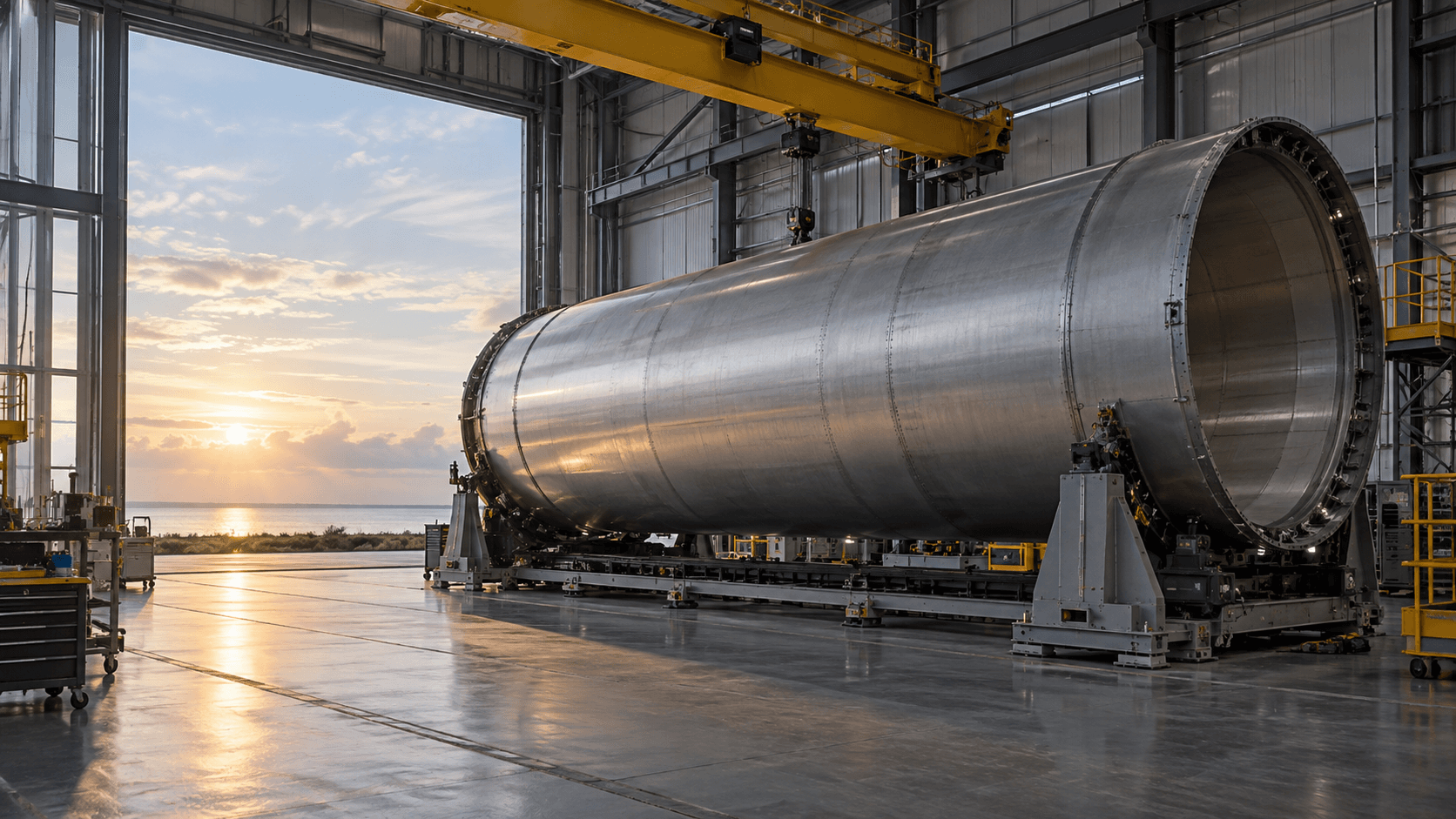
NASA has given Terran R a route into its launch market. For the Space Coast, that is a more useful development than another rendering of a rocket above the Atlantic. It connects a vehicle being built for Cape Canaveral to a defined government purchasing system. The important question now is which evidence will turn that access into missions, and which parts of the surrounding industrial system have to work before it can.
On September 9, NASA announced that Relativity Space and its Terran R launch service had joined the NASA Launch Services II contract through its on-ramp provision. The agency said the service would be available for future missions. Its announcement did not identify a spacecraft assigned to Terran R, a mission-specific price, or a launch date. It also did not announce a launch-vehicle certification category. Those omissions define the news: a procurement milestone has happened, while several other decisions remain separate.
NLS II is a multiple-award, indefinite-delivery, indefinite-quantity contract. In plain English, NASA maintains a contracting framework through which it can acquire launch services as mission requirements develop. Admission creates the opportunity to compete within that framework. It does not mean NASA has just purchased an announced number of Terran R flights. Reporting the contract as a block of guaranteed launch revenue would give the announcement a certainty it does not contain.
The timing is specific. NASA says the ordering period runs through June 2030, while the overall performance period extends through December 2032. Those dates describe different things. One concerns when orders can be placed under the contract; the other covers performance under it. Neither date is Terran R's first-flight deadline. Keeping those clocks separate matters when assessing a program whose hardware development, customer selection, and mission preparation will not necessarily advance on the same schedule.
The on-ramp is also a deliberate feature, not an exception invented for Relativity. NASA says it offers an annual opportunity for new providers to compete and for existing contractors to introduce vehicles not already on their contracts. That gives the agency a way to refresh its options as the launch industry changes. A purchasing system that admitted only the vehicles available at its creation would gradually turn a procurement decision into a barrier against the next generation.
Kennedy Space Center's Launch Services Program manages NLS II. NASA describes that program as a broker: it matches spacecraft with suitable rockets and supports the process from pre-mission planning through post-launch. The agency can also use the contract to provide launch services for other government organizations, including the National Oceanic and Atmospheric Administration. For local readers, this is the Space Coast's less visible role in spaceflight. The region houses not just departure infrastructure, but the organization that helps decide how important payloads get to space.
A rocket's maximum advertised lifting capacity is only part of that matching problem. NASA's explanation of its launch strategy names payload complexity, orbit, schedule, and acceptable risk as relevant considerations. A vehicle can look attractive on a capacity chart and still be the wrong answer for a particular spacecraft. The mission is buying a successful delivery under its own constraints, not a theoretical number of kilograms detached from destination, timing, and assurance.
Relativity's current product page describes a two-stage vehicle intended to launch from Cape Canaveral's Launch Complex 16, with a first flight targeted for late 2026. Its advertised performance includes 23,500 kilograms to low Earth orbit with a downrange landing and 33,500 kilograms in an expendable configuration. These are company design specifications, not payloads independently verified as having been delivered. They also describe different operating configurations. Comparing either number with another rocket without stating the conditions would make the comparison less informative.
The difference between those configurations matters commercially, but it does not settle the economics. A customer would still need the actual service offer for its mission, while an operator would need evidence about the costs and work associated with the chosen configuration. NASA's September announcement provides neither a Terran R price list nor a demonstrated turnaround record. There is no basis here for declaring a particular percentage reduction in launch costs. The procurement opening is real; a quantified market-wide saving is not established.
NASA's risk framework explains why contract admission cannot do the work of flight evidence. Its certification matrix distinguishes high-, medium-, and low-risk launch-vehicle categories and associates them with different levels of flight history and review. It includes management-system requirements as well as flight experience. Certification is therefore not simply a logo that appears after a supplier enters a purchasing pool. This report does not assign Terran R a certification status that NASA's announcement has not provided.
That framework is not a demand that every payload accept the same expense or conservatism. In its explanation of emerging launch providers, NASA contrasts complex, low-risk-tolerance NLS II missions with higher-risk commercial approaches for suitable payloads. The agency names Lucy and Mars 2020 as examples of the former. Other research missions can accept a different risk balance. The useful principle is proportionality: match the assurance effort to what the payload can tolerate, rather than confusing willingness to innovate with willingness to treat every loss as interchangeable.
From a builder's perspective, this creates a practical distinction between selling capability and demonstrating suitability. A launch company can describe a broad market for its rocket. A mission team must assess whether that rocket fits a particular job. The evidence needed for that decision can be narrower, more detailed, and less glamorous than the market story. A successful commercial strategy has to serve both audiences without letting the promises made to one substitute for the proof required by the other.
Relativity's July program update, published August 11, offers a dated view of the engineering work behind its ambitions. The company reported completion of first-stage structural qualification, second-stage cryoproof testing at NASA Stennis, and acceptance testing of the Aeon V engine. The update still described second-stage hot-fire testing as upcoming. These are company-reported milestones from that period. They should not be silently promoted into a complete, independently checked description of readiness in September.
The certification matrix makes the engineering burden more concrete. Its requirements extend into acceptance testing, qualification, quality-system audits, subsystem review boards, and review of the launch complex, with the exact requirements varying by category and certification route. It also addresses corrective action after failures and the possibility of additional technical scrutiny after major vehicle upgrades. A launch service is therefore assessed as a changing technical system, not just a count of successful departures. The history matters, but so does understanding what produced it.
The ground system belongs in that assessment too. In the same July update, Relativity reported energizing the horizontal integration facility at LC-16, proof testing an assembly-room crane, and activating permanent site power. These details are less photogenic than an engine firing, but they describe infrastructure needed to handle and prepare the vehicle. The meaningful operational question is whether the site and rocket can support the intended mission together. Progress on the flight article alone cannot answer it.
The Florida expansion adds a longer horizon. Space Florida's July 21 announcement described plans for an additional Terran R production facility and expanded test and launch-support infrastructure across Kennedy Space Center and Cape Canaveral Space Force Station. It said Relativity would be eligible for up to $134 million through the Florida Department of Transportation's Spaceport Improvement Program. Eligibility is not the same as a statement that all of that money has been disbursed.
Space Florida also projected thousands of new jobs by the end of 2034. That is an economic-development expectation, not a count of positions already created. The distinction is especially important for a local publication. A region can reasonably welcome a proposed industrial expansion while still asking for evidence of construction, hiring, and operations as the project advances. Treating a distant target as today's workforce would make it harder to tell whether the investment is delivering.
Independent coverage supplies a useful counterweight to the schedule language. Ars Technica reported the Florida expansion in July and expressed doubt that Terran R would make its official year-end first-flight target. That was the outlet's assessment at the time, not a confirmed announcement of a delay. NASA's new contract admission does not resolve that disagreement. The September event is grounded in NASA's own release; the independent coverage provides context on the expansion and schedule risk, not a fresh audit of launch readiness.
For suppliers and workforce planners, the sensible response is to distinguish several types of demand. Access to a contract can support a pipeline of opportunities. A specific mission selection can make that pipeline more concrete. Production commitments and recurring operations would provide different evidence again. This is an editorial recommendation about how to interpret the milestones, not a claim to know Relativity's private ordering plans. A local business should not size its commitments solely from the largest number in an expansion announcement.
There is a strong case for NASA admitting emerging vehicles before every commercial question is settled. The agency's mixed-fleet policy explicitly aims to use both established and emerging domestic capabilities. Keeping the procurement route open allows future mission decisions to consider new options. The counterargument concerns execution: another eligible supplier adds limited practical choice if it cannot satisfy the mission's requirements when needed. The answer is not to close the route, but to keep the mission-assurance decisions rigorous.
The next material developments will be specific: an identifiable mission assignment, additional documented test results, applicable certification decisions, and flight performance. Each would answer a question that the contract announcement leaves open. There is no need to diminish September's achievement to keep that distinction intact. Terran R has gained access to a consequential customer framework managed here on the Space Coast. What makes that valuable is the prospect of dependable service emerging from it, not the ability to announce the same doorway twice.
LaunchPad positionTrack contract access, mission orders, certification, and flight performance as separate milestones in the Space Coast's launch economy.
This report draws on the linked primary sources and reputable reporting. Company statements are treated as claims until independently demonstrated.