Some Cape Canaveral launches carry the hardware that catches a moment the universe will never repeat. StarBurst belongs in that category. Its job is to notice the first high-energy flash from a neutron star merger while other observatories measure the same event differently. Miss the flash, and a later telescope cannot simply request another exposure of the beginning.
NASA selected SpaceX on September 17 to launch StarBurst aboard a Falcon 9 Bandwagon rideshare mission from Space Launch Complex 40 at Cape Canaveral Space Force Station. The current launch timing is no earlier than 2028. This is a transportation award for a small scientific spacecraft, not a completed launch or a new astronomical discovery. For the Space Coast, it adds a specific research mission to the future manifest.
One number needs removing from the hype immediately. NASA's release cites a $1 billion maximum across the VADR launch-services contracts over a ten-year ordering period. It does not disclose the price of the StarBurst task order. Calling this a billion-dollar SpaceX launch award would turn the capacity of a purchasing program into the price of a single purchase. The release supports no such conclusion.
Space & Defense reported the selection on September 18, attributing the mission and contract details to NASA. That coverage provides a separate published account, not an independent audit of the contract or validation of the instrument. The reporting here rests on NASA's award notice, technical descriptions and test updates. Where those documents leave a question open, the question stays open.
The calendar requires similar discipline. NASA's older mission description still refers to a one-year mission beginning in 2027. A January 2026 engineering update also discussed launch as early as 2027 and targeted launch readiness by June 2026. The September award now specifies no earlier than 2028. That newer, mission-specific notice is the relevant launch guidance. It does not explain the change, and it does not confirm completion of every test previously scheduled.
The distinction between readiness and a launch date is useful beyond this spacecraft. One describes whether a payload has reached the condition needed for flight; the other describes when its transportation is planned. An earlier readiness target cannot establish that a later flight happened, nor can a later launch window alone identify the engineering cause. For StarBurst, assigning blame from those dates would require evidence that the announcement does not provide.
What NASA is buying access to orbit for is a wide-field gamma-ray monitor. It is designed to detect the initial emission of short gamma-ray bursts associated with merging neutron stars, the dense remnants of exploded stars. Gravitational-wave observatories provide a different measurement of these systems. Other telescopes can examine light from the aftermath. Multimessenger astronomy is the effort to put those observations together, rather than ask one instrument to tell the entire story.
The historical demonstration is GW170817, observed on August 17, 2017. NASA's account describes gravitational waves from a neutron star merger associated with a short gamma-ray burst detected by Fermi, with INTEGRAL also identifying the burst in follow-up analysis. Optical and infrared observations then located the fading counterpart in the galaxy NGC 4993. The connection allowed researchers to study an event through signals that carried different information.
That follow-up was not a single photograph. NASA reported Swift ultraviolet observations about 15 hours after the initial signals, followed by a rapid fade that left the source undetectable in ultraviolet when Swift returned on August 29. Chandra detected X-rays nine days after discovery. Researchers interpreted the delayed X-ray appearance in terms of the viewing angle and the expanding jet. The measurements changed with both wavelength and time.
This is the practical reason an early gamma-ray detection matters. It contributes a timestamp and information about direction and energy to a larger investigation. Subsequent observations can examine evolving debris and outflows, but they do not replace that initial measurement. StarBurst's purpose is to strengthen this part of the observing network. It is not a claim that the satellite alone will identify every property of a merger.
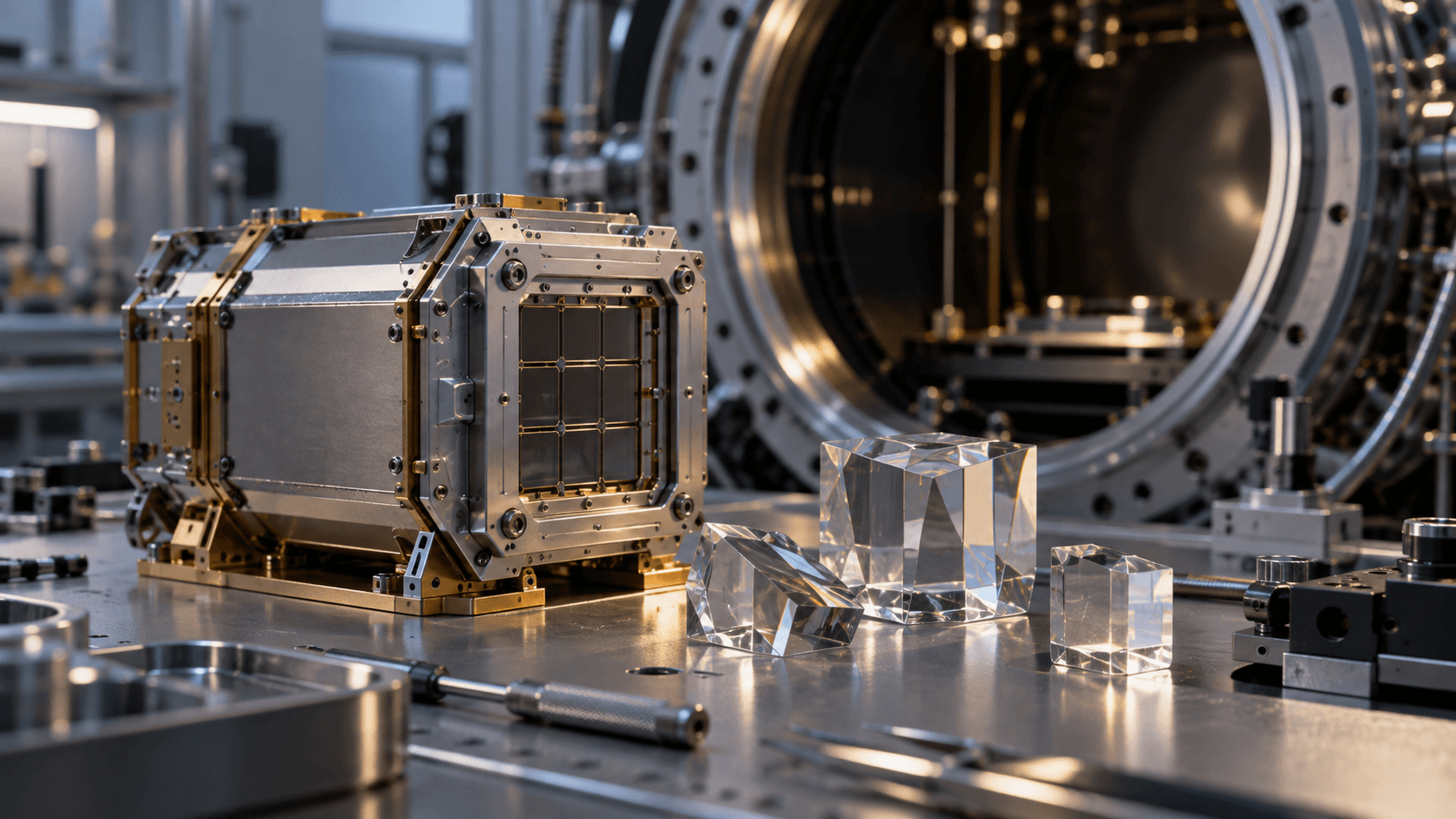
Inside the instrument, the measurement starts with twelve scintillation detectors. NASA's technical description explains that incoming gamma rays interact with crystals, producing ultraviolet and visible photons. Attached silicon photomultipliers convert the light into measurable electrical signals. Electronics digitize those signals, and their amplitude supplies an estimate of the energy of the incoming gamma rays. An otherwise invisible event becomes a set of recorded measurements.
Timing and orientation supply additional information. An onboard clock synchronized to GPS records the arrival times, while differences in signal strength among detectors help estimate where the source lies. The mission is designed to observe the sky that Earth does not block. That last condition matters: wide coverage does not mean seeing through the planet, and an estimate derived from detector responses is not the same thing as a sharp optical image.
NASA describes StarBurst's effective area as more than five times that of Fermi's Gamma-ray Burst Monitor. That is a design comparison about the detector's response, not a promise of five times as many scientific discoveries. A joint observation also requires an accessible event and useful measurements from other facilities. The value of a larger collecting capability is real in the mission design, but multiplying one hardware metric cannot calculate the eventual science return.
NASA's own public technical summaries also disagree on the detector material and energy range. Its detailed mission page describes one crystal composition and range; the HEASARC catalog lists another. Those specifications are therefore not treated here as settled. The consistent elements are the twelve-detector layout, scintillation-based sensing and broad sky coverage. Before using the exact performance bounds for an engineering decision, a reader needs a reconciled, current instrument specification.
The mission's scientific questions extend beyond counting flashes. NASA lists the origins of short gamma-ray bursts, the remnants left after neutron star mergers, the behavior of matter within neutron stars and the structure of their fast outflows. These are research objectives. A launch contract does not resolve them, and a successful detection would be an input to analysis rather than an automatic answer to all four.
Even the projected event rate needs its label. In January, NASA said StarBurst was expected to find up to ten joint gamma-ray and gravitational-wave events per year. That is a forecast, not observed StarBurst performance. The same update linked the desired launch period to gravitational-wave observing opportunities. With the launch now listed no earlier than 2028, the overlap with other facilities remains something to confirm, not assume from an older planning paragraph.
There is tangible hardware progress beneath those projections. NASA's January report says the instrument arrived at Marshall Space Flight Center in March 2025 and underwent thermal-vacuum and vibration testing. The thermal campaign ran continuously for eighteen days. Technicians used radioactive material inside the chamber so the detector could register gamma-ray signals during testing. This connected environmental exposure with instrument operation instead of checking only whether the hardware remained physically intact.
The team also performed a 24-hour vacuum bake-out to remove unwanted gas or vapor and used a shaker table to simulate launch vibration. Thermal-balance measurements helped refine engineering models for hot and cold conditions. Those tests provide evidence about the tested instrument and its models. They are not orbital results, and they do not eliminate the distinction between an instrument test and verification of the integrated spacecraft.
According to that update, the instrument then went to the University of Toronto's Space Flight Laboratory and was integrated with the spacecraft bus in 2025. Further calibration, vibration and thermal-vacuum work was planned for spring 2026. The record reviewed for this article does not establish the outcome of every planned step. The useful next engineering update would identify the integrated configuration tested, the completed work and the remaining path to flight.
The institutional division of labor makes that integration consequential. NASA identifies Marshall with overall project management, the Naval Research Laboratory with instrument design and fabrication, the University of Alabama Huntsville with flight software, and the Universities Space Research Association with science operations. The Space Flight Laboratory supplies the spacecraft bus and mission operations role. Kennedy's Launch Services Program manages the launch contract. The mission depends on those contributions meeting, not merely existing separately.
VADR, short for Venture-Class Acquisition of Dedicated and Rideshare, is designed to give risk-tolerant science and technology payloads access to commercial launch services. NASA describes the approach as using less agency oversight and more flexibility in commercial management to target lower costs. That is a deliberate tradeoff, not an absence of requirements or a prediction that a particular rocket will fail. StarBurst is also part of the lower-cost Astrophysics Pioneers program.
The procurement documents need to be read by date as carefully as the flight plan. NASA's VADR overview, last updated in July 2025, still lists a five-year ordering period and a $300 million ceiling. The September 2026 StarBurst award gives ten years and $1 billion. This report uses the newer notice for those current figures while retaining the overview's explanation of the program's purpose. Neither page supplies the StarBurst launch price or enough information to calculate its savings.
For builders, the interesting architecture is specialization with shared evidence. StarBurst is designed to capture the prompt gamma-ray signal; gravitational-wave facilities and follow-up telescopes contribute observations it cannot substitute for. Precise timestamps, detector calibration and source-location estimates are therefore central outputs, not administrative extras. A small instrument becomes more useful when other investigators can connect its measurements to their own. That is the operating logic behind the mission's modest size and broad scientific ambition.
The next milestones to watch are concrete: updated spacecraft readiness, a firmer rideshare schedule, and an observing plan that matches the mission's actual flight window. After launch, the evidence shifts to calibrated detections and associations with other observatories. Cape Canaveral will supply the departure point. The payoff comes when a brief signal from a distant collision becomes a usable piece of a much larger measurement.
LaunchPad positionTrack the updated flight schedule, integrated spacecraft readiness and joint observing opportunities without confusing a contract ceiling with the mission's price.
This report draws on the linked primary sources and reputable reporting. Company statements are treated as claims until independently demonstrated.