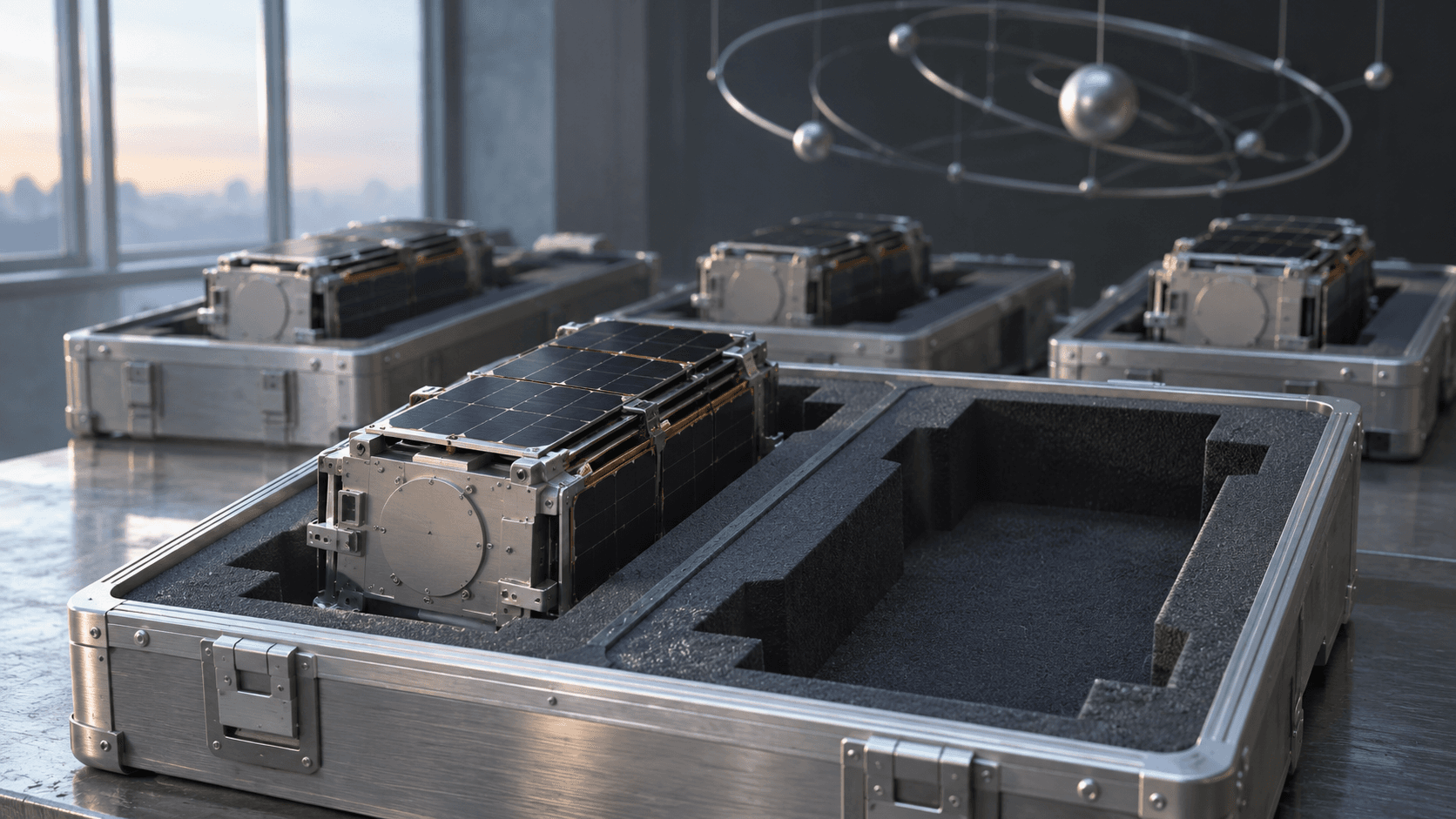
A satellite factory can finish its work while a broadband network still waits for capacity. Vulcan's failed flight on November 15 makes that distinction painfully concrete for Amazon Leo. The immediate loss was a batch of spacecraft. The larger operating question is how a constellation converts hardware on the ground into dependable service when a major launch program has to investigate another failure. Manufacturing, transport to orbit and network commissioning each have their own completion criteria.
Amazon's mission record confirms that LV-01 lifted off from Cape Canaveral's Space Launch Complex 41 at 12:40 p.m. EST, carrying 40 satellites, and that the payload was lost after a Vulcan anomaly. Its statement expresses continued confidence in ULA. That is support for a supplier, not a revised launch schedule or a determination of what failed. The record establishes the outcome clearly while leaving the recovery plan open.
SpacePolicyOnline reports that this was Vulcan's fifth flight and ULA's first total mission failure since the company's formation in 2006. It reproduces ULA's account of an anomaly about ten minutes into flight and the company's commitment to investigate and determine corrective action. Two earlier Vulcan missions had nozzle problems but still delivered their payloads. That history matters, yet it does not identify the cause of this loss. A repeated interruption in operations need not have a repeated technical explanation.
Ars Technica adds a narrower, still provisional finding: its sources point to the core booster, while the precise component remains unresolved. The report does not establish whether an engine, propellant supply hardware or something else caused the problem. That distinction should survive every retelling. Locating a suspected problem within a stage is not the same as proving a defective part, and neither supplies a defensible return date on its own.
ULA's mission overview explains why component labels matter. The launch configuration combined six solid rocket boosters with a core powered by two methane-fueled BE-4 engines. Above it sat a version of Centaur V optimized for low Earth orbit, using liquid hydrogen and liquid oxygen with two RL10 engines. These are distinct propulsion systems with different functions in the ascent. A statement about one cannot casually become a diagnosis of another merely because all appear on the same vehicle diagram.
The spacecraft also depend on interfaces beyond propulsion. ULA describes a payload adapter providing structural and electrical connections between the satellite stack and Centaur, alongside separate processing, integration and launch-control facilities. This is why a rocket's headline lifting capability is only part of the delivery system. The payload must fit the particular vehicle and its operating sequence. The mission overview describes that architecture; it does not establish which interface, if any, contributed to Sunday's anomaly.
Amazon's preflight plan shows the commercial concentration behind the mission. It had contracted 38 Vulcan launches to carry more than 1,500 first-generation satellites, with initial missions carrying 40 apiece. The company also said it had completed its thousandth satellite in early September and had hundreds ready for launch. Those are different inventories: manufactured spacecraft, flight-ready spacecraft and successfully deployed spacecraft. Treating them as one progress measure hides where the next increment of service actually depends on execution.
The same announcement described new integration and mobile-platform infrastructure allowing two Vulcan missions to be prepared simultaneously. Amazon expected LV-02 within weeks of a nominal LV-01. That condition is decisive. The new facilities address preparation capacity; they do not independently settle vehicle readiness after a failed flight. The preflight cadence target should therefore remain a conditional plan, rather than being carried forward into an assumed recovery timetable.
For customers, a successful launch would still be an intermediate step. Amazon describes Leo as three connected systems: satellites, ground infrastructure and customer terminals. Gateway antennas move customer traffic between space and terrestrial networks, while telemetry, tracking and control antennas support spacecraft operations. Connections on the ground then reach the internet, cloud services or private networks. A satellite count captures only one part of that arrangement. It cannot by itself tell a prospective user whether service is available at a particular location.
Amazon's network explanation places the intended operating orbits between 590 and 630 kilometers and describes a design involving more than 3,000 satellites. The purpose of a constellation is coordinated coverage, not simply accumulating objects overhead. The company's descriptions of speed and coverage remain product claims, rather than independent measurements of service following this launch. For a builder evaluating a connection, the relevant evidence is an available service with usable terms and observed performance, not a manufacturing milestone substituted for connectivity.
The next disclosed deployment plan provides a more concrete checkpoint. Amazon lists an Ariane 6 mission carrying 36 satellites no earlier than November 23. Its described sequence includes deployment around 465 kilometers, contact and health checks, raising the satellites to 630 kilometers, and commissioning. That is a target and an operating plan, not a completed addition to capacity. It also makes the stages of delivery visible: reaching an initial orbit and becoming ready to serve customers are separate milestones.
There is a substantive counterargument to treating Vulcan's failure as a complete stop for Leo. Amazon already uses other launch providers. In September it expanded its Arianespace agreement by six missions, taking that commitment from 18 to 24. At the time, three Ariane flights had delivered 100 Leo satellites. This is an operating relationship with completed deployments behind it. It gives the program another route to orbit, even though it does not establish that extra near-term slots are available on demand.
Amazon's account of that agreement also describes how capacity changes within a provider. The third Ariane mission carried 36 satellites using upgraded solid boosters, and the companies said they were working to increase payload counts further. Long-term orders help justify investment in the launch system that will fulfill them. The limitation runs in the other direction: a larger contracted manifest is not proof of immediate spare capacity. Procurement creates a commitment; flight hardware, integration and a successful mission still have to deliver it.
Vulcan's government customers face a different set of acceptance decisions. ULA announced national-security certification in March 2025 after a process that included two demonstration flights, 52 certification criteria, 60 payload-interface verifications and 114 hardware and software audits. Those details show that certification was a substantial technical program, not merely a ceremonial label. They also put its meaning in perspective. A historical certification establishes a completed assessment; it does not turn every subsequent anomaly into an already answered question about the next mission.
The demand at stake extends well beyond this satellite batch. ULA's April 2025 announcement described a contract for 40 percent of the relevant National Security Space Launch Phase 3 procurement, with missions ordered in fiscal years 2025 through 2029 and launches extending through 2034. That is a long delivery horizon. It should not be read as the percentage of all American launches, or as evidence that the awarded missions have flown. Contracted demand explains the importance of recovery without measuring recovery itself.
Before Sunday's launch, Air & Space Forces Magazine reported that Space Force officials wanted evidence from Vulcan's early commercial flights to inform future military missions. Its October report described nozzle design and process changes, with further testing continuing. That makes commercial flight data consequential beyond Amazon's own manifest. It also means a commercial launch attempt was never equivalent to unconditional approval for every military payload. Customer acceptance depends on the particular evidence and risk assessment, rather than on a shared announcement that operations have resumed.
The same report explains why moving a payload to another launcher is not a simple booking change. Space Force official Eric Zarybnisky pointed to integration timelines, loads and dynamics analysis, and technical constraints that can prevent some transfers. Work completed in advance can make a swap faster; missing work can delay it. This gives procurement teams a practical distinction to investigate: an alternative provider on a contract is useful, but a payload already analyzed for that alternative may be a more actionable option.
The FAA's published mishap process supplies another boundary on expectations. For licensed operations, the operator must preserve evidence, follow its approved response plan and submit a preliminary written report within five days. The agency can investigate or oversee an operator-led investigation. Its stated purpose is to identify causes and corrective actions that protect public safety. Those are general requirements, not a newly disclosed finding about Vulcan, and the process page offers no basis for assigning this investigation a completion date.
The FAA also distinguishes closing an investigation from authorizing a return to flight. One route involves acceptance of the final report, implementation of corrective actions and satisfaction of licensing requirements. Another can allow flight before an investigation closes when the required safety case and preventive measures support that determination. Thus an open investigation does not always mean flight is categorically impossible, while a company's desired schedule does not supply authorization. Any eventual Vulcan clearance needs its own specific evidence; this general framework cannot stand in for it.
The most useful recovery update would connect a demonstrated cause to a correction, then to the missions that correction permits. For Amazon, a revised deployment sequence would make the customer consequence clearer than another aggregate satellite-production number. For government payload owners, the evidence needed to accept a particular flight may differ from the commercial customer's. These are the questions the available documents leave open. Until those answers arrive, the loss is confirmed, but the duration and commercial cost of the disruption are not.
LaunchPad positionTrack corrective-action evidence, revised deployment sequences and payload readiness separately. Preflight cadence targets do not establish a recovery schedule.
This report draws on the linked primary sources and reputable reporting. Company statements are treated as claims until independently demonstrated.