Voyager 1 has reached a distance that turns a routine troubleshooting exchange into a multiday operation. On November 18, NASA's spacecraft became the first human-made object one light-day from Earth, about 25.9 billion kilometers away. NASA put the crossing at 10:16:07 UTC; ABC Science's updated reporting confirms the milestone. The number is extraordinary. The more useful engineering story is how a machine launched in 1977 still returns information while its operators deliberately retire capabilities, rearrange software and preserve enough heat to keep the remaining system working.
Nothing special happened to the spacecraft's surroundings at that distance. NASA's Jet Propulsion Laboratory explicitly says the milestone changes neither the local environment nor anything aboard Voyager 1. A light-day measures how far light travels in 24 hours. It is not a new physical boundary, and Voyager did not enter interstellar space this morning. That happened in 2012, when it crossed beyond the heliosphere, the bubble associated with the solar wind. The larger solar system, including distant objects governed by the Sun's gravity, extends farther. Confusing those boundaries would turn a communications milestone into a scientific event that did not occur.
The practical consequence is a roughly two-day round trip for a message and its answer, before adding the time needed to diagnose a problem or prepare the next command. That is an operating constraint, not merely a delay in seeing a spectacular photograph. Voyager's cameras are no longer the mission's working eyes. NASA's FAQ explains that they were turned off after the 1990 solar-system portrait to conserve power and memory, and their control software was removed. The remaining mission must justify itself through measurements it can still make, rather than through every capability the spacecraft once carried.
Power sets the terms. NASA's August account of work on Voyager 2 explains that the probes' radioisotope thermoelectric generators turn heat from decaying plutonium into electricity, with available power declining by about four watts each year. The loss sounds small until the system has already spent decades giving up optional loads. Engineers are managing electricity and temperature together: reducing consumption is useful only if the spacecraft remains warm enough to operate. This makes a simple instruction to turn more equipment off incomplete. The thermal effect of the change matters alongside the electrical saving.
That coupling explains the coordinated operation the team calls the Big Bang. NASA reported Voyager 2's successful change in August, then confirmed in October that Voyager 1 had completed its version in early September. On Voyager 1, three devices were switched off and three lower-power alternatives substituted together. The coordination preserved the distribution of heat while reducing demand. These were changes to the use of equipment already aboard the distant spacecraft, not the delivery of new hardware. The engineering achievement was finding a workable configuration inside a severely constrained existing system.
The gain should be described as time bought for science, not a reset of the spacecraft's age. NASA said Voyager 2 would otherwise have needed another instrument shutdown before the end of 2026; the change was expected to keep its three instruments operating for at least an additional year. The later Voyager 1 report said another shutdown could have been necessary as early as summer 2027 without its corresponding operation. Those are mission-team assessments of the power budget. They do not promise that a different component cannot fail first, or that every instrument once turned off will return.
The losses are already concrete. In April, NASA sent commands to shut down Voyager 1's Low-energy Charged Particles experiment, which had measured ions, electrons and cosmic rays. The shutdown order was not improvised during the latest scare: science and engineering teams had agreed years earlier on a sequence for retiring equipment while preserving a useful mission. The April report identified two remaining science instruments, measuring plasma waves and magnetic fields. Longevity therefore comes with an explicit reduction in what the mission can observe. Counting years alive without counting the measurements retained would miss the tradeoff.
One small exception captures the care involved. NASA kept the retired particle instrument's half-watt motor running to preserve the best chance of reactivating the instrument if spare power could later be found. That was an option, not a statement that reactivation had happened. It illustrates a choice that is easy to overlook in a shutdown plan: some small expenditures preserve future flexibility even when the main function must stop. The April account also described an unexpected power drop during a February roll maneuver, which increased concern about an automatic low-voltage response and the difficult recovery it could require.
Distance changes the division of labor between the spacecraft and its team. In October, two scheduled communication attempts failed before Voyager 1's signal returned, according to JPL. Contact resumed before the team sent troubleshooting commands. Engineers found that a thruster group had gone offline and backups had activated, an automatic response to a detected problem. JPL said the cause was still under investigation. A recovered radio link was welcome evidence of survival, but it was not a completed explanation of the incident. The report leaves that uncertainty intact, and so should any account of the milestone.
For builders, the episode is a specific example of why a remote system needs a stable fallback that does not wait for a human reply. It is not evidence that autonomy can solve every failure. The human team still had to understand the event, assess the remaining equipment and decide what to do next. A safe state buys the investigation time that the communication path cannot provide quickly. Voyager makes that relationship unusually visible because the wait is measured in days and the hardware cannot be brought back to a workbench.
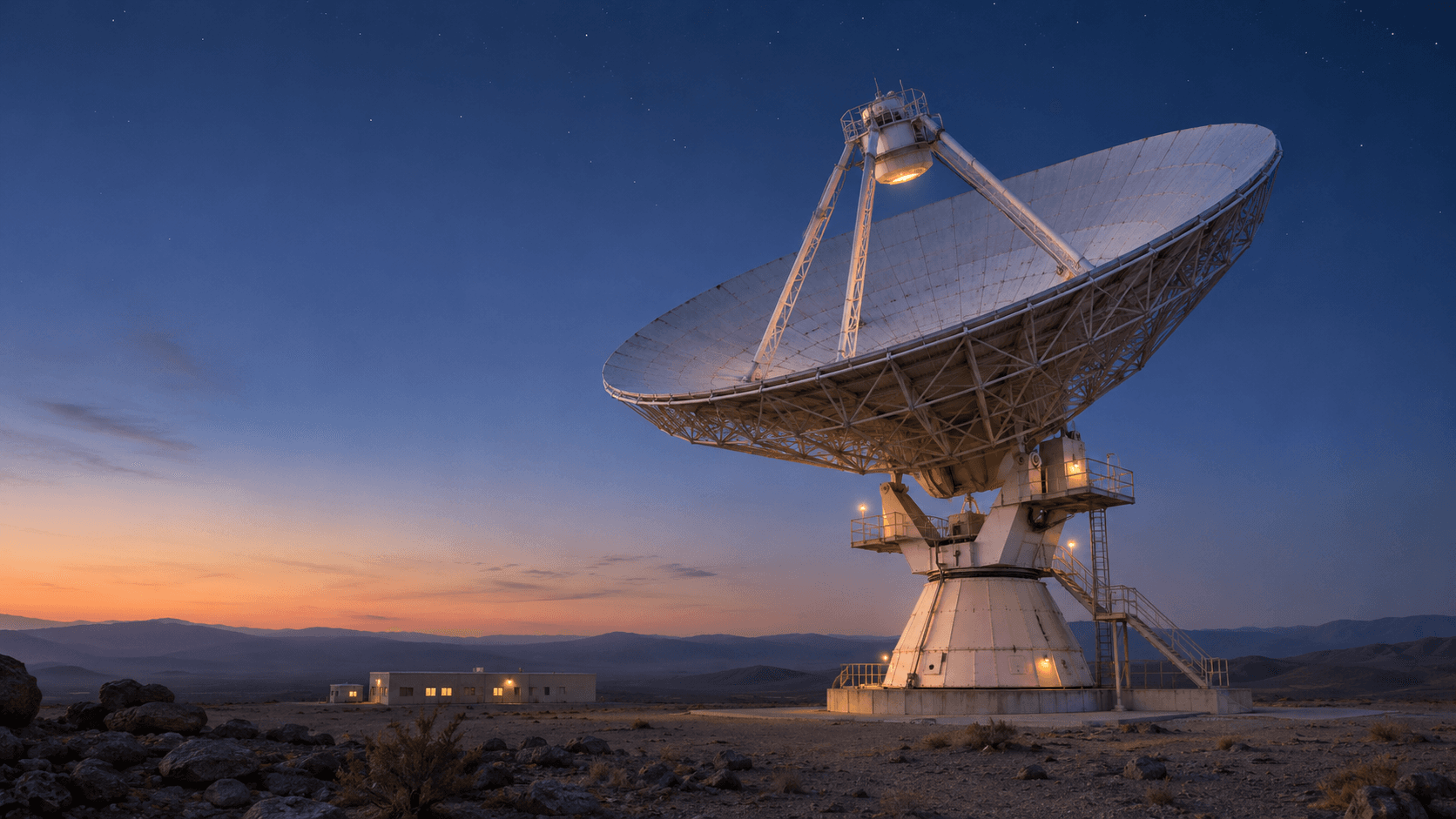
The ground system is part of the machine that makes this possible. NASA's Deep Space Network commands and tracks spacecraft and monitors their health through facilities at Goldstone in California, near Madrid in Spain, and near Canberra in Australia. Their spacing allows one site to take over as Earth's rotation carries a target below another site's horizon. That geographical coverage should not be confused with a dedicated, uninterrupted connection to each mission. The network serves multiple spacecraft and scientific investigations. A probe can retain a functioning transmitter while its useful contact still depends on available ground support.
NASA's interstellar-science page puts Voyager's science stream at 160 bits per second and describes average tracking of six to eight hours per spacecraft per day. Its use of the term real time does not cancel the propagation delay. The stream still takes about a day to cross the distance. This distinction separates two constraints that are often collapsed into one: how much information can be carried and how long it takes to arrive. A faster stream would not remove the wait imposed by distance. The operational design must accommodate both, along with the periods when a ground station is actually listening.
The mission has already demonstrated why receiving a radio signal and receiving useful data are different accomplishments. In November 2023, Voyager 1 stopped returning readable science and engineering information even though controllers could tell it was receiving commands. NASA traced the problem to failed memory hardware in the flight data subsystem, which packages information for transmission. The team could not replace the chip, and the code it held would not fit into any single available memory location. The workaround divided that code across other locations and adjusted the references needed to keep the pieces functioning together.
NASA's April 2024 recovery report is precise about what came back first. The team transmitted the relocated engineering-data code on April 18 and received confirmation on April 20 that the spacecraft could again report its health and status. Restoring science data was still a subsequent task in that report. The sequence matters: engineers recovered the information needed to understand the machine before completing the return of its scientific output. It is a concrete case for separating a system's control, diagnostic and productive functions when evaluating whether a repair has actually restored the service people care about.
There is no defensible single retirement date in these accounts. In ABC Science's November 18 reporting, project scientist Linda Spilker estimated that power and thermal resources could last into the early 2030s, while pointing to clogging thrusters and the spacecraft's increasing cold. That is a conditional assessment, not a warranty. Older NASA reference material also retains forecasts that have already been overtaken by events. Current, dated mission updates deserve more weight than an undated expectation preserved on an otherwise useful reference page. The relevant question is which limiting condition arrives first, and whether the team has a workable response when it does.
None of this makes the distance record less remarkable. It makes the endurance claim more specific. The same mission that delivered planetary images is now preserving a much smaller set of measurements from a place where only the two Voyagers have operated. NASA's milestone material emphasizes that the probes continue sending data from outside the heliosphere. Their value is tied to that location as well as their instruments. Keeping a measurement alive there can justify work that would look disproportionate if judged only against the age or computing power of the equipment producing it.
Voyager's next useful achievement will not require another round number on the distance counter. It will be another interpretable measurement, another successful contact, or another operating change that saves enough power without making something else too cold. The record belongs partly to the original spacecraft and partly to the people and ground infrastructure still adapting around its failures. For anyone building systems expected to outlast easy maintenance, the demanding lesson is to preserve ways to diagnose, reconfigure and reduce scope. Voyager remains productive because survival has been treated as an ongoing engineering decision, with the scientific cost of each decision kept visible.
LaunchPad positionTrack the capabilities retained as well as years of operation. Voyager shows why power, temperature, fallback behavior and the ground system must be managed together.
This report draws on the linked primary sources and reputable reporting. Company statements are treated as claims until independently demonstrated.