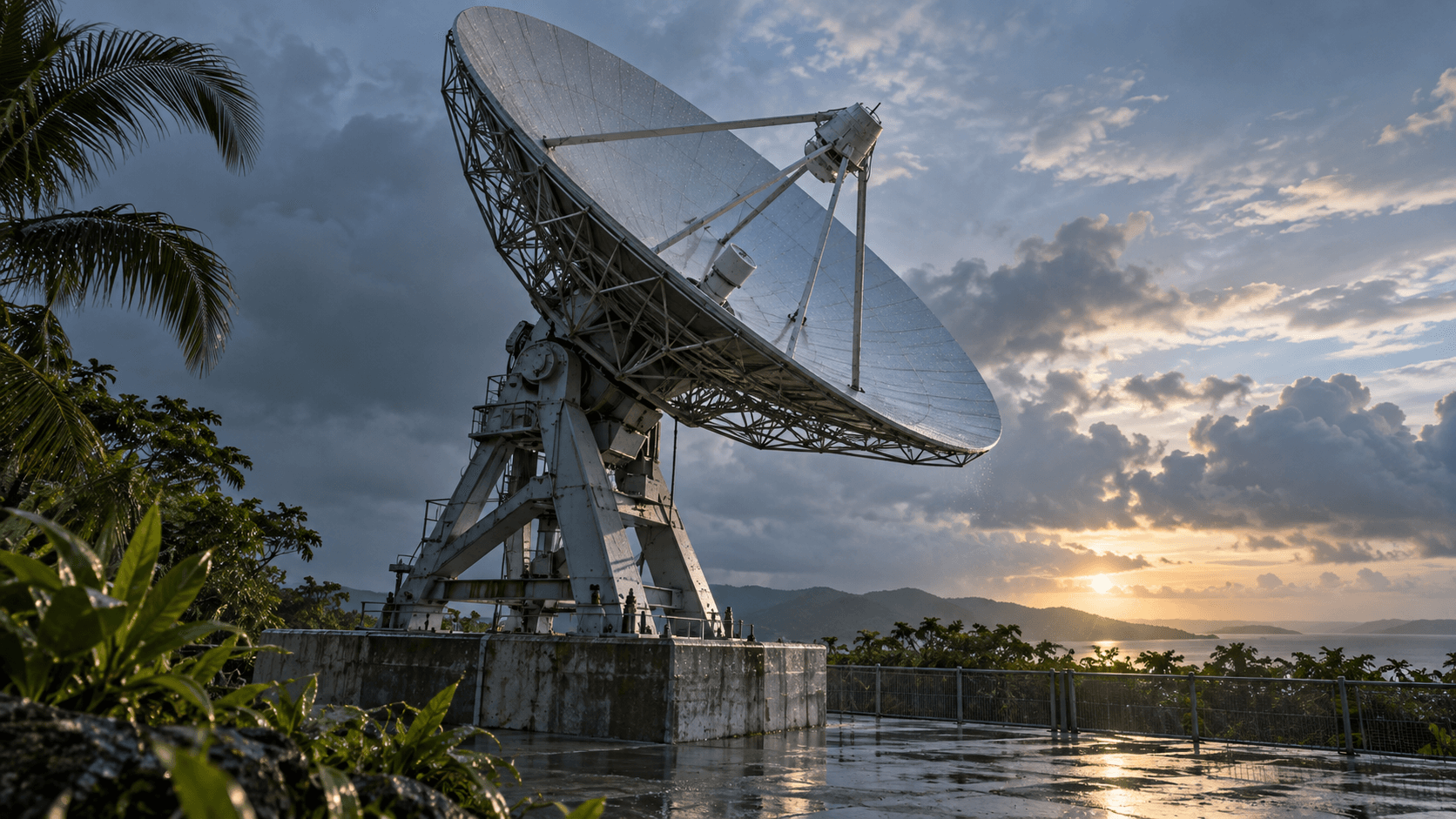
Space infrastructure has a habit of disappearing from the conversation until something on Earth breaks. NASA's latest account of its Guam Remote Station is a reminder that an orbiting spacecraft still depends on equipment exposed to weather, construction schedules and funding decisions. Restoring that equipment can matter as much as launching another satellite. In this case, the important milestone was a rebuilt communications antenna, not a new vehicle leaving the pad.
NASA reported on September 16 that the station's central antenna had returned to service on July 1, 2026. A September 10 ceremony marked the completed restoration following damage from Typhoon Mawar in 2023. Those are different dates with different meanings. September brought the public account and recognition of the recovery; it was not the moment engineers first switched the antenna back on.
The agency says the restored antenna closes a gap in its Tracking and Data Relay Satellite communications coverage. The report establishes NASA's declared return to service, but it is not an independent engineering acceptance audit. Economia dello Spazio's September 17 coverage also traces the announcement to NASA. The operational details here therefore remain attributed to the agency, with earlier technical material used to examine what changed and what cannot be inferred.
Guam's role makes more sense once the network is unpacked. TDRS satellites sit in geosynchronous orbit and relay communications between lower-orbit spacecraft and ground facilities. NASA identifies the International Space Station and Hubble among the users. Instead of relying only on a spacecraft passing within view of a particular ground antenna, a mission can send its information through a relay with a much broader view.
The relay still needs a working route to the ground. NASA describes Guam as the station that closes its Zone of Exclusion, the coverage gap this part of the network was built to address. Its September account says losing Guam can leave the station without contact for up to 20 minutes in a roughly 90-minute orbit. That is a description of the exposure without the facility, not evidence that every orbit experienced an identical outage throughout the recovery.
Counting dishes is therefore a poor substitute for understanding coverage. An antenna somewhere else is not automatically an equivalent replacement for an antenna in Guam. The spacecraft, relay and ground terminal have to form a usable communications path. This is the architectural lesson of NASA's account: the value of a site comes partly from the position it occupies in the network, not just the amount of metal installed there.
Mawar struck on May 24, 2023. According to NASA, two 16.5-meter antennas were destroyed, while an 11-meter north antenna and the Inter Facility Link building were damaged. This was not simply one replaceable component failing inside an otherwise unaffected facility. Several parts of the same site were hit together. For anyone designing redundancy, that is the uncomfortable distinction between having multiple assets and having assets that can survive different failures.
The immediate response was improvisation with a purpose. NASA says it repaired the least-damaged antenna and borrowed two mobile terminals from the U.S. Army to expand coverage. Partial service returned within months, in time for a November 2023 spacewalk. That recovery deserves to be separated from the eventual rebuild. An interim capability can support operations without establishing that every damaged asset has been restored.
An earlier scientific advisory presentation adds another important checkpoint. Material presented to NASA's Astrophysics Advisory Committee on July 23, 2024, records service to TDRS-275 returning in June 2024. It describes an approximately ten-minute gap in continuous coverage lasting more than a year. That is an intermediate service milestone, not a statement that the central antenna was fully rebuilt in 2024.
The older presentation and the September account should not be flattened into one convenient outage statistic. They discuss different milestones and describe coverage in different terms. The record supports a phased recovery: emergency support, restoration of a specified relay service, and completion of the central antenna rebuild. It does not support a claim that astronauts spent three years under an unchanged communications blackout. Nor does it provide enough detail to reconstruct every mission's availability over that period.
The durable rebuild required resources beyond the emergency response. NASA says Congress provided disaster-relief funding in early 2025, construction began that summer, and work finished in summer 2026. The same appropriation funded upgrades at three other Near Space Network ground stations. The September article does not disclose the Guam project's total cost or identify those other stations, so there is no basis here for calculating a price per restored minute of coverage.
The work also crossed organizational boundaries. NASA credits Guam personnel with debris removal, site security and the on-island recovery. Glenn Research Center managed the repairs, while the Near Space Network operates from Goddard Space Flight Center. A companion ceremony at White Sands recognized off-island support. These responsibilities matter because restoring an operational service is not the same task as delivering an antenna: the installation has to reconnect with the people and systems that use it.
NASA describes the rebuild as hardening the station against future storms. That is a stated objective, not a license to call it storm-proof. The public account does not supply detailed design loads, component qualification results or an operational availability series. A serious assessment would want that evidence. The useful next question is not whether the repaired station looks substantial in a photograph, but how the rebuilt configuration performs when conditions deteriorate.
The broader Near Space Network combines government and commercial assets, direct-to-Earth links and space relays. NASA's overview lists more than 40 antennas and service coordination for missions within 1.25 million miles of Earth. Those figures describe a portfolio of capabilities, not a promise that every antenna can serve every mission. Treating the network as a single undifferentiated pool would hide the coverage and compatibility questions that Guam brings into focus.
Scientific users have been explicit about why those distinctions matter. The 2024 time-domain and multimessenger astrophysics advisory presentation separates bandwidth, latency and coverage. In plain English: how much data can move, how long it takes to become available, and when a connection exists. Improving one does not necessarily fix the others. A fast transfer during a narrow contact window is a different service from a smaller message delivered promptly whenever an event occurs.
That presentation also identifies a constraint inside the spacecraft. Some missions need frequent or rapid downlinks of large datasets because onboard computing cannot perform all the analysis needed to detect and characterize transient events. The communications system is consequently part of the scientific workflow, not just the delivery service for a finished result. Delaying a downlink can delay the ground analysis that determines what other observations should happen next.
Scheduling creates another layer of friction. The same advisory group argued for short-notice access to communications assets and more efficient scheduling interfaces. It described software interfaces that expose availability and reduce back-and-forth with human schedulers. These were recommendations in a 2024 presentation, not evidence that the entire network has since acquired those capabilities. They do explain why replacing hardware alone cannot settle every service problem.
For an operator, this suggests a more demanding acceptance test. Demonstrate the link, but also demonstrate how a mission requests it, how an urgent request is handled and what happens when the expected path is unavailable. That is our operational reading of the advisory findings, not a claim that NASA skipped such testing in Guam. The point is to evaluate the service a mission actually receives, rather than stop at the specification of its most visible component.
Commercialization does not remove that obligation. NASA's account of its May 2025 communications town hall describes a planned retirement of the legacy TDRS fleet and a transition toward commercial relay services for emerging missions. Rebuilding Guam while planning that transition is not inherently contradictory. Existing missions still need support during a changeover. A future purchasing strategy cannot, by itself, carry today's command or return today's scientific measurement.
The agency's own questions to industry show where the hard work sits. Its town hall account identifies backward compatibility, positioning and timing services, cost models, anomaly support and terminal availability as subjects for further input. Those are not decorative procurement details. They determine whether a proposed service can fit a mission, what happens when it fails and whether the customer can budget for using it. The announcement expresses goals; it does not establish that every question has been resolved.
The 2024 advisory group made a related economic argument: proposal teams need current documentation or tools to estimate communications costs, consistent requirements, and transition planning that does not disadvantage missions dependent on a changing service. It also identified potential benefits from accessing multiple providers through a common interface. Potential is the operative word. More vendors become useful redundancy only when their services are accessible under the conditions the mission actually requires.
For builders selling into this market, the opportunity is therefore more specific than another satellite connectivity pitch. Show which mission requirements the service meets, how switching works, what support exists during an anomaly and how costs can be estimated before a mission commits. These are practical implications of the documented gaps and questions, not a forecast of contract revenue. A compelling network diagram is only the beginning of that demonstration.
Guam's restoration brings the discussion back to a concrete asset and a completed milestone reported by its operator. The strongest takeaway is not that NASA has eliminated communications risk, or that commercial systems should replace everything immediately. It is that continuity requires both maintaining the system missions use now and proving the system they may use next. The ground station is back. The standard for the next architecture should be evidence that the full service survives losing a critical piece.
LaunchPad positionEvaluate communications as a complete service: coverage, latency, scheduling, compatibility and recovery under failure, not just antenna count.
This report draws on the linked primary sources and reputable reporting. Company statements are treated as claims until independently demonstrated.