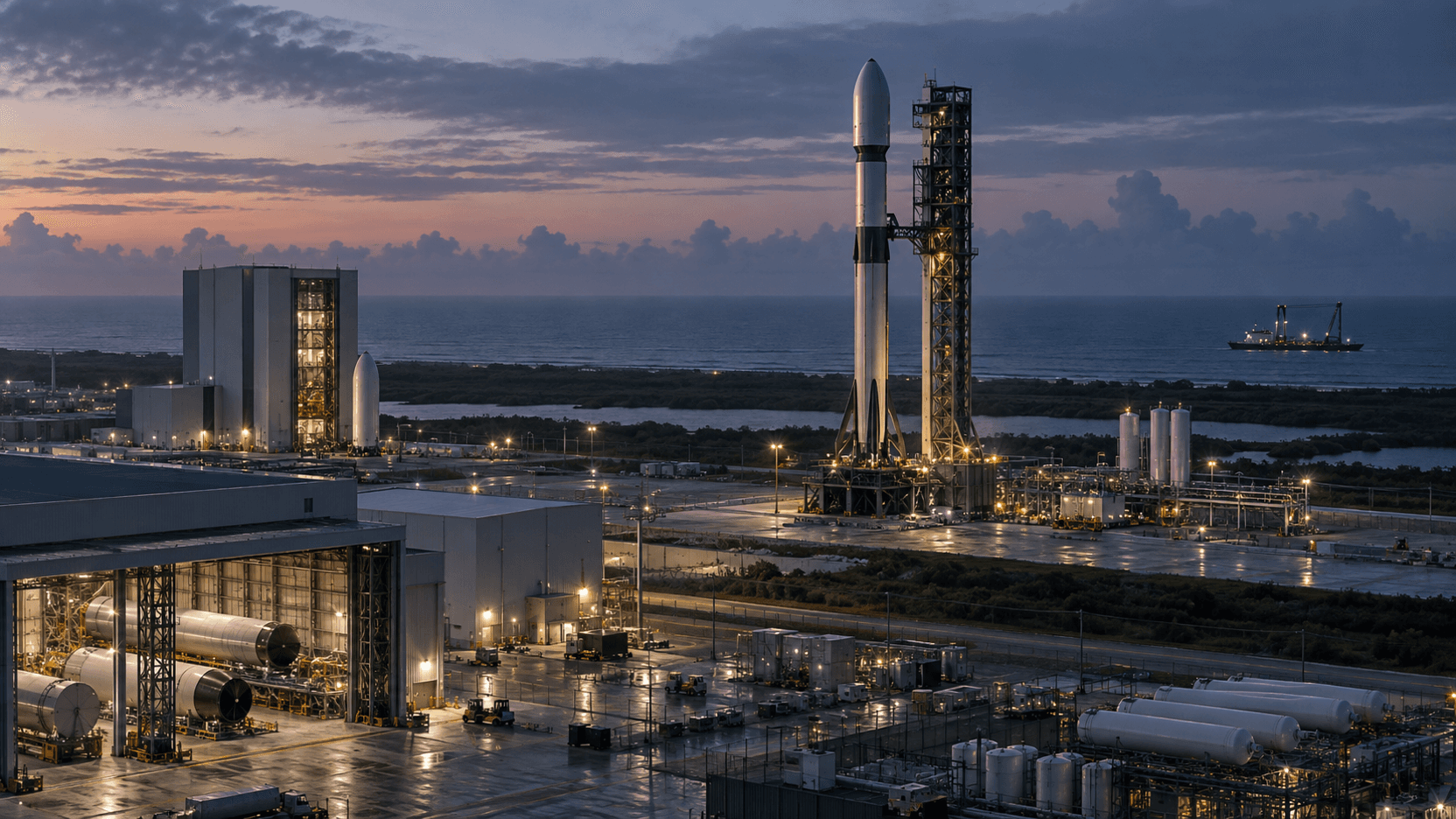
Stoke Space has raised enough money to build like a launch company before proving it can fly like one. On September 8, the company announced an initial closing of a billion-dollar Series E round. Stoke says the financing brings its total capital raised to $2.3 billion. Nova has not reached orbit. The gap between those two facts is not an embarrassment to explain away. It is the bet.
Read the financing language carefully. Stoke says it completed an initial closing of a billion-dollar round. It did not disclose how much entered the company in that first closing, and it did not announce a valuation. The Next Web called out that distinction in its coverage. The round may be sized around a billion dollars, but the public announcement does not establish that every dollar is already sitting in Stoke's account.
What is established is the strategic change. The company is no longer funding one rocket on one schedule. It is pushing Nova Pathfinder toward a first orbital flight targeted for early 2027 while developing Nova Block 2, a larger vehicle targeted for 2029. The financing is meant to expand manufacturing, test, launch, recovery, and production capacity so those programs can move in parallel.
That is a different game from keeping a prototype alive until the next milestone. A prototype company optimizes for the next test, the next investor update, and enough runway to survive a delay. An operating launch company needs factories, test stands, pad systems, payload processing, recovery assets, flight software, supplier depth, and people who can repeat the work after the first rocket leaves the ground. Stoke is trying to finance that transition before flight data arrives.
Point72 Ventures and Spark Capital co-led the Series E. Stoke listed General Innovation, Glade Brook Capital, US Innovation Technology, Washington Harbour Partners, Woven Capital, Y Combinator, and other new and existing investors as participants. Investor confidence is meaningful because rockets consume capital with industrial efficiency. It is not technical validation. A term sheet cannot survive reentry.
Pathfinder is supposed to produce the evidence. Stoke describes it as the first orbital configuration in the Nova family, designed to carry real payloads, demonstrate core reuse technologies, and give the company operating experience. GeekWire reports that Pathfinder is designed to place 3 metric tons into low Earth orbit. Its first stage uses seven Zenith engines, while its upper-stage Andromeda system integrates 24 thrust chambers into an actively cooled metallic heat shield.
The active cooling system is the heart of Stoke's thesis. Getting a booster back is difficult. Getting an upper stage back is vicious because the stage returns from orbital velocity and absorbs far more reentry energy. Stoke's design circulates cryogenic liquid hydrogen through channels in a metallic heat shield, using propellant as the cooling medium. The company says the same architecture supports ascent, orbital maneuvering, reentry, and landing.
None of that is flight-proven at orbital scale for Stoke. The company completed a vertical takeoff and landing test with its Hopper upper-stage prototype in 2023, and it says a 2026 proto-qualification campaign for the Pathfinder first-stage structure covered 46 test objectives while exercising fluid systems, avionics, software, ground systems, and operating procedures. These are real development milestones. They are not a recovered orbital stage, a fast refurbishment cycle, or a second flight of the same hardware.
The early 2027 launch target should be treated as a target. GeekWire describes it as a slight slip from earlier expectations. The first mission is meant to answer basic questions that no funding announcement can settle: can the integrated vehicle reach the intended orbit, can its systems survive the flight environment, can the company operate safely from the Cape, and can the architecture generate useful data for reuse? A launch attempt is the beginning of the proof sequence, not the end.
Block 2 raises the ambition before Pathfinder has delivered that first answer. Stoke says the larger vehicle is designed to place 15 metric tons into low Earth orbit in a fully reusable configuration and more than 4 metric tons into geosynchronous transfer orbit. The design uses a 5-meter payload fairing, 14 Zenith engines on the first stage, and a redesigned hydrogen-powered upper stage. The company targets a first Block 2 flight in 2029.
Those are design claims and schedule claims. They are not available capacity that a satellite operator can depend on today. The phrase 15 metric tons becomes economically meaningful only after the vehicle flies, recovers, can be inspected without heroic labor, and returns to the pad on a repeatable schedule. Full reuse is not a geometry problem alone. It is a maintenance, reliability, logistics, and fleet-utilization problem wearing a rocket costume.
Stoke's decision to develop Block 2 now still makes strategic sense. A 3-ton vehicle can serve dedicated missions and prove the machinery. A 15-ton vehicle can address larger constellation deployments and spread fixed operating costs across more payload. Waiting until Pathfinder completes years of flights before starting the larger system could leave Stoke with a technically elegant vehicle aimed at a market that has moved upward in mass and volume.
Starting both programs together creates the opposite risk. Engineering teams can split their attention. Requirements can leak backward from the larger vehicle into hardware that needs to fly now. Test infrastructure, manufacturing tooling, software, and management bandwidth can become shared bottlenecks. Parallel development compresses the calendar by spending more money and accepting more coordination risk. That is exactly why the round is so large.
The factory footprint shows where the money is going. Stoke says its Kent, Washington headquarters covers 168,000 square feet. GeekWire reports that the company is expanding its Moses Lake test site from 75 acres to 550 acres so work on the two vehicle configurations can proceed with fewer conflicts between test areas. Chief executive Andy Lapsa told the publication that Stoke has about 400 employees, including roughly 50 at Moses Lake and 50 at Cape Canaveral.
This is not glamorous spending, which is why it matters. Rocket companies fail when hardware waits for a test stand, a blast radius blocks another program, a pad modification slips, or a production process cannot reproduce what a small team built by hand. More acreage does not create reliability by itself. It can remove the physical conflicts that turn every test campaign into a scheduling knife fight.
The Space Coast is the operational hinge. Stoke is building at Space Launch Complex 14 at Cape Canaveral Space Force Station, the historic pad used for John Glenn's 1962 orbital mission. GeekWire reports that a new payload-processing facility there was intentionally sized for both Pathfinder and Block 2. The company says vehicle hardware will move from qualification work in Washington to wet-dress rehearsals and static-fire testing at the Cape before flight.
For the region, that means Stoke is not merely renting a launch date. It is assembling a recurring operation with people, processing, testing, customers, and recovery requirements. If Nova flies at useful cadence, the economic footprint spreads beyond the pad into specialized labor, marine operations, logistics, payload integration, and suppliers. If the schedule slips, the Cape also becomes the place where parked infrastructure makes the delay visible.
Stoke frames the larger vehicle as an answer to scarce launch capacity and growing demand from commercial constellations and national-security architectures. That is the company's market thesis. It is credible enough to attract serious capital, but the sources reviewed do not independently quantify every part of Stoke's demand forecast. Customers asking for more capacity does not guarantee they will buy it from a new vehicle on a new schedule.
Launch is full of projected demand that disappears when spacecraft arrive late, financing closes slowly, or government procurement changes. It is also full of real missions forced to wait because the available providers, orbits, and schedules do not line up. The valuable product is not raw kilograms to orbit. It is control over timing, destination, integration, and repeat access. A reusable medium-lift vehicle could matter if it turns those variables into dependable inventory.
The phrase fully reusable can become its own trap. Investors and customers do not receive value because both stages return in a presentation. They receive value when recovered hardware lowers the marginal cost of the next mission without creating an expensive inspection ritual. The decisive metrics will be recovery success, component life, refurbishment hours, turnaround time, launch availability, insurance performance, and the number of flights each vehicle completes before major replacement.
That is why comparisons with SpaceX need discipline. Falcon 9 recovers its booster but discards the upper stage. Starship is designed for dual-stage reuse but has not yet established routine full reuse in the reporting reviewed here. Stoke is pursuing a different payload class and a different architecture. Calling it a SpaceX rival makes an easy headline. Proving a second independent reusable launch system would be the much more consequential outcome.
A second provider would matter to commercial operators and to the government for the same reason redundancy matters in every critical network. Capacity controlled by one company can be efficient until a failure, schedule conflict, policy dispute, or national-security requirement exposes the concentration. Stoke's support from NASA, the US Space Force, the Defense Innovation Unit, and the National Science Foundation, as described by the company, sits inside that broader push for more launch options.
The financing therefore buys three kinds of time. It buys engineering time to get Pathfinder through integration and qualification. It buys calendar time to begin Block 2 before Pathfinder matures. It buys market time to build capacity before prospective constellation customers settle permanently into other launch plans. Capital can expand all three windows. It cannot stop them from closing.
The next update that matters is hardware, not valuation. Watch whether Pathfinder reaches Cape Canaveral, completes integrated testing, and makes its early 2027 attempt. Then watch what comes home, what needs repair, how long the next vehicle takes, and whether Block 2 inherits validated systems instead of inherited optimism. A reusable rocket becomes a transportation business only when the second flight is less dramatic than the first.
Stoke has secured the financial permission to pursue the hard version of the company. It can build the smaller proof vehicle, the larger commercial vehicle, and the industrial base at the same time. That is unusually ambitious and appropriately expensive. Now the narrative gets simple. The company has reported $2.3 billion in capital raised and zero orbital flights. Every launch, recovery, inspection, and refly from here will decide whether that gap was foresight or just very well-funded hope.
LaunchPad positionThe financing gives Stoke enough capital to stop behaving like a single-prototype startup and start building a launch system in parallel across vehicles, factories, testing, recovery, and Cape Canaveral. It does not prove orbit, recovery, refurbishment, cadence, reliability, or economics. Those are the next scorecards.
This report draws on the linked primary sources and reputable reporting. Company statements are treated as claims until independently demonstrated.