SMILE has earned permission to do science without yet delivering every measurement its science plan needs. ESA's September 30 update says the European-Chinese mission was declared ready on September 23. Its ultraviolet camera is observing auroras. Its Earth-facing X-ray observations still face excess stray light. Those statements describe different parts of the same observatory, not contradictory verdicts on whether the mission works.
The released ultraviolet sequence was captured on July 24 during commissioning. ESA identifies a 58-minute interval showing an auroral substorm around the northern pole. The agency separately reports that the instrument now records for 45 hours at a time, a capability that should not be confused with the length of the published clip. Space.com's October 2 coverage also describes the daytime and nighttime auroral view, drawing on ESA's release. It is useful outside reporting, but not an independent calibration of the instrument. The observations are older than the announcement, and this is not a new October storm warning.
What makes the footage valuable is its spatial coverage. A photograph from the ground records a local view of a much larger phenomenon. The northern auroral oval is a changing structure, and seeing its shape evolve gives researchers something different from a succession of disconnected sightings. ESA describes UVI as the first camera since 2008 to capture the complete northern ring in ultraviolet. This is an observational capability, not evidence that the mission has already improved a forecast or prevented an infrastructure failure.
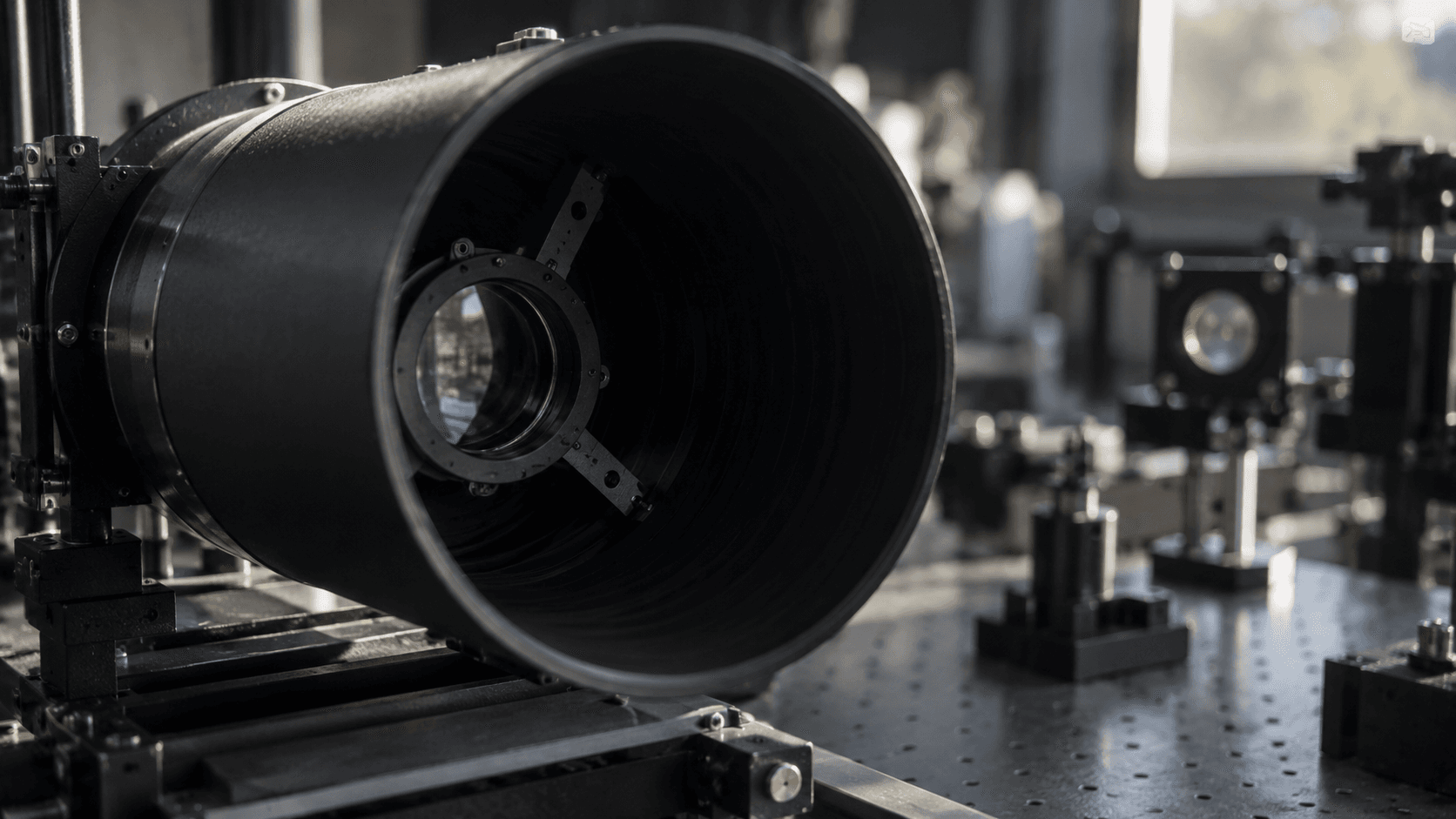
The instrument choice explains the view. ESA's ultraviolet design account says auroras emit predominantly in ultraviolet, while visible-light observations lose the daytime portion against the bright Earth. UVI still has to suppress ultraviolet dayglow from the upper atmosphere. Its optical chain uses four coated mirrors, a CCD sensor and an image intensifier. The published design calls for images as often as once a minute, with resolution between 30 and 90 kilometers depending on orbital position. These specifications describe a regional science instrument, not a camera capable of inspecting individual pieces of ground infrastructure.
Time coverage matters alongside resolution. ESA describes an orbit that lets the spacecraft spend long intervals looking down from above the northern pole before returning close to the southern pole to deliver data roughly every two days. Long observations can connect stages of a disturbance that a shorter observing window might separate. But the orbit also cautions against treating a research observation schedule as an always-on operational feed. An instrument's ability to collect a sequence and a customer's ability to receive a useful alert are different requirements.
SMILE's four instruments are deliberately complementary. The soft X-ray imager, SXI, and the ultraviolet imager, UVI, look outward to collect images. The magnetometer, MAG, measures magnetic conditions near the spacecraft, while the light ion analyser, LIA, samples local particles. ESA's instrument overview distinguishes these remote and local measurements explicitly. The engineering point is straightforward: a wide image and a local sample answer different questions. One describes a larger pattern; the other measures conditions at the spacecraft's location. Combining them is more informative than asking any single instrument to stand in for the entire system.
The X-ray measurement has a particularly indirect relationship to the familiar idea of a photograph. Charged solar-wind particles interacting with neutral particles can produce soft X-ray emission through solar-wind charge exchange. SXI is designed to use that emission to study the boundary where the solar wind encounters Earth's magnetic environment, including the sunward magnetopause and polar cusps. The camera does not simply photograph invisible magnetic field lines. It observes light associated with an interaction, from which researchers investigate the surrounding structure and its behavior.
ESA traces the charge-exchange opportunity back to the unexpected X-rays seen around Comet Hyakutake with ROSAT in 1996. For SMILE, square channels in micro-pore optics direct X-rays onto CCD detectors. The design includes cooling to minus 120 degrees Celsius and shutters for passages through the radiation belts. These choices illustrate why turning an attractive physical effect into useful observations requires an entire instrument, not just a sensitive detector. Optics, thermal conditions, exposure to the environment and unwanted signal all enter the measurement problem.
That last constraint remains live. ESA says SXI has taken celestial test images, but detects too much stray light when aimed toward Earth. Teams are changing settings and onboard software. The agency also expects changing geometry and the approach of northern winter to lower the background, with a minimum around mid-October. A useful magnetopause or cusp image is an anticipated outcome, not a result established by the September announcement.
Successful imaging of a distant target does not, by itself, settle performance against a different background. Equally, the disclosed problem does not establish that the X-ray camera is unusable. The defensible position sits between those claims. The mission has an instrument producing test observations and a specific observing condition still being addressed. For builders, this is a recognizable acceptance problem: a component can pass a functional test while the intended measurement remains limited by its operating environment. The next test needs to exercise that environment, not merely repeat the easier demonstration.
The reason to pursue the harder measurement is that space weather is a coupled process. NOAA explains that sustained fast solar wind and a southward-directed interplanetary magnetic field can favor energy transfer into Earth's magnetosphere. The resulting disturbances involve currents, particles and magnetic fields, not just a brighter sky. Heating can alter the upper atmosphere and increase drag on low-orbiting satellites. Changes in the ionosphere can affect radio propagation. A small auroral substorm should not be casually equated with a severe geomagnetic storm, and a striking image is not a severity scale.
Existing operational forecasts provide a useful comparison. NOAA's auroral product uses the empirical OVATION model, with solar-wind speed and magnetic-field measurements taken upstream at L1. Its advertised lead time is 30 to 90 minutes, reflecting the travel time from those observations to Earth. When the solar-wind input is unavailable or contaminated, NOAA describes a fallback driven by the current Kp geomagnetic index, with no forecast lead time. A colored oval on that product is therefore a model output with a stated input chain, not a live photograph of the atmosphere.
NOAA also says the relationship used to estimate auroral viewing probability was checked against ultraviolet observations from NASA's Polar satellite. That history gives a concrete reason to value new global imagery: observations can help test a model rather than merely decorate its output. It does not establish that SMILE data are already entering OVATION, or that any resulting forecast would be better. A credible improvement claim would need a comparison against the existing product, including where and when it helps, which events it misses and what happens when the new input is absent.
On the ground, the translation becomes more demanding. NOAA's power-transmission account explains how changing magnetic fields drive currents through conducting networks. The response depends on both artificial paths, such as power lines, and natural paths through the ground and nearby water. The resulting slowly varying currents can push transformer cores into saturation, contribute to heating and disturb protection or voltage stability. NOAA cites a nine-hour Canadian blackout and a transformer loss in March 1989 among the historical consequences. This is why a map of the aurora cannot be treated as a map of transformer damage. The same broad disturbance must still be translated through local electrical conditions and equipment behavior.
Navigation has a different failure path. According to NOAA, ionospheric plasma changes how satellite radio signals propagate, and quiet-condition corrections can become inaccurate during a disturbance. Dual-frequency receivers can compensate for some effects, but sufficiently disturbed conditions can prevent signal lock. The agency identifies precision farming, construction and surveying among the applications that depend on accurate positioning. It also distinguishes equatorial scintillation associated with the normal day-night cycle from storm effects. A service claiming to improve positioning reliability must therefore identify which problem it is addressing. Better knowledge of one mechanism is not a universal repair for every lost or inaccurate fix.
These distinctions suggest a more useful way to evaluate the mission's practical value than counting impressive images. First ask whether a measurement separates the physical signal from its background under the conditions that matter. Then ask whether it can be aligned in time with the other instruments and with an event being studied. Finally ask whether the resulting explanation improves a particular decision. Those are proposed evaluation questions, not additional mission achievements. For a forecasting application, the last stage would include delivery latency and false alarms; for a grid application, it would also require the local response that a global image alone cannot supply.
There is a reasonable counterargument to demanding immediate operational value: a science mission should not need a near-term commercial product to justify a new way of observing nature. Understanding how the magnetosphere responds is itself a valid objective. The mistake would be on the other side, promising lower outage losses or more accurate navigation before the chain from observation to outcome has been demonstrated. Researchers can explore that chain without pretending it is complete. Infrastructure operators can follow the work without replacing their existing procedures on the strength of a commissioning release.
The most interesting result may eventually be a disagreement between measurements. If an image, a local particle reading and an existing model imply different accounts of an event, that is a question worth investigating rather than an inconvenience to average away. A new vantage point earns its value by making such tests possible. SMILE's ultraviolet observations already provide material for those questions. Its broader promise depends on bringing the complementary measurements into the same investigation, with their limitations visible. For now, the auroral sequence is real evidence; the full explanation of what connects the Sun, the magnetic boundary and a failure on Earth remains work to be done.
LaunchPad positionJudge SMILE's complementary observations on their own evidence, and require a demonstrated link before claiming improved forecasts or infrastructure protection.
This report draws on the linked primary sources and reputable reporting. Company statements are treated as claims until independently demonstrated.