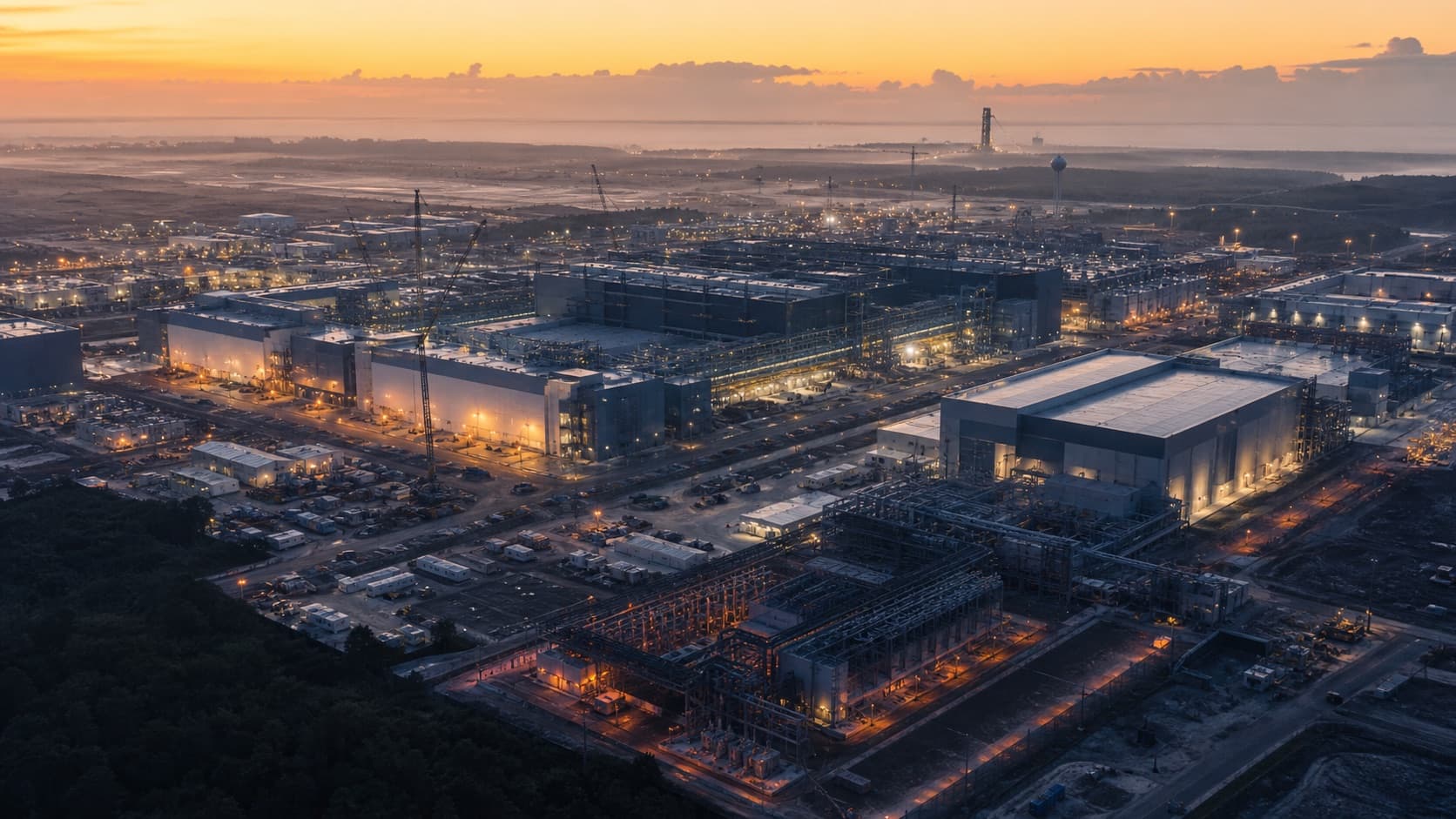
The proposed $70 billion industrial district in the Philippines is not merely a technology park. It is the first major physical test of a U.S.-led effort to reorganize the infrastructure of artificial intelligence around trusted allies.
A 4,000-acre site in New Clark City, Philippines, has become the focal point of one of the most ambitious economic-security initiatives launched by the United States in recent years.
The proposed development is associated with Pax Silica, a U.S.-led coalition intended to secure the complete supply chain supporting artificial intelligence. Philippine officials say the New Clark City project could eventually attract between $40 billion and $70 billion in investment, create as many as 190,000 direct jobs, and become a major center for semiconductors, advanced manufacturing, critical-mineral processing, and AI infrastructure.
Those numbers have understandably attracted attention. They have also produced a misleading shorthand: that the United States selected one piece of land and placed a $70 billion bet on it.
The reality is more complicated.
The United States has not purchased the land, and it has not committed $70 billion. The Philippine government has designated approximately 1,620 hectares of state-controlled land for a proposed industrial ecosystem. The $70 billion figure is the upper end of a full-development projection that may take 10 to 15 years or longer to realize.
The final bilateral framework is still being negotiated. Most prospective tenants have not been disclosed. The largest financial figures remain estimates rather than contractual commitments.
Yet the project is strategically important precisely because it reaches beyond the numbers. New Clark City is intended to become the first major physical node in a new international system connecting critical minerals, energy, semiconductors, manufacturing, data infrastructure, and frontier AI models.
To understand Pax Silica, it is necessary to stop thinking of AI as software alone.
The Physical Supply Chain Behind Artificial Intelligence
Artificial intelligence may appear weightless when accessed through a phone or browser, but its foundations are intensely physical.
Before an AI model can answer a question, minerals must be extracted and refined. Semiconductor equipment must be manufactured. Silicon wafers must be processed. Chips must be fabricated, paired with high-bandwidth memory, packaged, tested, and installed inside data centers.
Those data centers require land, fiber-optic connectivity, cooling equipment, water, electricity, backup systems, and physical security.
The complete chain begins with critical minerals. Those minerals move through refining and materials processing before reaching semiconductor equipment manufacturers and chip fabrication plants. Finished chips must then be combined with memory, packaged, tested, delivered through international logistics networks, and installed inside enormous computing facilities. Frontier AI models sit at the top of this physical system, not outside it.
The global distribution of those capabilities has created major strategic dependencies.
China dominates or strongly influences many critical-mineral processing and industrial supply chains. Taiwan remains central to advanced semiconductor fabrication. South Korean companies dominate high-bandwidth memory. The Netherlands is home to ASML, the only company able to produce the extreme-ultraviolet lithography systems required for the world’s most advanced chips.
Japan remains essential to semiconductor materials, specialized chemicals, silicon wafers, optics, and precision manufacturing equipment. The United States leads in GPU design, cloud platforms, frontier AI models, and semiconductor intellectual property, but it still depends heavily on overseas production.
Pax Silica is Washington’s attempt to turn those dependencies into a coordinated allied network.
What Pax Silica Is
Pax Silica was formally launched in Washington on December 12, 2025, under U.S. Under Secretary of State for Economic Affairs Jacob Helberg.
Its founding declaration calls for collaboration across software platforms, frontier models, telecommunications systems, fiber networks, data centers, semiconductors, advanced manufacturing, transportation, logistics, mineral refining, and energy.
The declaration also calls on participating economies to reduce excessive supply-chain dependencies, coordinate investment-security practices, address state-backed overcapacity and industrial dumping, protect sensitive technology, and prevent critical infrastructure from falling under undue foreign control.
China is not named directly in every section of the agreement, but the strategic objective is unmistakable.
Pax Silica is designed to reduce reliance on supply chains controlled or heavily influenced by China while building a trusted network around the technologies, materials, and infrastructure required for artificial intelligence.
The declaration itself is nonbinding. Pax Silica is not currently a treaty organization, customs union, or conventional free-trade agreement. It has no publicly defined collective-enforcement mechanism.
Its significance will come from the projects, financing arrangements, investment rules, export controls, industrial zones, procurement policies, and commercial relationships created beneath the declaration.
Pax Silica is therefore better understood as an organizing framework for economic security than as a traditional international institution.
Who Designed It
The central architect of Pax Silica is Jacob Helberg, the State Department’s Under Secretary for Economic Affairs.
Before entering government, Helberg advised Palantir CEO Alex Karp, worked on global policy at Google, served on the U.S.-China Economic and Security Review Commission, and founded the Hill & Valley Forum, which connects Silicon Valley executives with members of Congress.
He also became a prominent advocate for legislation forcing a sale or prohibition of TikTok and wrote The Wires of War, a book arguing that technology infrastructure had become a central battlefield in geopolitical competition.
Helberg’s central argument is that AI leadership cannot be secured simply by producing the best models. It requires influence over the entire system supporting those models.
That includes the mines producing strategic materials, the facilities refining them, the companies building lithography equipment, the manufacturers producing memory and processors, the ports moving sensitive goods, and the energy systems powering computing infrastructure.
In this view, artificial intelligence is not merely a software industry. It is the organizing force behind a new industrial order.
A Coalition of Complementary Capabilities
Pax Silica began with seven founding signatories and has expanded rapidly.
Following Italy’s accession on July 31, 2026, the coalition has 25 declaration signatories. They include the United States, Australia, Israel, Japan, South Korea, Singapore, the United Kingdom, Qatar, the United Arab Emirates, India, Sweden, Finland, the Philippines, Norway, the European Union, Germany, Greece, the Netherlands, Argentina, Chile, Costa Rica, El Salvador, Kazakhstan, Panama, and Italy.
Taiwan has endorsed the declaration’s principles through a separate economic-security statement but is not a formal signatory.
The coalition’s composition becomes more logical when viewed through the AI supply chain.
South Korea provides high-bandwidth memory through Samsung and SK Hynix. The Netherlands contributes ASML and its irreplaceable lithography systems. Japan provides semiconductor equipment, silicon wafers, chemicals, optical systems, and precision manufacturing.
The United Kingdom contributes Arm’s chip architecture and a sophisticated AI research and investment ecosystem. Israel contributes semiconductor design, cybersecurity, defense technology, and major Intel and Nvidia research operations.
Australia, Chile, Argentina, Kazakhstan, and the Philippines contribute different combinations of critical minerals and resource potential. The United Arab Emirates and Qatar provide energy, sovereign capital, and the capacity to finance large-scale computing infrastructure.
Singapore and Panama occupy strategically important positions in global logistics. Germany and Italy add industrial automation, semiconductor production, power electronics, optics, machinery, and advanced manufacturing.
The United States sits near the center of the network with frontier models, cloud infrastructure, GPU design, semiconductor intellectual property, capital markets, defense demand, export controls, and political leadership.
This is not a formally assigned division of labor. It is a map of the industrial capabilities Washington is attempting to connect.
The objective is not for every country to recreate the entire AI supply chain within its own borders. That would be enormously expensive and economically inefficient.
The objective is to link difficult-to-replace capabilities across countries the United States considers reliable.
Pax Silica is not simply a trade bloc. It is closer to an operating system for allied industrial power.
Why New Clark City?
The Philippines joined Pax Silica in April 2026. At the same time, Washington and Manila announced plans to establish a 4,000-acre Economic Security Zone within New Clark City in Tarlac.
New Clark City is a government-planned development managed by the Bases Conversion and Development Authority, or BCDA. The broader development covers approximately 9,450 hectares, while the larger Clark Freeport and Special Economic Zone covers roughly 35,300 hectares.
The proposed Pax Silica district would occupy approximately 1,620 hectares.
Several factors make the location strategically attractive.
New Clark City is part of the Luzon Economic Corridor, a Philippines-U.S.-Japan initiative connecting Subic Bay, Clark, Manila, and Batangas. The corridor is intended to combine ports, airports, railways, roads, industrial districts, and energy infrastructure.
The site is near Clark International Airport and within reach of the deep-water Port of Subic. In July, BCDA and the Subic Bay Metropolitan Authority signed an agreement designating Subic as the preferred maritime gateway for Pax Silica.
That agreement covers specialized cargo handling, data integration, supply-chain tracking, expedited processing for accredited companies, and more efficient transportation between Subic and New Clark City.
The Philippines also has an established electronics and semiconductor industry, a large English-speaking workforce, and significant deposits of nickel, copper, cobalt, and other strategic resources.
Geographically, the country is close to Japan, South Korea, Taiwan, and the larger Southeast Asian manufacturing network.
The Philippines is also a longstanding U.S. treaty ally whose strategic relationship with Washington has deepened amid growing tensions in the South China Sea.
The site carries historical symbolism as well. New Clark City occupies land that formed part of a former American military reservation before U.S. forces withdrew from Philippine bases in 1991.
That territory is now being positioned as a commercial technology hub within a new American-led economic-security architecture.
What the New Clark Development Could Contain
Government descriptions portray Pax Silica New Clark as a mixed industrial and innovation ecosystem rather than a single hyperscale data-center project.
The proposed district could include semiconductor assembly, testing, advanced chip packaging, electronics production, critical-mineral processing, AI computing infrastructure, data centers, robotics, industrial research, energy systems, aerospace, transportation technology, and supporting logistics.
It would also require utilities, education, housing, workforce development, roads, communications infrastructure, and environmental systems.
BCDA has pushed back against portrayals of the entire zone as a massive data-processing center. The agency describes it as a broader semiconductor and advanced-manufacturing ecosystem.
The distinction matters because the project’s economic value will depend heavily on which industries ultimately occupy the site.
A district dominated by warehouses and data centers would produce a different economic outcome from one containing advanced packaging facilities, chip-design laboratories, equipment manufacturers, research centers, and locally integrated supply chains.
The Philippines’ Opportunity to Move Up the Value Chain
The Philippines is already an important participant in semiconductor assembly, packaging, and testing.
International companies operating in the country include Texas Instruments, Analog Devices, onsemi, NXP, STMicroelectronics, Amkor, ROHM, and others. Electronics consistently account for more than half of Philippine merchandise exports.
However, the country’s role remains concentrated primarily in lower- and middle-value manufacturing activities.
Many wafers, machines, designs, and components are created elsewhere, processed or assembled in the Philippines, and then exported.
Pax Silica could provide a pathway into more advanced activities such as chip design, wafer-level packaging, industrial research, equipment maintenance, semiconductor materials, robotics, higher-value mineral processing, and applied AI systems.
The opportunity is particularly important because the Philippines’ business-process-outsourcing industry is increasingly exposed to automation.
A substantial portion of routine customer service, administrative processing, and back-office work could be affected by the same AI systems Pax Silica is intended to support.
Industrial development offers one possible route toward replacing vulnerable service-sector employment with more technical, physical, and higher-value economic activity.
Whether that transition occurs will depend on the final requirements imposed on foreign investors.
Where the $70 Billion Comes From
BCDA currently presents approximately $10 billion as an initial investment requirement.
At full development, the agency projects investment of between $40 billion and $70 billion.
BCDA also estimates that the district could produce between 130,000 and 190,000 direct jobs, along with between 500,000 and 800,000 indirect or induced jobs.
Projected government benefits include approximately ₱68 billion to ₱75 billion in annual tax revenue and roughly ₱60 billion in lease income over 25 years.
The project has also been associated with up to $200 billion in export potential.
These numbers should be treated carefully.
BCDA says more than 30 companies have submitted expressions or letters of interest, but most have not been publicly identified. The agency has also stated that it cannot fully process prospective investors until the final U.S.-Philippines framework is completed.
The methodology behind the employment, tax, and export estimates has not been published in sufficient detail for independent verification.
Reports also conflict over whether the $200 billion export figure represents annual full-development capacity or cumulative exports over an extended period.
The project’s current timeline anticipates a possible framework agreement in late 2026, construction beginning around 2028, and development continuing for 10 to 15 years or longer.
The $70 billion figure is therefore best understood as a long-term development scenario, not a secured investment package.
Which Companies Are Involved?
A U.S. delegation led by Jacob Helberg visited the New Clark City site in May 2026 with representatives from more than a dozen companies.
The publicly identified participants included 8VC, Agility Robotics, Joby Aviation, Valar Atomics, and Foxconn.
8VC is a venture-capital firm investing across industrial technology, logistics, defense, and healthcare.
Agility Robotics develops humanoid robots for industrial work.
Joby Aviation is developing electric vertical-takeoff aircraft and air-mobility systems.
Valar Atomics is an advanced nuclear-energy company.
Foxconn is the world’s largest contract electronics manufacturer and was represented by Chairman Young Liu.
Their presence demonstrates commercial and strategic interest. It does not constitute a confirmed investment.
None of these companies should be described as a Pax Silica tenant until it announces an actual lease, capital commitment, construction plan, or operating agreement.
The Most Concrete Energy Agreement
The most substantial infrastructure agreement announced so far involves ACWA Power Philippines.
ACWA signed a lease with BCDA for a separate 500-hectare site within New Clark City. The company plans to develop up to 500 megawatts of solar generation combined with battery storage.
At the stated minimum investment of $400,000 per megawatt, a complete 500-megawatt project would represent at least approximately $200 million.
The project remains subject to final design, regulatory approval, and future development phases.
ACWA describes the facility as an energy anchor for data centers and advanced industries moving into New Clark City.
BCDA has also signed memoranda with several Japanese companies.
Sustech will explore renewable-energy forecasting and electricity-demand management. Index Strategy and Yachiyo Engineering will study integrated transportation infrastructure. Marubeni will explore power, water, and utility systems.
These are meaningful enabling agreements, but they remain far below the scale implied by the $70 billion full-development projection.
Power May Be the Hardest Constraint
BCDA has discussed an eventual electricity requirement of approximately three gigawatts.
Meeting that demand would require an enormous industrial-scale energy system.
ACWA’s proposed 500-megawatt solar-plus-storage project represents only one component.
Solar facilities do not continuously produce their full nameplate capacity. Battery systems must also be large enough to support nighttime operations, poor weather, and fluctuations in generation.
A reliable three-gigawatt system may require additional renewable generation, new transmission capacity, grid-scale batteries, natural gas, geothermal power, nuclear energy, dedicated off-grid facilities, and long-term power-purchase agreements.
BCDA says the development will rely on dedicated power facilities rather than drawing its complete requirements from surrounding communities.
The details, approvals, and financing of that system remain unresolved.
The participation of Valar Atomics in the U.S. delegation is notable in this context, but no nuclear project for New Clark City has been publicly announced.
The Water Requirement
Published estimates place possible water demand between approximately 90 million and 130 million liters per day, depending on the final combination of semiconductor manufacturing, computing infrastructure, and other industries.
Semiconductor production requires significant quantities of ultrapure water.
The wastewater must also be treated to strict standards because manufacturing processes can involve solvents, acids, metals, and other industrial chemicals.
BCDA says the project will use surface-water harvesting, storage, treatment, rain capture, recycling, and potentially desalination rather than relying on existing community supplies.
Those proposals must eventually be supported by hydrological studies, infrastructure designs, drought planning, environmental approvals, wastewater standards, and enforceable operating requirements.
The project’s environmental credibility will depend on execution, not assurances alone.
Land, Incentives, and the 99-Year Lease
The United States is not purchasing the New Clark City site.
The land remains under Philippine control through BCDA.
Qualified foreign investors may be eligible for leases lasting up to 99 years. However, the exact legal structure will depend on BCDA’s statutory authority, land titles, development contracts, and the application of Philippine investment law.
Potential companies may also qualify for substantial tax and customs incentives.
Depending on their registration and activities, those benefits could include income-tax holidays, special corporate income-tax treatment, enhanced deductions, duty-free importation of equipment and materials, and VAT exemptions or zero-rating.
Some incentives could potentially extend for decades.
The central policy question is whether the economic value retained by the Philippines will justify the concessions provided to foreign investors.
Sovereignty and Governance
The proposed framework has already created a political dispute.
BCDA President Joshua Bingcang said U.S. negotiators had raised questions involving American jurisdiction or diplomatic immunity connected to the development.
Philippine officials responded that the zone would remain subject to Philippine sovereignty and law.
Helberg later said the immunity issue had been taken out of context.
Because the final framework is not public, it is impossible to evaluate the precise provisions governing personnel, contractors, dispute resolution, security, and enforcement.
There is no public evidence that New Clark City has been approved as an American military installation. Philippine officials describe it as a commercial and high-technology project.
Still, the development will carry national-security implications if it handles controlled semiconductor technology, critical minerals, supply-chain intelligence, restricted computing systems, or dual-use manufacturing.
Commercial status does not eliminate strategic importance.
The final framework should clearly establish which country’s laws govern operations, how disputes will be resolved, which companies qualify as trusted participants, and whether Chinese-linked firms or equipment will be restricted.
It must also address industrial data, cybersecurity, intellectual-property ownership, regulatory access, and the authority of Philippine institutions inside the zone.
Environmental and Community Concerns
Critics have raised concerns involving Indigenous Aeta communities, farmers, land rights, water availability, industrial pollution, mining expansion, and the use of long-term foreign leases.
BCDA says the proposed district lies within areas already designated as buildable and outside formally recognized ancestral domains.
The agency also says any affected families will remain within their communities and that individual projects will be required to obtain Environmental Compliance Certificates.
The controversy is unlikely to disappear without greater transparency.
The exact boundaries, environmental studies, infrastructure assumptions, lease structures, and community-impact plans should be released before irreversible commitments are made.
Several Philippine lawmakers have already called for investigations examining the project’s economic, environmental, labor, agricultural, social, and sovereignty implications.
The Technology-Transfer Question
The most important test may not be the amount of foreign investment.
It may be the amount of lasting technological capability created inside the Philippines.
Foreign companies could receive long leases, tax benefits, infrastructure, workforce access, and strategic positioning within a trusted U.S.-led supply chain.
What will the Philippines receive in return?
Will companies be required to train Filipino engineers?
Will they establish local research facilities?
Will they purchase from Filipino suppliers?
Will they transfer meaningful technical capabilities?
Who will own the patents, tooling, industrial data, and AI systems developed inside the zone?
Will the Philippines move from packaging chips designed elsewhere to creating more of its own intellectual property?
A successful agreement should build a domestic ecosystem of Filipino engineers, researchers, suppliers, universities, entrepreneurs, and technology companies.
Without those commitments, Pax Silica risks becoming a system in which the Philippines supplies land, minerals, electricity, tax incentives, and labor while the highest-value assets remain abroad.
That is the difference between industrial transformation and industrial dependency.
Pax Silica Beyond the Philippines
New Clark City is the most visible Pax Silica project, but it is part of a larger strategy.
In March 2026, the State Department announced its intention to work with Congress to allocate $250 million for a Pax Silica Fund supporting critical-mineral extraction, refining, infrastructure, and manufacturing.
The proposed fund is meant to serve as catalytic capital that attracts much larger pools of private and sovereign investment.
It should not be confused with the projected $70 billion value of New Clark City.
Other Pax Silica initiatives include a supply-chain credentialing pilot connected to Panama’s ports, the Foundry School advanced-manufacturing curriculum developed with Stanford University, and a proposed Economic Security Zone in Kazakhstan.
The initiative also includes critical-mineral and AI cooperation among partner countries, proposed industrial projects in Israel, and Gulf-region computing infrastructure supported by energy and sovereign capital.
The emerging structure suggests that Pax Silica will function through a distributed network of industrial zones, logistics systems, financing mechanisms, educational programs, and trusted-technology standards.
An American Alternative to Belt and Road
China’s Belt and Road Initiative expanded Chinese influence through infrastructure, state financing, ports, railways, telecommunications systems, energy projects, and long-term commercial relationships.
Pax Silica offers a different model, at least in theory.
It is intended to be private-sector-led, commercially governed, and built around allied technological capabilities.
Instead of focusing principally on transportation infrastructure, it organizes around the complete AI stack: minerals, energy, chips, computing capacity, models, logistics, standards, and capital.
The strategic implications could be substantial.
Countries inside the network may receive better access to American technology, capital, advanced chips, infrastructure financing, and trusted markets.
Companies outside the network could face stricter export controls, investment reviews, procurement restrictions, and exclusion from sensitive supply chains.
Pax Silica does not need to become a formal treaty organization to reshape commercial behavior.
It can exert influence through financing decisions, technology-access rules, preferred logistics systems, government procurement, and the definition of which vendors are considered trustworthy.
That is how a political declaration can gradually become an economic order.
It does not happen through one grand treaty.
It happens through thousands of decisions concerning who can finance, build, purchase, connect, and participate.
How Success Should Be Measured
The project should not be judged by the size of its announcement.
It should be judged by whether companies make binding capital commitments, whether anchor tenants are publicly identified, and whether the required power and water infrastructure is actually constructed.
It should be judged by environmental compliance, Filipino engineering employment, local supplier participation, technology transfer, domestic intellectual-property ownership, and measurable movement into advanced packaging, research, and chip design.
It should also be judged by how transparently communities are treated, whether the complete bilateral framework is published, and whether the government’s economic projections withstand independent review.
If New Clark City produces advanced manufacturing, Filipino-owned suppliers, local research, technical education, and genuine movement up the semiconductor value chain, it could become a transformative national project.
If the Philippines provides land, minerals, power, labor, and decades of tax incentives while foreign companies retain all strategic technology and control, the outcome will be much less impressive.
The 4,000-Acre Test
Pax Silica represents an important shift in American economic strategy.
The United States is no longer treating AI leadership solely as a competition between software companies.
It is increasingly treating energy, mineral access, industrial capacity, logistics, and semiconductor production as parts of a single national-security system.
New Clark City is where that theory may first be tested at physical scale.
The proposed development could become a serious allied manufacturing center, a catalyst for Philippine industrial transformation, and a strategic anchor inside the Indo-Pacific.
It could also become an overpromised industrial zone built around optimistic projections and insufficient infrastructure.
The outcome will depend on the contracts signed, the companies that commit, the capabilities transferred, and the amount of long-term value retained by the Philippines.
Every technological era eventually reveals its physical architecture.
The industrial age ran on coal, steel, railways, and factories.
The petroleum age ran on oil fields, pipelines, tankers, and military-protected shipping routes.
The AI age will run on critical minerals, electricity, semiconductor equipment, advanced memory, data centers, and models.
Pax Silica is Washington’s attempt to determine who controls that architecture before someone else does.
The United States did not simply select 4,000 acres of land.
It selected a location where it hopes to begin constructing the physical foundation of power in the age of artificial intelligence.
This essay was written by Blocpod and originally published on Medium. It is preserved here with its original publication date and a custom LaunchPad Observer cover. Read the canonical edition