The most expensive telescope in the world can still get fooled by a star doing normal star things.
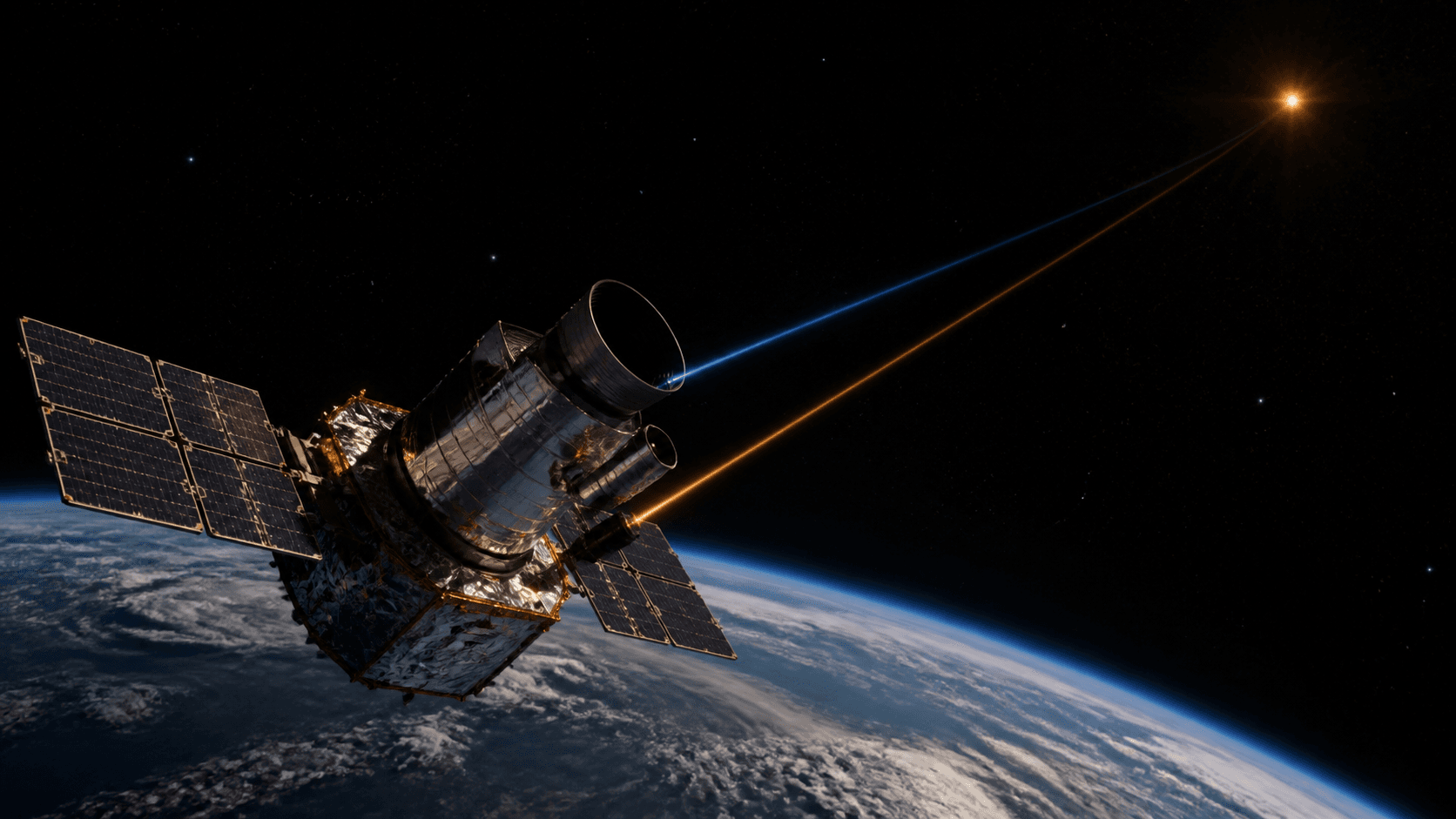
NASA's Pandora SmallSat has begun science observations after launching on January 11 and completing commissioning. The mission will study at least 20 known exoplanets, observing each one at least 10 times in continuous 24-hour sessions. Its central job is to separate the light altered by an exoplanet's atmosphere from changes caused by spots, bright regions, and other activity on the surface of the host star.
That sounds like cleanup work because it is. It is also where good science lives. When a planet passes in front of its star, a tiny fraction of starlight filters through the planet's atmosphere. Different molecules absorb different wavelengths, leaving a chemical fingerprint. But the star is not a perfect lamp. Its surface changes, and those changes can mimic or distort the same atmospheric signatures researchers are trying to measure.
Pandora attacks the ambiguity by observing visible and near-infrared light at the same time. The visible channel tracks the changing stellar surface while the infrared channel measures the wavelengths used to study planetary atmospheres, including water signatures. The mission uses an 18-inch all-aluminum telescope and a near-infrared detector originally manufactured as a spare for the James Webb Space Telescope.
The mission is deliberately narrow. Pandora is not a general-purpose Webb replacement, and NASA is not claiming it will independently characterize every atmosphere in detail. It is designed to create repeated, time-resolved observations that help researchers model the star well enough to interpret data from larger observatories with less confusion.
That division of labor is smart infrastructure. Flagship telescopes are scarce and expensive. A lower-cost spacecraft can spend long periods gathering calibration data that would be painful to buy with premium observing time. Pandora is also the first satellite launched through NASA's Astrophysics Pioneers program, which accepts more risk in exchange for faster, lower-cost missions led by early-career researchers.
The primary mission is planned for one year, and the data will be published through the NASA Exoplanet Archive. The proof will come when Pandora's stellar models reduce disagreement in atmospheric measurements across observatories. Discovery is not only about finding a faint signal. Sometimes the breakthrough is finally understanding the noise.
LaunchPad positionThe mission is not trying to replace larger observatories. It is building the correction layer that can make their scarce observing time more trustworthy.
This report draws on the linked primary sources and reputable reporting. Company statements are treated as claims until independently demonstrated.