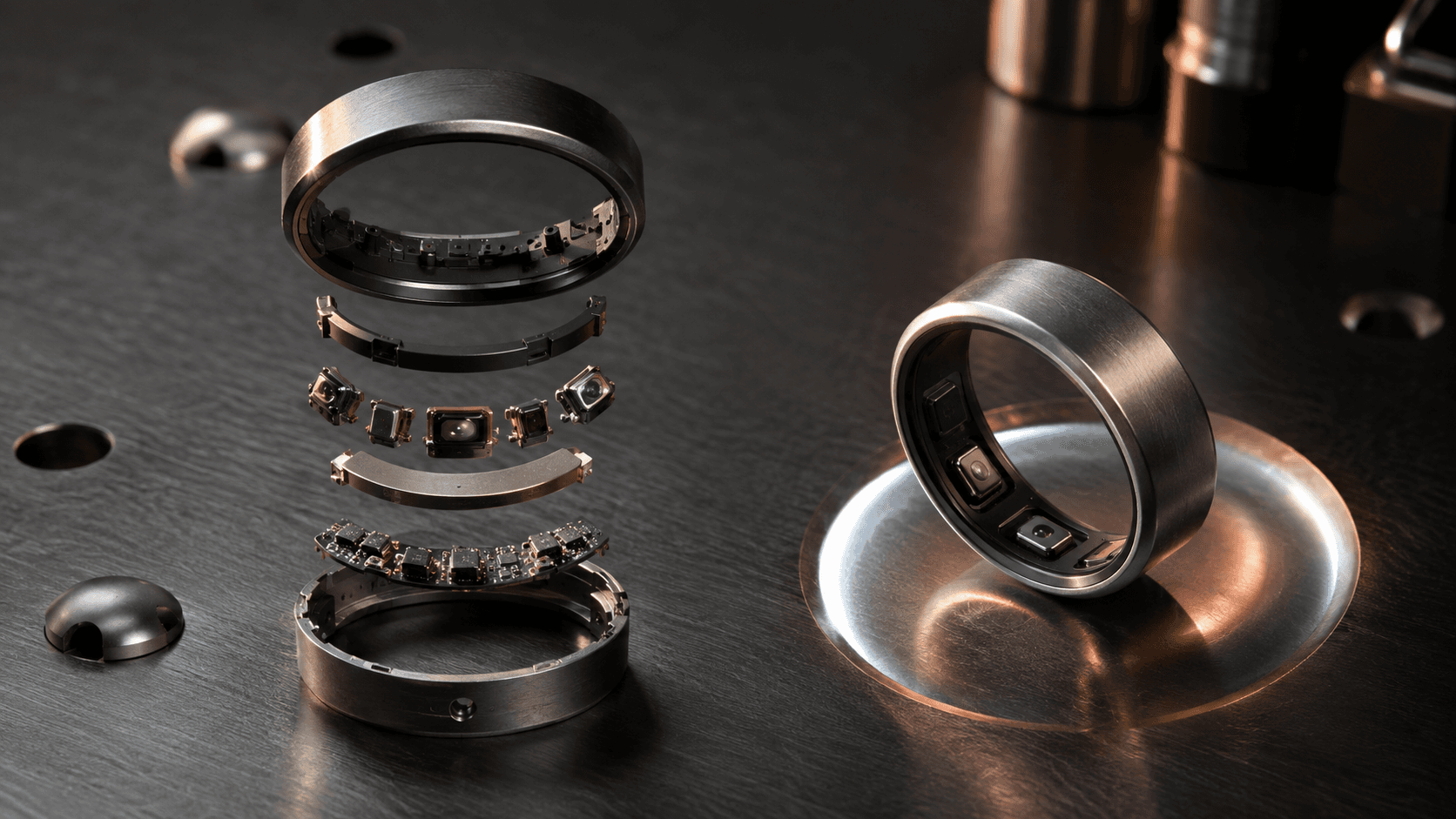
Oura is asking the public markets to look at a ring and see a health platform. The filing says that ambition is real. It also says the physical object still pays most of the bills. For the nine months ended June 30, 2026, hardware generated 80 percent of Oura's revenue. Membership contributed 20 percent. Anyone trying to force this company into a clean hardware or software box is going to misunderstand both the opportunity and the risk.
On September 3, Oura Health Oy filed a public Form S-1 with the Securities and Exchange Commission and applied to list on Nasdaq under the symbol OURA. Reuters independently confirmed the filing and the headline financial results. This is not a completed initial public offering. The document leaves the number of shares, price range, and gross proceeds blank, and some of the eventual shares are expected to come from existing holders rather than the company. The next filing amendments still matter.
The growth is not subtle. Oura reported $1.2145 billion in revenue during the nine-month period, up 74 percent from $697.6 million a year earlier. Hardware revenue rose 65 percent to $974.0 million. Membership revenue rose 121 percent to $240.5 million. The mix moved four percentage points toward membership, from 16 percent to 20 percent. That is the business in one frame: the ring remains the engine, but the recurring layer is gaining speed faster than the machine that feeds it.
Oura says it sold 3.1 million rings during those nine months and 3.6 million over the trailing year. Paid members reached 5 million at June 30, double the 2.5 million reported for the comparable date. More than 94 percent of historical ring activations converted to paid membership after the included 30-day period, according to the company. That metric is powerful because the hardware purchase is doing two jobs at once. It creates revenue at checkout and places a subscription proposition directly on the customer's body.
This is not the standard software funnel. Oura cannot acquire most customers with a download, a free account, and an email sequence. It first has to design, manufacture, ship, fit, and support a miniature sensor system. The device is the acquisition surface. The app and membership are the retention surface. The strategic bet is that the upfront industrial complexity creates a relationship that simpler health apps cannot easily reproduce.
The membership economics explain why management wants investors to look past the current revenue split. Oura reported an 89 percent gross margin for membership. Overall gross margin was 55 percent, up from 51 percent. The company attributes the total improvement partly to lower warranty rates and lower unit manufacturing costs. Software-like margin is clearly present inside the model, but it is attached to a physical product with batteries, sensors, titanium, logistics, returns, sizing, and warranties. The attractive layer does not exist independently of the expensive one.
Retention looks strong, but the definition deserves daylight. Oura reported weighted-average 12-month retention of 85 percent at June 30, 2026. The comparable prior-period figure was 87 percent, so this is not an improvement story. The company's calculation also counts a member who cancels and returns within 12 months as retained. That does not make the metric useless. It means analysts should not confuse it with a simple never-canceled cohort rate.
Pricing is modest enough to feel like an extension of the product rather than a second purchase decision. In the United States, Oura lists membership at $5.99 per month or $69.99 per year after the included trial period. The company says 63 percent of new members began on annual plans during the nine months. Annual selection reduces monthly cancellation opportunities and brings cash in earlier, but the filing does not disclose a clean customer acquisition cost, lifetime value, or standalone operating profit for membership. Anybody presenting those economics as settled is filling blanks the filing leaves open.
Profitability is real and recent. Oura reported net income of $60.8 million for the nine months, compared with $1.6 million a year earlier, producing a net margin of about 5 percent. It also reported adjusted EBITDA of $106.7 million at a 9 percent margin, a company-defined non-GAAP measure. But fiscal 2025 net income was roughly break-even at $10,000, and fiscal 2024 net income was $3.6 million. One strong period proves that profit can appear. It does not yet prove that the margin is durable through a public-company cycle.
The spending required to sustain growth is visible. Sales and marketing expense rose 84 percent to $257.9 million and increased slightly as a share of revenue, from 20 percent to 21 percent. Oura says about 40 percent of new members arrive organically, which would be an important advantage if it persists. Still, company-wide marketing expense is growing faster than hardware revenue. The market should watch whether brand strength eventually lowers acquisition pressure or whether category competition forces Oura to keep buying attention at scale.
Distribution is becoming both leverage and dependency. Oura says 49 percent of hardware revenue came through retail during the nine months, with a footprint of about 8,400 doors and partners including Amazon, Best Buy, and Target. Retail can remove friction from a product whose size and physical feel matter. It can also concentrate negotiating power in a small number of channels and place the ring beside alternatives at the exact moment of purchase. The filing explicitly identifies retailer concentration as a risk.
International expansion remains more potential than proof. Less than 20 percent of hardware revenue came from outside the United States during the reported period. That leaves geographic room to grow, but every new market adds language, tax, privacy, health-claim, customer-service, and distribution requirements. A wearable that touches biometric data cannot treat global expansion like shipping another consumer accessory. The commercial system has to travel with the product.
Manufacturing is the second major dependency. Oura says it does not manufacture internally and relies on a limited number of contract manufacturers and suppliers, including some single-source or limited-source relationships. Its component stack includes semiconductors, optical sensors, batteries, flexible circuit boards, and titanium. Manufacturing and supply are concentrated in Northern Europe and Asia. At June 30, the company had $119.7 million in non-cancelable purchase commitments, mostly due within 12 months. That is what growth looks like before a customer clicks buy: capital gets committed against a demand forecast that can still be wrong.
The hardware concentration cuts both ways. Substantially all of Oura's revenue comes from the ring and associated membership. Focus helped the company create a recognizable category and refine one interaction model. It also means a quality issue, supply disruption, adverse patent decision, or shift in consumer preference can hit nearly the entire business at once. A platform narrative does not erase single-product exposure just because the product produces a lot of data.
Competition will attack from several directions. Oura names Apple, Google and Fitbit, Samsung, Coros, Garmin, Whoop, and software wellness companies. The dangerous competitor is not necessarily the device with the closest shape. An ecosystem owner can distribute health features through a phone, watch, operating system, or clinical partnership that already has the customer's identity and attention. Other hardware companies can also pressure Oura's membership proposition by offering useful features without a recurring fee. Subscription margin is attractive, which is exactly why rivals will try to commoditize it.
Oura's strongest defense may be the longitudinal relationship rather than the ring itself. A wearable earns value by collecting comparable signals across sleep, activity, recovery, temperature, and other measurements over time. That history can make the product more useful and make switching feel costly even when the raw device can be replaced. This is an analytical inference, not a disclosed switching-cost metric. The same history also raises the stakes for accuracy, privacy, security, portability, and user trust.
The company wants to move beyond general wellness and deeper into preventive and clinical health. That is where the addressable problem gets larger and the evidence burden gets heavier. The filing explains that medical-device functions can require FDA clearance, de novo classification, or premarket approval depending on the claim and risk. It notes that the Fertile Window feature is regulated as a medical device in some jurisdictions. A useful wellness insight and a clinically actionable claim are not the same product, even when they appear in the same app.
Health data creates a similar distinction. Oura discusses obligations under privacy, biometric-data, consumer-protection, security, GDPR, and breach-notification regimes. It can also face HIPAA duties when acting in a covered role such as a business associate. That does not mean every piece of direct-to-consumer ring data is universally protected by HIPAA. The broader point is harsher: the more the company becomes a health platform, the less a data failure looks like an ordinary consumer-electronics mistake.
Intellectual property is another live operating risk. Oura reports 1,140 patents and patent applications, plus 299 design patents and applications. It also discloses active disputes, including a Samsung complaint at the International Trade Commission seeking import restrictions and a case from Omni MedSci seeking about $120 million. Oura says the claims lack merit. Those are allegations, not findings, but import remedies and product-level patent fights matter more when one device family carries almost the whole company.
The cleanest way to read the filing is as a flywheel with friction. The ring acquires a paid member. The membership raises lifetime revenue and margin. Better software and a longer data history can improve retention. Retention supports more investment in the next ring and broader health services. Then manufacturing, channel fees, marketing, competition, regulation, and trust take their cut at every rotation. The business becomes exceptional only if the flywheel compounds faster than the friction.
Investors should resist two lazy stories. The first is that Oura is just a jewelry-shaped gadget company, because 5 million paid members and an 89 percent membership gross margin make that description incomplete. The second is that Oura is already a software platform with hardware attached, because hardware still produces four dollars out of every five. The accurate model is a vertically coordinated health business whose subscription advantage depends on executing a difficult physical system.
The IPO process now has to turn that model into public evidence. The most useful next numbers will not be another giant total for rings sold. They will be cohort retention under a consistent definition, acquisition efficiency as retail expands, warranty and manufacturing stability, membership contribution after shared costs, international economics, and regulatory progress on higher-value health functions. Oura has filed the argument, not finished it. The ring got the company to the market. The quality of the system around the ring will decide what the market believes it is worth.
LaunchPad positionOura is not yet a software company that happens to sell a ring. It is a hardware-led acquisition engine attached to a faster-growing, higher-margin membership layer. The public-market case depends on proving that the combination compounds without letting manufacturing, channels, competition, or medical regulation eat the advantage.
This report draws on the linked primary sources and reputable reporting. Company statements are treated as claims until independently demonstrated.