Building a new section of a structure in orbit is a real threshold. Finishing a useful space asset is another. DARPA's November 5 announcement of automated truss assembly moves the first threshold out of the laboratory, while Caltech's accompanying account makes clear that the reflector remains incomplete. That combination makes the result more useful than a sweeping declaration that orbital factories have arrived. It gives builders a demonstrated operation to work from and leaves the remaining engineering problem visible.
The experiment belongs to DARPA's Novel Orbital and Moon Manufacturing, Materials and Mass-efficient Design program, known as NOM4D. A Caltech payload joined separate components into a truss while operating in space. DARPA describes the event as the first automated assembly of a structure in orbit. That historical claim is the agency's, supported by the participating team's account; the material reviewed here does not independently establish priority across every earlier space experiment. The new reporting is nevertheless materially different from a launch announcement or a proposed demonstration: the team reports construction after reaching orbit.
Caltech says its ASTRA payload deployed two sections assembled before launch and then built a third. It also says completing the entire truss appears unlikely before the mission ends in December. Those details define the achievement: an additional bay was constructed, rather than an entire reflector assembled from scratch. The strongest reading of the result is evidence that the proposed joining process can operate in space. A claim that a finished antenna has entered service would go beyond the reported work.
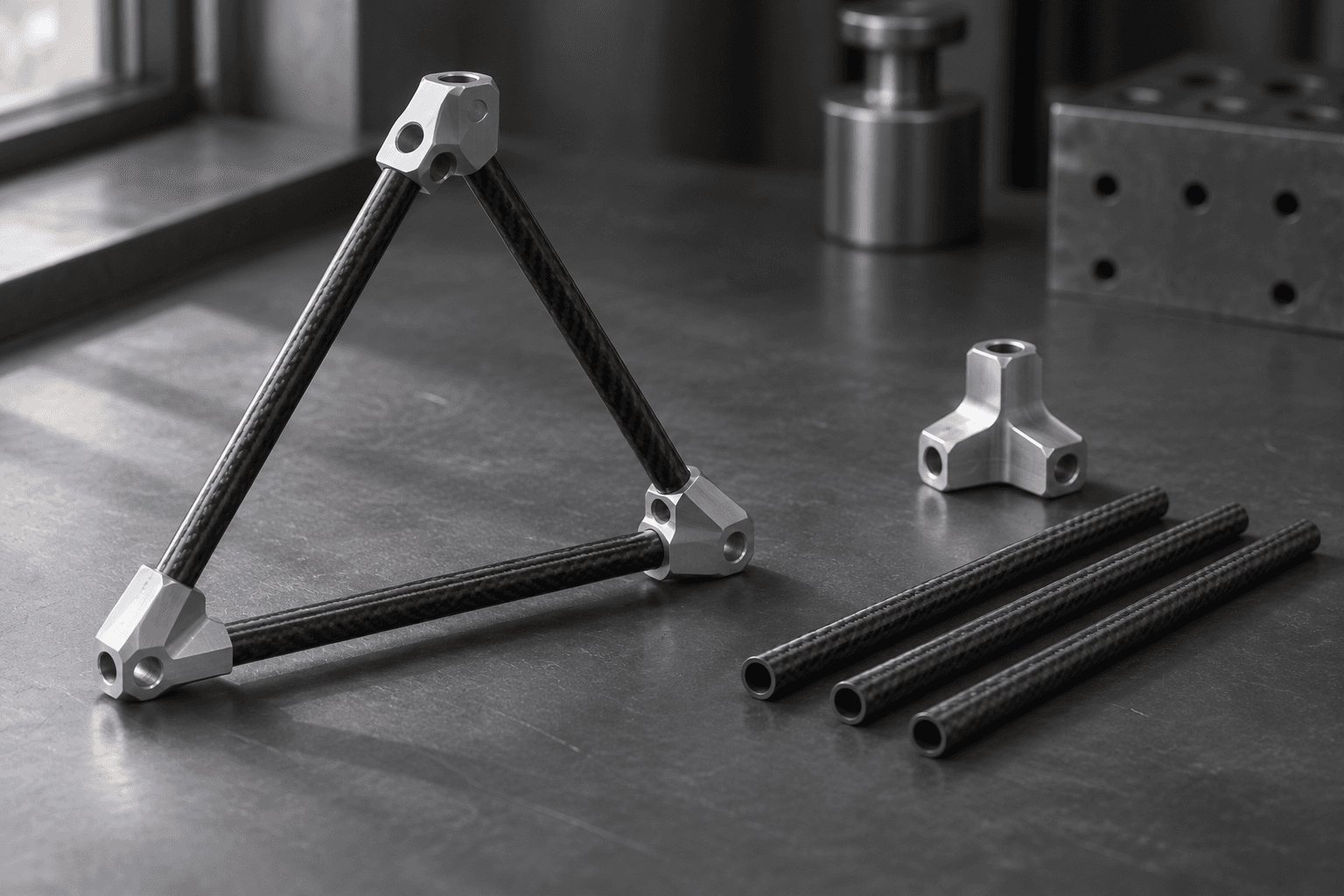
DARPA's description is deliberately mechanical. A gantry moving along three linear axes connects composite truss members through specially designed joints. The system adds reflective material as it constructs and releases successive sections. Instead of requiring a robot to range around an expanding structure, the approach brings parts through a repeatable assembly process. Its promise rests on coordinating component handling, joining and release. Nothing in the announcement requires a general-purpose artificial intelligence capable of inventing construction methods on the fly. Calling the operation automated should not obscure how specifically the machine and its parts were designed for each other.
The mission's original boundary matters. In its February 2025 description, DARPA specified a 1.4-meter circular truss experiment and explicitly excluded the electronics needed for an operational radio-frequency antenna. Reflective material would stand in for the surface of a future aperture. Accordingly, even a completed structural demonstration would not by itself establish communications performance. A prospective customer would still need evidence appropriate to the intended service. Constructing the support, producing the required surface and demonstrating a useful instrument are different acceptance questions; buying one as proof of all three would be an avoidable category error.
The team's earlier technical paper, In-Space Assembly of Large Mesh Reflectors, explains why this is not simply a matter of repeating a successful grip. Its ground experiments found that the geometry of a partly constructed reflector can pull cables tight before the next section has cleared the assembly plate. The result can be jamming, excessive cable tension or a distorted configuration that locks itself in place. Tilting the plate reduces some distortion, but the builder also needs room for its internal mechanisms. The prototype therefore combined geometric choices with supports and springs to manage shape, followed by a separate prestressing operation. These are findings from ground development, not a diagnosis of the flight difficulties. They show why the structure and the construction sequence have to be designed together.
That distinction changes how to assess scaling. A repeated local operation can simplify the builder without making the completed system trivial. An evaluation should ask what happens after a section is joined: whether it releases correctly, whether the emerging structure reaches the intended configuration, and whether the next operation remains possible. Those questions follow from the prototype work, but they are also a useful way to read the current result. Success at a single construction step should lead to a more demanding test sequence, with separate evidence for completion and final performance.
Autonomy also has a narrower meaning here than unattended production. Caltech describes ground-issued commands, checks using downloaded photographs and workarounds tested on a flight spare in its laboratory. It reports about seven or eight daily contact windows of roughly 15 minutes. The researchers therefore had to fit troubleshooting around intermittent access. For the next design, a useful measure would be how much intervention each additional section requires. A machine can execute assembly movements autonomously while still depending heavily on people to recognize problems and decide how operations resume.
The spacecraft services are part of that operating picture. DARPA says the payload launched aboard Transporter-16 at the end of March and was hosted on Momentus's Vigoride platform. Momentus supported launch integration and supplied power, communications, imaging and other services during the demonstration. This division of work gives a construction experiment a way to reach orbit without being treated as a complete independent spacecraft business. It also creates interfaces that must be included in the demonstration's success criteria. An assembly mechanism cannot be evaluated as though its power supply, command path and view of the work area are irrelevant accessories.
For companies considering a similar hosted experiment, the practical questions are contractual and technical at once. Who supplies the imagery needed to confirm a completed operation? Which team diagnoses a stalled sequence? What evidence must be returned before the next action is authorized? These are proposed diligence questions, not terms disclosed for the Caltech flight. Their purpose is to make the boundary between payload and host explicit. A convincing mechanism demonstration should produce an equally clear account of the supporting services needed to reproduce it, rather than leaving those services hidden inside the success story.
The economic proposition begins with launch packaging. NOM4D is investigating structures assembled where they operate, rather than complete structures squeezed into a fairing and later unfolded. DARPA's earlier program description also points to designs so light that they could sag under their own weight on Earth. The intended advantage is freedom to optimize for the operating environment instead of carrying the full design burden of a finished terrestrial structure. That remains an architectural opportunity. The announcement does not establish a delivered cost per square meter, a commercial assembly rate or a measured economic advantage over deployable alternatives.
A credible business case would have to include the builder itself, its stored components, spacecraft support and the work required to recover from interrupted assembly. Otherwise, a mass-efficient final structure could be compared unfairly with a competing system whose full delivery burden has been counted. This is not evidence that the approach loses such a comparison. It identifies the comparison that has yet to be supplied. Builders can treat the orbital result as justification for a better experiment without treating it as a completed procurement case. Customers should ask for the system boundary behind any future savings claim.
DARPA's program decisions explain why a limited orbital result can still be valuable. The agency says it redirected the final phase from further laboratory work toward flight demonstrations after promising earlier progress. Its November account gives 15 months from the idea for an orbital demonstration to launch of a working prototype. That is a specific development interval, not the age of the entire program or a forecast for future projects. The decision exposed the concept to conditions that a laboratory could not settle completely. An incomplete construction sequence can inform redesign if the test reveals which operations need simplification or stronger recovery provisions.
NOM4D also separates assembly from making structural material in space. Its University of Illinois Urbana-Champaign project addresses composite processing, with an International Space Station experiment still described as forthcoming in DARPA's November announcement. The earlier program account explains a self-propagating polymerization reaction intended to harden a carbon-fiber structure without heating the entire object in a large autoclave. That would address a different part of the construction chain. Joining prepared members does not demonstrate that such members can be manufactured reliably in orbit, and a successful material-processing experiment would not automatically demonstrate a complete assembly system.
The program's name should not encourage a further jump to lunar construction. DARPA's February account explicitly says the final phase focuses on materials from Earth and does not pursue Moon-based technologies. The same account describes a future ambition for radio-frequency apertures of 100 meters or more, including applications in observing the region between Earth and the Moon. The November statement discusses even larger potential structures. These are motivations for the research. They are not the dimensions achieved by this demonstration, announced customer orders or evidence that a particular operational system has been funded.
The evidence available for this result is principally the sponsor's announcement, the performer's account and its earlier technical paper. Searches also surfaced institutional republication and announcement summaries, but no independent inspection of the flight telemetry. The appropriate conclusion therefore stays close to the reported operation and its disclosed limits. The next consequential result would show a longer construction sequence, a completed structure and the support needed to reach that state. For builders, that is a concrete development agenda. Orbital assembly has gained a reported flight result; turning it into dependable production remains work that can now be tested more precisely.
LaunchPad positionEvaluate assembly, completed geometry and useful payload performance separately. A reported flight milestone does not yet establish production economics.
This report draws on the linked primary sources and reputable reporting. Company statements are treated as claims until independently demonstrated.