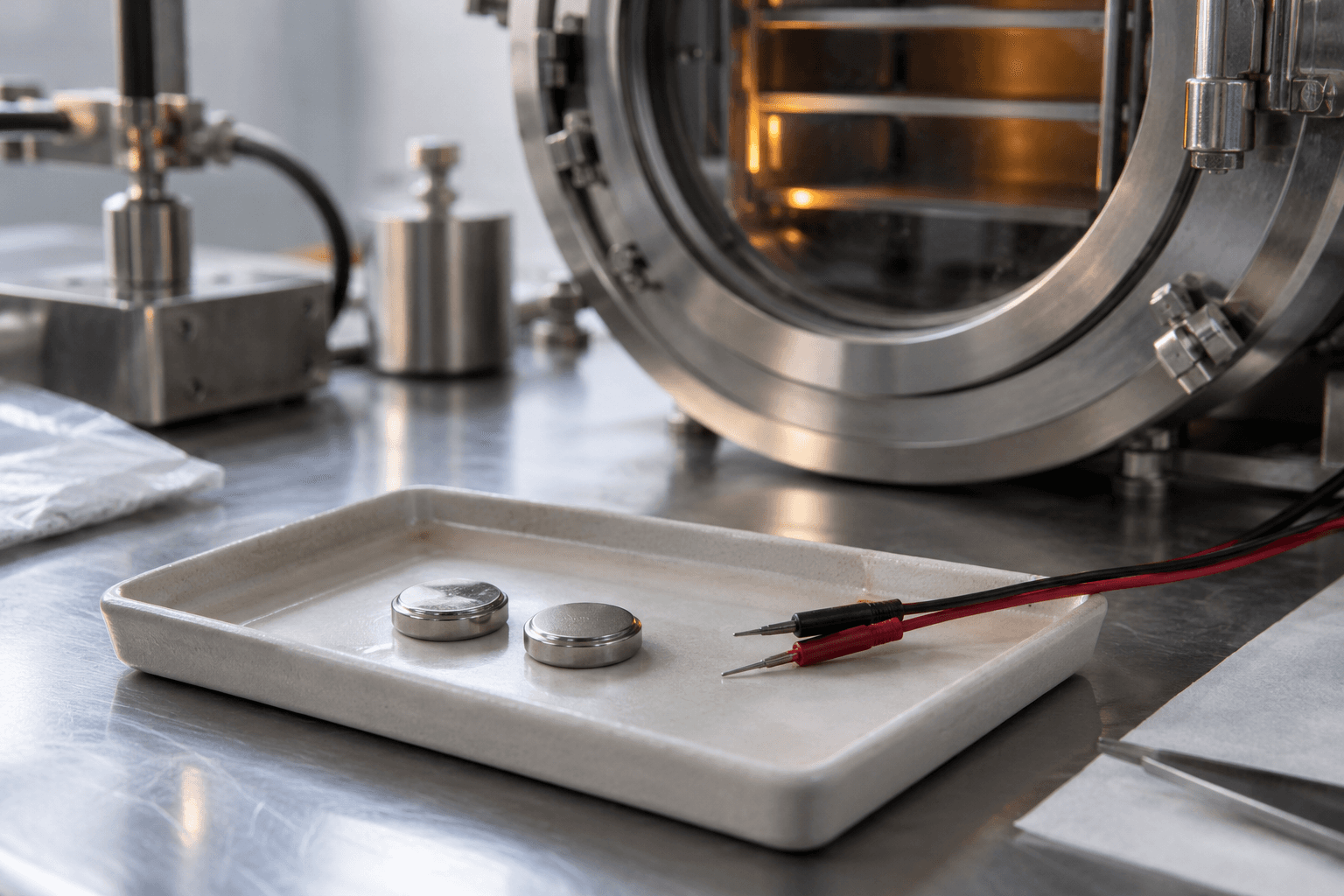
NASA's newest lunar battery result contains two very different cold records. Small prototype cells reportedly worked at minus 80 Celsius, with reduced performance. They also survived exposure to minus 170 Celsius, but could not operate there. The distance between those statements is where a spacecraft designer has to work. A battery that can be left cold and revived may change a mission's heating requirements. It does not give a rover permission to drive through the coldest part of its environment without a thermal plan.
In its October 14 announcement, NASA describes recent thermal-vacuum tests of coin-cell prototypes for SPEARS, short for Solid Power for Extreme Environment Adaptability and Resilience in Space. The project is led at Glenn Research Center, with testing at Langley. NASA reports good operation from 80 Celsius down to minus 60 Celsius, followed by slightly reduced performance at minus 80. Separately, it reports no damage after exposure to extremes of 100 Celsius and minus 170 Celsius. These are agency-reported laboratory results, not a published qualification of a complete lunar power system.
The distinction matters because the most interesting proposed benefit is intermittent heating. NASA says small heaters could bring the cells back into their operating range after deep cold, instead of keeping them warm continuously. That could reduce thermal-management weight and support lower costs or longer missions. None of those system-level savings is quantified in the announcement. The result makes a different operating strategy worth investigating; it does not establish how much mass a specific spacecraft can remove or how much extra science it can perform.
The public evidence also has a firm boundary. NASA's article does not provide the number of tested cells, discharge profiles, capacity curves, repeated-cycle results or a numerical definition of the reduced performance at minus 80. It does not give heater energy, warmup time or a complete pack's mass. Those omissions do not mean the team has no such measurements. They mean an outside reader cannot calculate mission performance from the announcement. No independent validation of this new SPEARS result was located for this report. The analysis here is bounded by NASA's account and two earlier NASA technical presentations.
SPEARS replaces a liquid electrolyte with a solid ceramic- or polymer-based material. In NASA's explanation, that removes the liquid's freezing behavior from the problem and allows cells to endure very cold storage before warming. But solid-state describes an important part of the battery, not a complete specification. Langley's testing lead, Yi Lin, says electrode choices can tune energy, power and durability for different applications. The article names tools, rovers, astronaut emergency packs and long-duration instruments as potential uses. It does not announce that any of them has received a flight-ready SPEARS battery.
A useful counterargument comes from NASA itself. In a 2022 presentation on power hibernation, Glenn researcher Richard Oeftering reported that tested 18650 lithium-ion cells could tolerate multiple freeze-and-thaw cycles. Their voltage fell to zero while frozen, then recovered when returned to operating temperatures, including recovery of their state of charge. Cells tested in a vacuum also recovered. That historical result prevents a simplistic reading of the new announcement: a liquid-electrolyte battery is not automatically destroyed whenever it freezes, and cold survival is not exclusively a solid-state capability.
That is not a head-to-head defeat for SPEARS either. The older presentation was examining a particular hibernation approach, not comparing the new prototypes under identical conditions. It explicitly asked how many freeze-and-thaw cycles cells could tolerate and what degradation mechanisms might emerge. Its results do not certify every conventional cell for lunar service. They establish a more demanding comparison: the relevant alternative may be a carefully managed conventional battery that sleeps through extreme cold, rather than one assumed to require continuous heating under every circumstance.
Oeftering's proposed architecture shows why a surviving cell is only the beginning. A solar-powered spacecraft would disconnect its battery from the main electrical bus and shut down until dawn. Illumination of its solar arrays would then trigger a restart sequence. The initial power source would be the arrays, not the still-frozen battery. This is a specific design concept for recovering after darkness, not a claim that SPEARS uses the same arrangement. It exposes a question any cold-storage strategy must answer: what powers the equipment that makes the battery usable again?
The presentation divides electronics into two groups. Most systems need to tolerate the cold and work after warming. Key power circuits need to start and operate while still cold. That second group must control the incoming solar power, prevent excessive voltage and keep other avionics inhibited until conditions are suitable. It must also support preheating the battery and avionics. A cell's ability to recover cannot substitute for those functions. If the power-management hardware cannot begin the sequence, stored battery energy is not yet available to rescue it.
Battery reconnection has its own work to do. In the proposed dawn sequence, a battery-management system operates independently of battery power, monitors temperatures and voltages, performs precharging, detects faults and isolates faulty strings. Precharging brings the battery toward the bus voltage before reconnection. These are useful requirements to examine alongside any claim about surviving a temperature extreme. The spacecraft needs to know which parts are ready to be connected, not merely that a test cell eventually produced voltage again. An orderly restart is a controlled electrical transition, not just a warming event.
The older presentation also locates risk outside electrochemistry. Electronics packaging must manage stresses associated with different thermal expansion behavior, while semiconductor properties change with temperature. It identifies circuit-board tolerance, device characterization and temperature compensation as development needs. These were questions in a 2022 research program, not a current inventory of unresolved SPEARS defects. Their relevance is architectural: improving the cell does not automatically improve every board, connection and control circuit surrounding it. A reduced battery-heating requirement still has to fit the rest of the spacecraft's temperature limits.
Another earlier NASA presentation, on SABERS solid-state batteries for deep-space applications, supplies a helpful scorecard. It treats safety, energy density, discharge rate, packaging weight and scalability as requirements to satisfy together. A battery can look impressive on one measure without meeting a mission's combined needs. Energy is the amount available for work; discharge rate concerns how quickly it can be delivered. NASA's list of possible SPEARS applications therefore should not be read as evidence that one tested cell configuration already satisfies all of their different load requirements.
The SABERS material makes the packaging question concrete. Its proposed solid-state bipolar stack uses a shared current collector and seeks to reduce containment and cooling overhead. That is a reason to investigate the complete assembly, not only the active material. Weight saved in packaging can affect usable energy per unit of system mass; added protection or control equipment can move the result in the other direction. The SPEARS announcement does not disclose a comparable pack-level accounting. Nor does it establish that its cells use the particular stack architecture described in the earlier presentation.
At the material level, the same SABERS presentation describes a composite cathode with three jobs distributed among its constituents: active material participates in storing and releasing energy, a solid electrolyte provides paths for lithium ions, and a conductive material provides paths for electrons. Composition and contact between those constituents matter. Increasing the active-material share alone does not answer whether ions and electrons can reach the places they need to reach. NASA's modeling work examines those transport networks alongside geometry and material properties. This is background on solid-state design constraints, not a disclosed recipe for the new SPEARS cells.
Measurement boundaries deserve equal care. One prominent energy figure in that earlier presentation is expressed per kilogram of cathode and comes from a test using liquid electrolyte. It is not a measured specific energy for a complete solid-state flight battery. Importing it into the SPEARS story would combine different hardware, different measurements and different stages of development. The practical lesson is to ask what has been weighed and what has actually been tested. A cathode result, a coin-cell result and an assembled battery result can each be useful without being interchangeable.
For a builder evaluating the new work, the next useful evidence would follow an entire operating sequence. How long can the assembly remain cold? What energy source starts recovery? How much energy and time does warming consume? What load can the recovered battery deliver, and how does that change after repeated cycles? How are weak cells detected and isolated? These are evaluation questions derived from NASA's own system-level work, not claims that a particular failure has occurred. Answers would let designers compare cold storage with continuous heating on the same mission basis.
The mission choice is equally consequential. A solar-powered instrument allowed to sleep through darkness can consider a dawn-recovery architecture. Equipment required to operate while still in deep cold cannot count a survival result as active capability. An emergency power pack raises a different question again: how quickly can its stored energy become useful when needed? NASA's announcement offers no universal recovery time. The proposed advantage should therefore be evaluated against the allowed inactive period, available recovery power and required load, rather than against the lowest temperature in the headline.
NASA says SPEARS began in 2026 and is initially focused on technology development, with commercial collaboration a possible later step. Ames is developing test boards and electronics to prepare the batteries for spaceflight testing. That places the announcement at a meaningful but early point: laboratory cells have reportedly demonstrated operation across a large temperature range and deep-cold survival, while flight preparation continues. The strongest next demonstration would connect those cell results to a repeatable warmup, restart and useful-load cycle in an integrated assembly. That is the evidence needed to turn a temperature record into a defensible spacecraft design decision.
LaunchPad positionCompare the complete cold-storage, warmup and useful-load cycle. A survival temperature is not an operating specification.
This report draws on the linked primary sources and reputable reporting. Company statements are treated as claims until independently demonstrated.