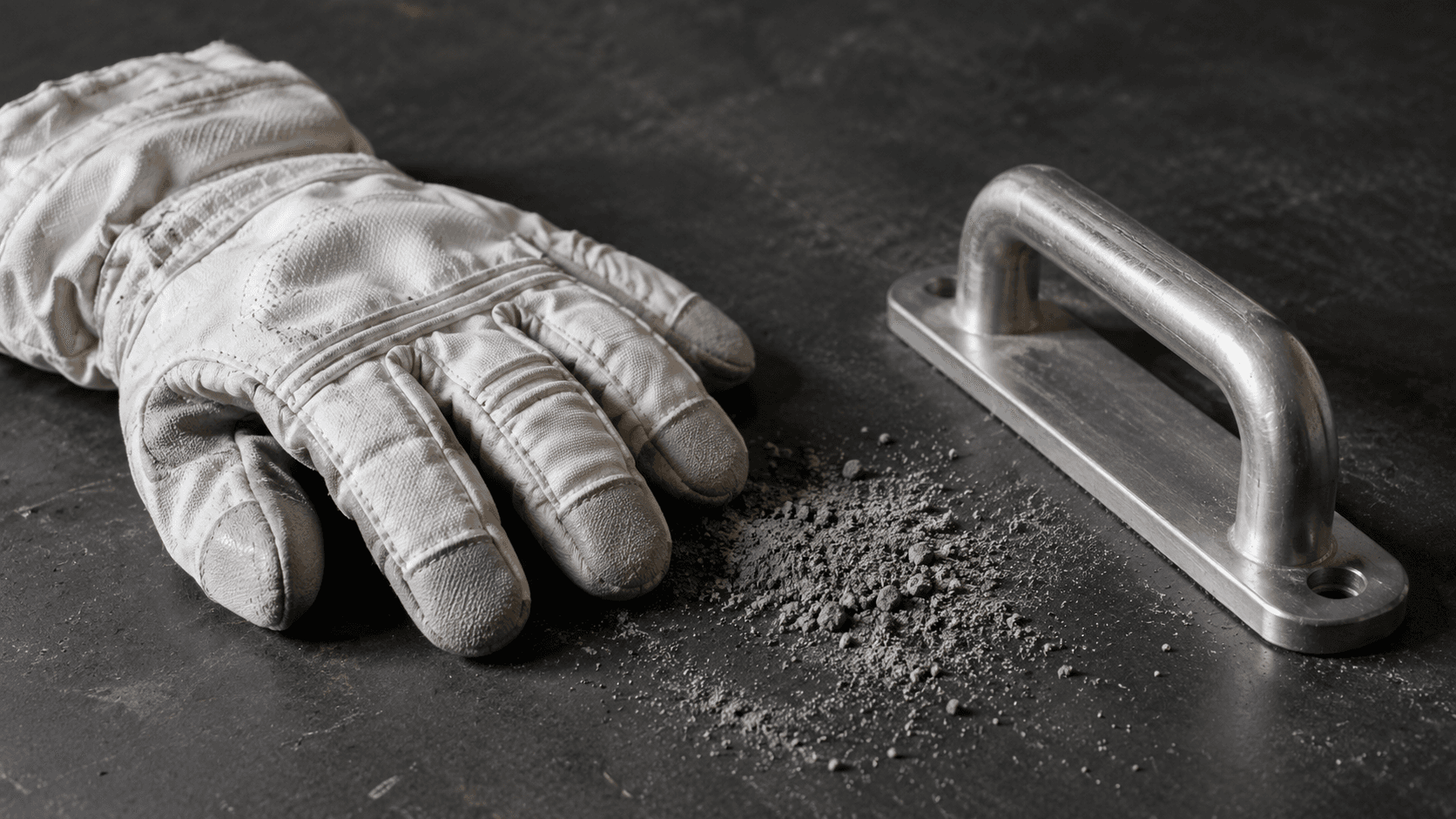
An astronaut returning to a lunar lander may need to settle an electrical difference before reaching for the handhold. NASA's new Lunar Grounding Challenge puts that contact problem in front of outside designers: how to bring a negatively charged spacesuit toward the lander's electrical potential without a dangerous discharge. Walking can build charge through contact with regolith, while the surrounding plasma can contribute additional charging. The agency identifies the transition from shadow into contact with a more positively charged vehicle as a concern for the suit, its electronics and its occupant.
The competition opened October 5, according to NASA's October 6 announcement, and accepts submissions until January 15, 2027. Up to $150,000 in prizes is available. The news is a call for concepts, not a completed grounding system or evidence of an astronaut accident. Reporting on this new competition rests on NASA's announcement and its linked technical brief; independent performance evidence for a proposed solution is not yet available. Earlier experiments help explain the engineering problem, but none should be mistaken for a winning design.
The brief asks designers to address a suit at roughly minus 100 kilovolts against a lander at about plus 100 volts. It assumes 200 picofarads of suit capacitance and available bonding points. Current at the suit interface must not exceed 1.0 milliampere, with a target of 0.2 milliamperes. Other requirements include a system below 20 kilograms, operation across four excursions over ten days, a worst-case discharge time of 30 seconds and no more than 40 watts drawn from the lander. These are prescribed design conditions, not a claim that every returning astronaut will reach the specified voltage.
Phase one does not require fabrication or physical prototype testing. Up to five finalists can proceed to refine their concepts with review feedback. That structure makes the competition accessible before teams have flight hardware, but also defines what selection could establish: a promising proposal can advance without having demonstrated its behavior in a lunar environment. A prize decision and a crew-system safety case would remain different achievements.
The physical complication starts with the word grounding. The Moon is not an enormous convenient version of an Earth laboratory's conductive reference. A 2022 NASA and University of Central Florida paper describes a balance involving incoming electrons and ions, sunlight-driven photoelectron emission, and secondary electrons. Change those currents and the equilibrium potential changes. Contact and separation between materials add another charging mechanism. A surface in sunlight and one in shadow therefore need not share the same electrical condition, even when they belong to the same exploration site. This is why a useful model must describe the environment around an object as well as the object itself. The paper provides mechanisms, not a measured probability that a particular astronaut will experience a particular discharge. Treating its discussion as a universal voltage prediction would erase the dependence that makes the problem worth studying.
NASA's south-pole environmental account gives the contact operation a physical setting. The Sun stays low, terrain produces elongated shadows, and nearby surfaces can have very different illumination and temperatures. Impact processing creates abrasive particles without Earth's wind and water smoothing their edges. Those conditions make a clean laboratory contact an incomplete representation of the job. In practical design terms, a proposed interface deserves evaluation as something a suited person must find and use amid dust and uneven lighting, not merely as two terminals on a circuit drawing. That is an engineering implication, not a reported usability result. A design could have an attractive electrical explanation while leaving the approach, alignment or completion signal unresolved. Conversely, an easy-to-grasp fixture would not by itself establish that the intended charge-transfer path is the one actually used.
The headline voltage also needs electrical context. OpenStax's capacitor treatment relates stored energy to half the capacitance multiplied by voltage squared. Applying that elementary model to the brief's capacitance and a round 100-kilovolt difference gives approximately one joule of stored energy and 20 microcoulombs of charge. This is an illustrative calculation, not a measurement of a suit or a safety determination. It sets aside the small lander offset, changing geometry and continued environmental charging. Its value is conceptual: voltage, stored energy and current describe different properties. Knowing one does not specify the others. A team still has to explain how charge moves, where energy goes and what happens during initial contact. An energy estimate alone cannot certify a discharge as safe, and a voltage number alone does not describe the complete event.
There is useful caution in NASA's earlier testing. Charles Buhler's August 2022 electrostatics workshop reports high-vacuum tests of suit materials associated with Hubble Mission IV in which approaching with a grounded probe did not produce brush discharges under the tested conditions. That is evidence against casually importing a familiar terrestrial spark picture into every space environment. It is not proof that all lunar contact arrangements are safe. The same workshop separates a material's ability to dissipate charge, its ability to retain enough charge for a discharge, and whether a process can generate that charge. Those are distinct questions. It also discusses adhesion mechanisms beyond electrostatic attraction. Neutralizing electrical charge should therefore not be advertised as a guarantee that all dust will fall away. The test environment and the claimed outcome need to stay attached to each other.
NASA has also pursued experiments that isolate how charging develops. Its February 2024 account of the Electrostatic Regolith Interaction Experiment describes a December 2023 New Shepard flight with three minutes of microgravity. Simulated dust was brushed against eight insulating materials, with an electrometer measuring charge and cameras observing behavior. NASA said the data were under review when that account appeared. That work matters here because material contact and gravity are experimental variables, not details to hide behind a generic dust label. It does not supply a completed astronaut-neutralization demonstration, and the earlier article does not establish what later analysis found. For a challenger, the useful lesson is to expose the assumptions behind a material comparison. A result obtained with a particular simulant and contact procedure should not silently become a result for every surface a suit might encounter.
A different line of research changes the surface itself. In November 2019, NASA described work on ultrathin indium tin oxide coatings applied to paint pigments through atomic layer deposition. The intended benefit was to let charge dissipate rather than accumulate on protected surfaces. The account discussed samples exposed on the International Space Station, with analysis still pending then, and possible applications to spacesuit fibers. Those were research directions, not a declaration that a coated lunar suit had been qualified. They illustrate an important choice of scale. Changing how a material retains charge is different from controlling an encounter between an entire suit and a vehicle. A coating could be relevant to a broader mitigation strategy without replacing the return-to-lander operation. The sensible comparison is what each intervention changes, not whether both can be described with the same dust-control label.
Some lunar dust technology has moved beyond terrestrial tests. NASA reported in March 2025 that its Electrodynamic Dust Shield removed regolith from glass and thermal-radiator surfaces during Firefly Aerospace's Blue Ghost Mission 1. The mission ended March 16. The shield uses electrodynamic forces to lift and move particles, and NASA's account presents before-and-after surface images. This is a materially different evidentiary category from a newly opened design competition: a reported demonstration on the Moon. It also addresses a different task. Clearing particles from selected surfaces does not establish that a charged astronaut can safely approach and connect to a lander. Both achievements may be useful to exploration, but neither should borrow the other's validation. The existence of a successful dust-removal experiment is a reason to demand precise descriptions of results, not to collapse every electrostatic problem into one solved category.
Independent coverage supplies some historical corroboration without closing that gap. The Associated Press reported in March 2025 that Blue Ghost's dust shield had shaken off abrasive particles during its lunar work. That supports the background distinction between an operating experiment and a proposed concept. It is not independent verification of the new grounding challenge's assumptions or any future submission.
For builders considering an entry, the most productive response would be an argument that another engineer can try to break. Identify the boundaries of the model. Explain which parts of the proposed behavior follow from established physics and which depend on an untested interface. Describe what a failed or incomplete operation would look like to its user. Separate the evidence needed to show electrical performance from evidence needed to show that the operation is usable. These are proposed review questions, not additional NASA rules. They would make competing concepts easier to compare without rewarding the proposal that draws the most convincing rendering or chooses the most favorable laboratory condition.
The counterargument to spending effort on such a specialized interface is that broader material treatments or environmental charge dissipation might reduce the problem before a dedicated device becomes necessary. The existing research makes those possibilities worth examining. It does not establish their sufficiency across the challenge's conditions. A strong proposal could show why less hardware is justified, provided it demonstrates the relevant assumptions rather than simply deleting the difficult case. Equally, adding a separate mechanism should earn its place by resolving a defined failure mode. Complexity is not evidence of safety. The useful competition is between explanations that survive scrutiny, including explanations for why a seemingly simple solution does not cover the whole operation.
What happens immediately before contact is the question to keep in view. Dust chemistry, surface coatings, ambient plasma and human operation all meet there, but each requires its own evidence. NASA has now specified a problem and invited designs; it has not announced that the problem is solved. The next meaningful result will be a proposal whose limitations are explicit enough to guide a credible test. For an exploration system, a handhold should be ordinary. Making that possible under unfamiliar electrical conditions is the engineering work.
LaunchPad positionSeparate material charging, particle removal and controlled suit-to-vehicle contact when judging lunar electrostatic concepts.
This report draws on the linked primary sources and reputable reporting. Company statements are treated as claims until independently demonstrated.