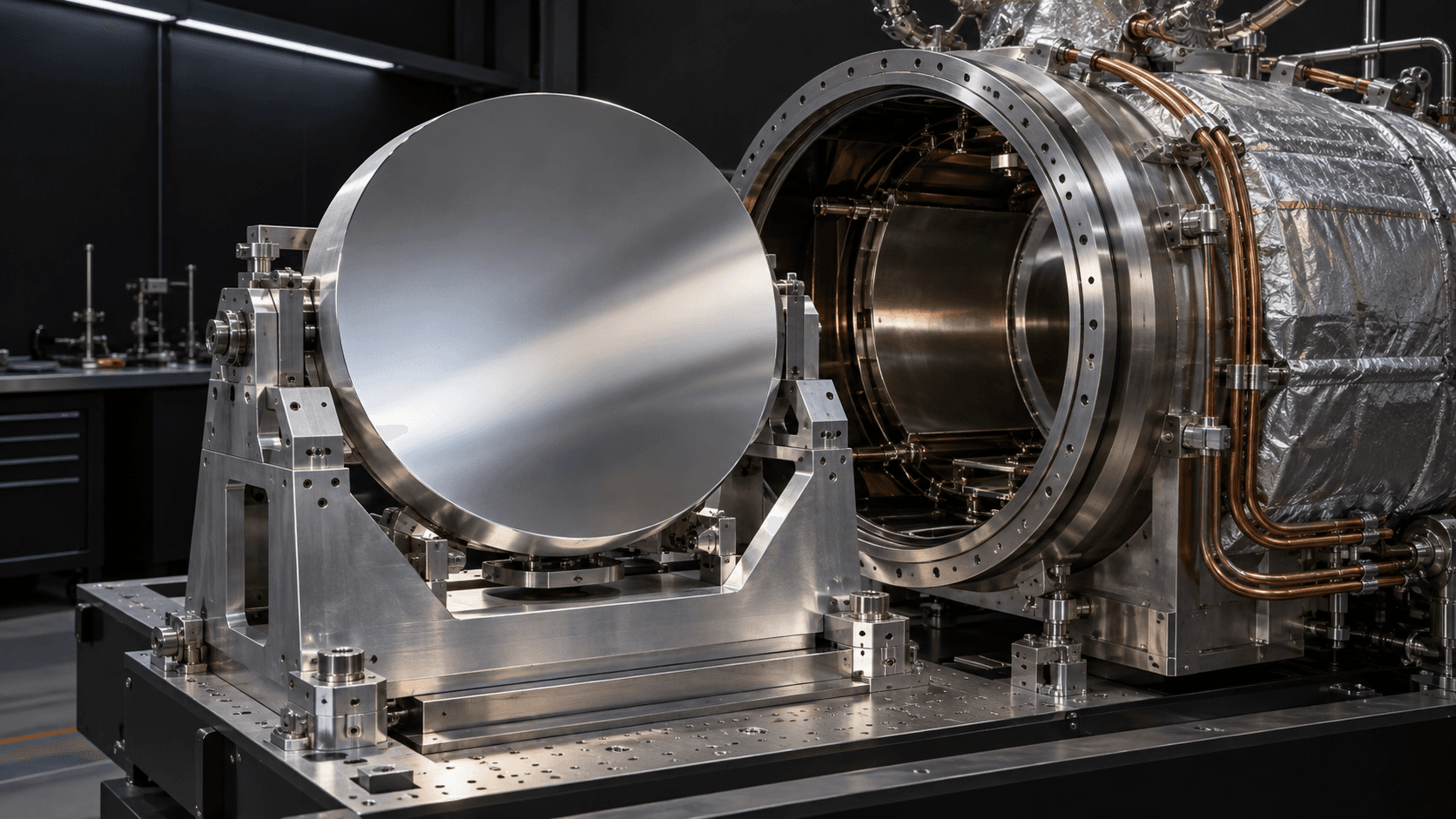
The universe does not care how impressive our telescope looks in a launch photograph. If the instrument cannot measure the wavelengths that carry the answer, the answer stays missing. NASA's selection of PRIMA is interesting for exactly that reason: it is an attempt to recover information, not simply to build another monument with a mirror.
On September 23, NASA selected the PRobe far-Infrared Mission for Astrophysics for Phase B, covering preliminary design and technology development. The agency targets a 2033 launch and a five-year mission. This is not confirmation for implementation. A later review must assess the technical, programmatic and cost case before Phase C. If confirmed, the project has a $1.2 billion cap, excluding launch and other nonproject costs.
The mission team's concept uses an actively cooled, 1.8-meter telescope to observe far-infrared light. That complements the wavelengths accessible to Webb and radio observatories. The scientific proposition is not that those instruments failed. Different measurements expose different parts of the same system. PRIMA would extend the available evidence rather than replace the telescopes already doing valuable work.
That is a useful correction to the way space technology gets marketed. A new observatory does not need to win every specification contest to matter. The stronger question is whether it can make a consequential measurement that existing instruments cannot supply adequately. For PRIMA, the team is organizing the mission around cold material, obscured activity and the ingredients from which planets emerge.
NASA established this Probe Explorer competition to occupy the space between smaller missions and flagship observatories. In October 2024, it selected PRIMA and the AXIS X-ray concept for studies, awarding each team $5 million for a twelve-month effort. The ambition was to buy substantial scientific capability without making every important question wait for a flagship-scale program.
The history is less tidy than a simple telescope beauty contest. Space.com reported in March that AXIS had been ruled ineligible. Principal investigator Christopher Reynolds attributed the outcome to programmatic disruption. NASA told the publication that the concept did not comply with the competition's requirements and that the decision followed its established process. Those are competing accounts of that earlier decision, not evidence that PRIMA has already cleared its own remaining reviews.
That distinction matters when judging the program. Selecting an instrument is not the same thing as demonstrating that it can be delivered. The independent reporting provides context for how this competition narrowed; it does not independently validate today's PRIMA announcement or its performance projections. The selection itself is documented by NASA. The technical case below comes from the mission team's published plans and research.
Start with temperature, because it is central to the proposed hardware. In a March presentation abstract for the American Physical Society, NASA's Matt Bradford described a staged thermal architecture: passive cooling followed by active cooling, with the telescope intended to operate at 4.5 kelvin. Instruments and detector arrays would have still colder stages. This is not a conventional camera placed behind a large lens.
The practical engineering implication is that the optical assembly, cooling system and sensors cannot be judged as unrelated components. The intended sensitivity depends on the combined arrangement. Buying an excellent mirror does not, by itself, produce the observatory described in that plan. Likewise, an attractive detector result does not prove that the integrated telescope will meet its goals throughout a mission.
The instrument team's description assigns different jobs to PRIMA's two instruments. PRIMAger would collect images across multiple wavelength bands and measure polarization. FIRESS, the Far-Infrared Enhanced Survey Spectrometer, would separate incoming light into spectra. The first helps characterize where interesting emission appears; the second provides a more detailed way to interrogate it.
FIRESS uses slit-fed grating modules, with an additional Fourier-transform module for higher spectral resolution. The published architecture also includes beam steering for scanning and chopping, and kinetic inductance detector arrays. Those choices serve observing tasks rather than a spec-sheet aesthetic. Mapping a region and closely examining a selected source place different demands on the same telescope.
The useful comparison is a survey followed by an investigation. One mode establishes what deserves attention across a field. Another spends observing time separating the signal more finely. That pairing is more scientifically meaningful than treating an image as the finished answer. It also makes instrument coordination part of the mission's value, rather than an accessory to the mirror.
Consider planet-forming disks. The team's principal-investigator science plan explains a stubborn accounting problem: images of dust and observations of carbon monoxide do not automatically reveal how much gas a disk contains. Converting those measurements into a gas inventory involves uncertain relationships. If the inventory is uncertain, conclusions about the material available to form planets inherit that uncertainty.
PRIMA's proposed approach includes a hydrogen deuteride line at 112 microns, alongside water and other chemical measurements. The goal is to constrain gas mass and investigate how the composition of planet-forming material changes. That is a much more specific claim than saying a new telescope will explain planetary origins. It identifies a missing measurement and a proposed route to obtaining it.
The same science plan addresses galaxies whose dust complicates observations of star formation and black-hole growth. Imaging would identify targets for spectroscopic follow-up. The question is how those processes develop together, not whether a dramatic-looking galaxy contains something interesting. Selecting targets and measuring relevant tracers are different steps, and the observing strategy needs both.
The FIRESS science-drivers paper adds an important qualification to the disk story. Hydrogen deuteride is a tracer, not a magical gas scale. Turning its emission into a mass estimate depends on isotope assumptions and thermochemical modeling. A more useful measurement can reduce uncertainty without eliminating the interpretation between photons and a physical conclusion.
That paper also describes tradeoffs that should survive into public coverage. Higher spectral resolution can carry a sensitivity penalty, and neighboring sources can blend together. Better sensitivity is not identical to better ability to separate adjacent objects. A telescope can collect a valuable signal while still needing a carefully chosen target and observing mode to answer the intended question.
The spectra and performance comparisons in this design research are projections and simulations, not PRIMA observations. That does not make them useless. It makes them evidence for evaluating a proposed instrument. Treating them as discoveries would erase the very experiment the mission is supposed to perform. The interesting test is whether the eventual hardware and analysis deliver what the models anticipate.
The planned observatory is also broader than the founding team's survey. Its published allocation reserves 75 percent of science time for General Observers and 25 percent for the principal-investigator program. In other words, most observing time is intended for a wider research community, not only the questions that helped win selection.
That changes how the asset should be evaluated. A narrowly optimized instrument might execute its original campaign beautifully yet offer limited flexibility afterward. A broadly useful observatory must make room for other investigators' targets and methods. The planned allocation is a statement about that balance, although it is not evidence that any particular outside proposal has won time.
The General Observer science page sketches uses ranging from comet composition to magnetic fields and variable young stars. These are proposed applications, not a catalog of completed results. Their relevance is that the same wavelength access could support very different investigations. The instrument would not need a new launch every time a researcher asks a different question.
For a builder, this is the distinction between a demonstration and shared infrastructure. A demonstration establishes that one carefully selected task can work. Infrastructure gives other people a dependable capability they can apply to tasks its designers did not fully specify. PRIMA's public science plans aim toward the latter. Whether its delivered flexibility matches that ambition remains a question for development and operations.
Readers should be careful with the apparently precise tables circulating around the concept. The team's fact-sheet page explicitly says hardware specifications and capabilities remain under formulation. Fine details vary across the published materials. Combining figures from different versions can create an authoritative-looking telescope specification that no single document actually describes.
The appropriate response is not to discard the technical material. It is to distinguish the stable scientific rationale from a design choice still being negotiated. Wavelength coverage, resolving power and mapping speed interact. A change in one can affect what an observer can accomplish with the others. Finalizing those trades is real engineering work, not a clerical step between announcement and launch.
Schedule language deserves the same care. NASA's 2024 study announcement discussed a 2032 launch; the current selection announcement targets 2033. That change is visible in the public record. It does not, on its own, establish why the timetable changed or justify inventing a story about an overrun. The earlier documents explain the program's starting point, not its final delivery promise.
For Space Coast readers, this is a mission to follow, not a launch to put on the calendar as a confirmed local event. The selection announcement does not award a launch site. The next meaningful milestone is whether the proposed observatory earns implementation approval. A render cannot answer that question, and neither can a confident headline.
Our view is that PRIMA's strongest argument is the specificity of the gap it seeks to close. Measure the material instead of inferring all of it from convenient proxies. Connect surveys with detailed follow-up. Give a broader community access to the resulting capability. That is a serious scientific direction. Now the program has to preserve those advantages while turning a promising design into an observatory that actually works.
LaunchPad positionFollow the measurement capability and remaining engineering gates. Proposed observations, simulated performance and a target launch date are not completed results.
This report draws on the linked primary sources and reputable reporting. Company statements are treated as claims until independently demonstrated.