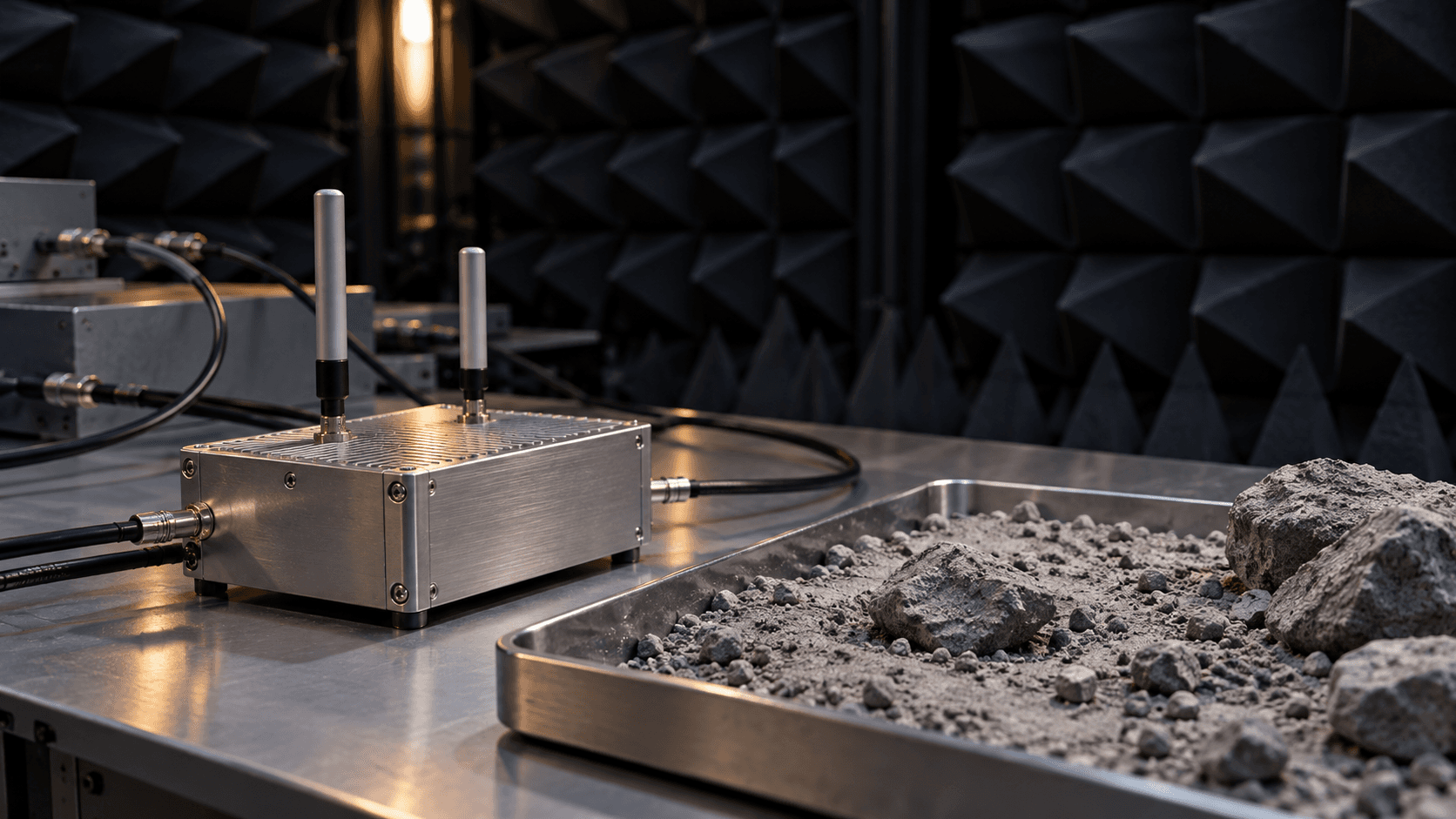
On the Moon, a radio can work exactly as designed and still fail to make a connection. Nokia's earlier lunar experiment demonstrated that uncomfortable distinction when the network and its intended user device could not operate together under the mission's power and temperature constraints. NASA's new lunar 5G award matters because the next challenge is not simply turning on another radio. It is making a usable communications system survive the conditions around it.
NASA announced on September 30 that Modulate Space Corporation received an approximately $38 million firm-fixed-price contract to develop lunar-surface 5G communications with integrated Wi-Fi 6 for Glenn Research Center. The agency describes technology development spanning hardware, firmware and software. This is an awarded development effort, not an announcement that a permanent lunar mobile network is already available to astronauts or commercial customers.
The work has two overlapping schedules. Development and laboratory demonstration of a network-in-a-box run from October 1, 2026, through January 31, 2028. The integrated lunar 5G and Wi-Fi surface network and flight demonstration have a performance period from November 30, 2026, through December 31, 2028. Those dates define contract work periods. They are not named launch appointments, and the brief release does not identify a landing provider or promise a particular coverage radius.
The award announcement is the primary evidence for that new commitment. No independent fresh-award reporting was located for this account; the independent reporting discussed below concerns the earlier lunar mission. Keeping that distinction visible prevents old flight heritage, current contract scope and future ambitions from being compressed into one claim of an operational service. There is enough substance in the actual development decision without making that leap.
NASA's Lunar 5G project describes a practical reason for borrowing terrestrial standards: astronauts need to communicate with one another, vehicles and instruments across a growing area of activity. The lunar south pole includes deep craters and mountainous terrain. A shared wireless approach could make adding another participating device less bespoke than designing every mission's connections independently. It does not make the Moon a terrestrial cellular market, or remove the need to qualify equipment for its environment.
The supplier's own description helps explain the hardware concept. Modul8 says its previous Nokia-era lunar system combined radio, network core, security and routing in a compact autonomous network-in-a-box. It also describes custom devices, antennas and mission-operations software around that package. In plain language, the box is intended to provide more of the local network than an antenna alone. That earlier design is useful context, not a published bill of materials for the newly awarded system.
Modul8's technology page also emphasizes 5G, Wi-Fi 6, local computing and storage as parts of its approach. Its advertised reach and capacity should not be mistaken for measurements from this NASA contract. For a rover or instrument builder, the relevant question is which functions remain available close to the equipment, and which depend on a connection onward. A fast local link and a dependable route back to Earth solve different parts of the mission.
That separation becomes clearer in NASA's LunaNet framework. Developed with the European Space Agency and Japan Aerospace Exploration Agency, LunaNet defines shared standards intended to let government, commercial and international systems cooperate. It encompasses networking, navigation, detection and information, and science services. It is not the name of a single spacecraft, and the new surface-radio contract is not equivalent to procuring every service in that broader architecture.
NASA describes lunar relays as a way to communicate when a surface user cannot see Earth directly. A local wireless connection can move data from a nearby instrument to a mission asset, while a relay or another onward link handles a different leg of the journey. The design implication is that performance must be considered along the whole route. Improving the first hop does not, by itself, establish end-to-end availability.
Terrain is a technical input to that problem, not scenic background. NTIA's Institute for Telecommunications Sciences explains that lunar propagation modeling must account for an environment without Earth's atmosphere, a rough surface shaped without terrestrial erosion, and the characteristics of lunar regolith. Its April 2026 account describes the Irregular Lunar Model and the September 2025 publication of ITU-R Recommendation P.2170. These tools support predictions about signal behavior; they do not replace measurements of the awarded equipment.
A communications team therefore needs to know more than whether a transmitter passes a laboratory check. The relevant operating question is what reaches a receiver at the intended location, with the actual terrain and equipment arrangement. A useful demonstration would compare predictions with observed performance and identify where the model is too optimistic. That is an engineering objective suggested by the propagation work, not a claim that NASA has published those results for this contract.
There is already terrestrial work on how the applications fit together. NASA's September 2025 account of Johnson Space Center testing describes engineers carrying radios, cameras and antennas in prototype backpacks. The team used commercial off-the-shelf hardware and open-source software to explore system interactions. At Johnson, simulated lunar spacewalks sent video, audio and telemetry over a private 5G network to a mock mission control. These were ground experiments, not transmissions by astronauts walking on the Moon.
Such tests can expose a different category of failure from a weak signal. A camera, telemetry stream and operational conversation share a workflow even when their individual components function correctly. The design should decide what matters most when conditions deteriorate, rather than leave every application assuming ideal capacity. For example, preserving an essential command exchange could be more useful than preserving the resolution of an accompanying video. That is a proposed operating priority, not a disclosed NASA scheduling rule.
The strongest cautionary evidence comes from the actual IM-2 flight. In its March 10, 2025 report, Nokia said the lunar network-in-a-box powered up, received commands and returned operational information through the mission's communications systems. It operated during a roughly 25-minute power window. But Nokia explicitly said it could not complete the first cellular call on the Moon. Telemetry reaching Earth was not proof of a successful cellular connection between the intended lunar endpoints.
The timing of component availability was decisive in Nokia's account. Telemetry initially indicated that the device on the Micro Nova Hopper was drawing power consistent with operation. By the time the network-in-a-box was activated several hours later, that device had become too cold under the mission's power constraints to connect. Separately functioning pieces did not produce a working end-to-end exchange. Future performance claims need to preserve that difference between component activation and connected service.
Finnish public broadcaster Yle independently reported the mission's partial success and missed call, describing the lander's sideways position and insufficient solar power. That reporting challenges an overly broad reading of the phrase first cellular network on the Moon without erasing the tests that did succeed. A short successful power-up is valuable flight evidence. It is still a different achievement from sustaining useful communications across moving devices for an operational mission.
Resilience also involves what happens after a link disappears. NASA's delay/disruption-tolerant networking guidance describes a store-and-forward approach: a node holds data until the next connection becomes available. NASA says DTN became an operational service in its Near Space Network and Deep Space Network following completion of its multi-center project in January 2026. That is an existing networking capability, distinct from the lunar relay infrastructure the agency describes as still in development.
Store-and-forward makes particular sense for information that remains useful when delivered later. It cannot turn a disconnected radio into a continuous live-control channel or supply power to an unavailable endpoint. An instrument's accumulated measurements and a time-sensitive maneuver command consequently deserve different treatment. A builder connecting equipment to a future lunar network should specify which information may wait, how old it may become, and what the equipment should do when contact is lost.
The standards strategy has a commercial consequence as well. If providers can agree on interfaces, a mission team can ask suppliers to demonstrate compatibility instead of commissioning an entirely custom relationship for every device. But standards compliance and a successful multi-vendor operation are not synonymous. A meaningful integration exercise must include the actual endpoints, the service being requested and the behavior during interruptions. A logo beside a standards acronym would not answer those questions.
For companies building payloads, habitats or surface vehicles, the most useful near-term output would be an increasingly explicit integration contract: supported interfaces, required power and thermal conditions, observable network states and the limits of each service. That would allow a payload team to make decisions while the communications system is still being developed. These are proposed needs for downstream users, not requirements we can claim to have read in an unpublished award attachment.
The new award puts resources and work periods behind a surface-network experiment. Its significance will grow if laboratory results, propagation measurements and a flight demonstration show how the entire connection behaves, including when conditions are unfavorable. The earlier mission already supplied a precise lesson: a powered base station is not enough when the other endpoint cannot join it. A lunar network becomes infrastructure when the mission can rely on the exchange, not merely point to the hardware.
LaunchPad positionEvaluate the complete communications path, including power, thermal availability, terrain, local applications and onward links; a radio powering up is not proof of sustained mission connectivity.
This report draws on the linked primary sources and reputable reporting. Company statements are treated as claims until independently demonstrated.