The exciting part of NASA's latest propulsion CubeSat is buried in the plumbing. Feeding two different kinds of thruster from one propellant supply sounds tidy until the engineering team has to reconcile what each device needs. ASCENT Propulsion Dual Mode is approaching its flight test with that integration problem at the center, rather than another promise that a remarkable engine will change everything.
NASA reported on September 25 that the 6U CubeSat completed helium leak, thermal-vacuum and spin testing at Marshall Space Flight Center. Final checkouts, solar-array integration and shipment remain. The agency lists a launch no earlier than October 1 aboard a Falcon 9 from Vandenberg Space Force Base, California. This is a ground-test milestone, not an announcement of successful flight.
The planned demonstration would operate about 325 miles above Earth for nine months. Initial short chemical and electric maneuvers would precede repeated orbit changes alternating between the modes, if checkout succeeds. Those are objectives. The current test-completion account comes from NASA; we have not independently inspected the flight hardware or its test records.
The design addresses a real tradeoff explained by MIT's Space Propulsion Laboratory. Chemical propulsion generally offers higher thrust, while electric propulsion can make more economical use of propellant at lower thrust. Combining them conventionally means accommodating systems whose propellants and supporting hardware may differ. That burden matters particularly when the spacecraft has little room, mass or power to spare.
ASCENT creates an opening because it is an energetic ionic liquid compatible with chemical propulsion and electrospray. Instead of deciding in advance how much propellant belongs exclusively to each mode, a shared supply could support both. That is the attraction to evaluate: flexibility within a constrained spacecraft. It is not a claim that every mission needs two kinds of propulsion.
Consider a hypothetical mission designer choosing between a brief maneuver and a gradual orbit adjustment. The useful question is not which thruster wins an isolated efficiency contest. It is whether the vehicle can complete the required maneuver in the available time, with enough resources left for everything else. A capability that arrives after the observation opportunity has passed is not especially useful.
That also supplies the counterargument. A mission whose requirements are satisfied by one established propulsion system might gain little from carrying another. Dual-mode capability needs to justify its integration and operating burden. The right comparison is between complete mission designs, not between an elegant shared-tank diagram and an intentionally clumsy alternative. Optionality has value only when the mission can use it.
Electrospray is easier to understand without the science-fiction framing. NASA's propulsion technology guide describes electric fields extracting and accelerating ions or droplets from a conductive liquid. The outgoing material generates thrust. This is not a fuel-free drive, and electricity does not eliminate the need to manage the material being expelled. The spacecraft still has to support the propulsion system as hardware.
MIT reported a relevant ground experiment in June. Researchers used a magnetically levitated test stand inside a vacuum chamber, varied the voltage applied to ASCENT-fueled electrospray thrusters and measured the response. Runs lasted up to 100 hours. The university reported comparable thrust performance to its conventional electrospray propellants. That supports the feasibility argument, but it is the university's account, not an independent replication.
A controlled experiment answers a narrower question than a spacecraft mission. It can establish that a device generates measurable thrust under the conditions tested. It does not, by itself, show that the assembled satellite will repeatedly feed that device, command it correctly and retain acceptable performance throughout its intended operations. Treating those as separate evidence requirements is how a promising experiment becomes a credible development program.
MIT's laboratory also reports delivering four modified electrospray flight units to Marshall. Their reservoirs are designed to be filled and refilled from the common onboard supply. Refilling here means moving propellant within the spacecraft. It does not mean a tanker arrives to service the satellite. That distinction matters because otherwise a modest but valuable integration capability starts sounding like an entirely different mission.
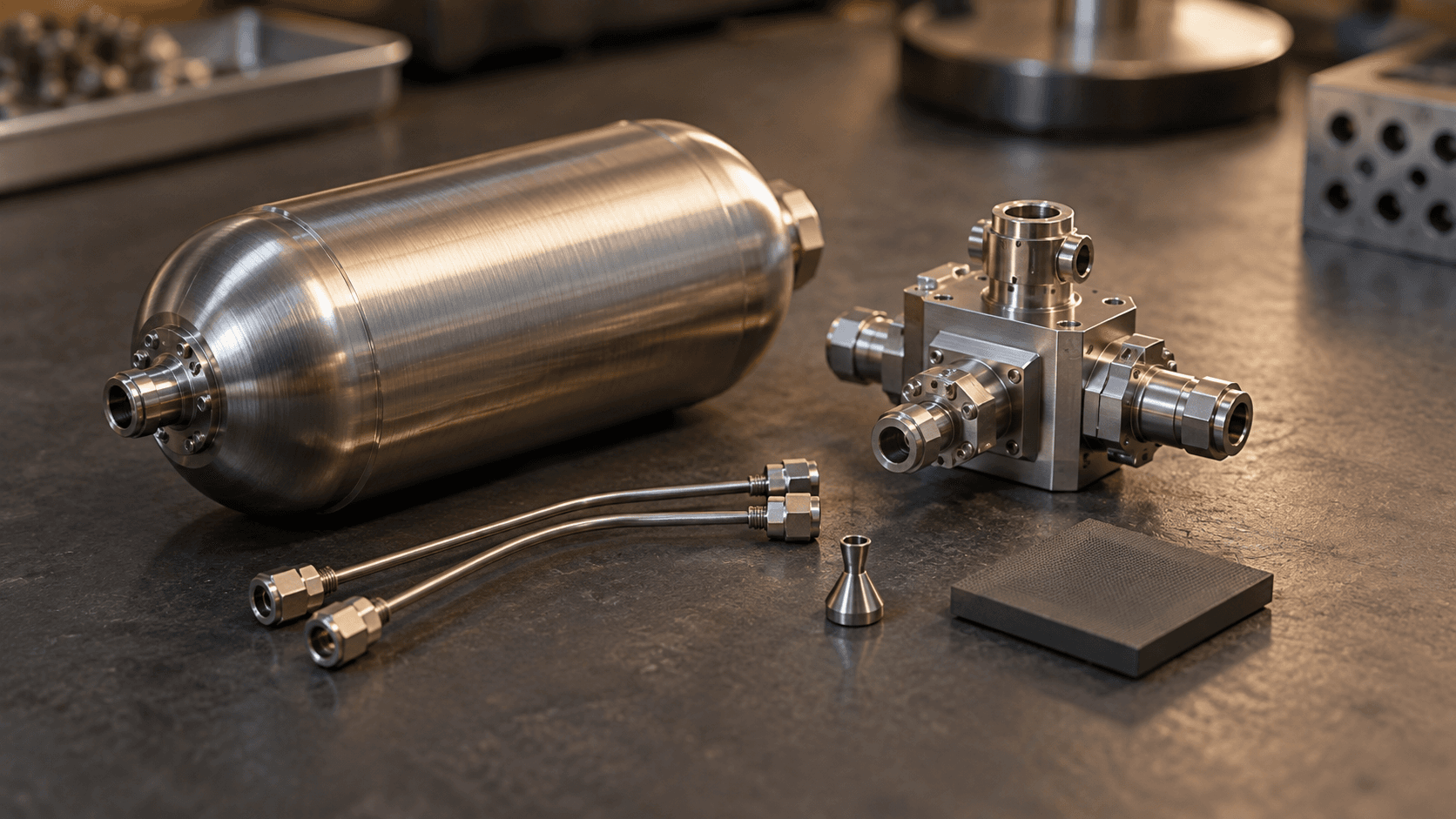
The pressure boundary explains why a common tank is not simply a plumbing shortcut. NASA's 2024 technical paper described tank pressures reaching 275 psi, while the electrospray inlet required less than 10 psi. A compact pressure-reduction system connected those operating regimes. These are details of the documented development design, not freshly released measurements of the flight vehicle.
The same paper described replacing an earlier additively manufactured pressure-reduction design with machined blocks and commercial flow restrictions. Concerns included removing residual powder, qualifying brazed joints and controlling delivery. This was a redesign of that subsystem, not evidence that the team abandoned every printed component. The history is useful precisely because it records where compact packaging created practical difficulties.
There is a product-development lesson in that choice. A smaller component is not automatically the better component if it becomes difficult to inspect, clean or service. The meaningful optimization target is the working system. If a little more physical volume makes a failure easier to prevent or diagnose, that can be an intelligent trade rather than a retreat from innovation.
The propellant itself already has chemical-flight history. NASA's account of the Green Propellant Infusion Mission describes successful orbital maneuvers using ASCENT with compatible thrusters, tanks and valves. The agency presents ASCENT as less toxic than hydrazine and easier to handle, while still describing protective equipment and procedures. Lower toxicity is a useful operational characteristic, not permission to treat an energetic propellant as harmless.
That history should raise confidence in the specific things it demonstrated. It should not be stretched into a certificate for every later configuration. The fact that a propellant works with one flight system says something important about feasibility. It does not settle whether a different feed arrangement, manufacturing process or operating sequence will work equally well. Hardware heritage has boundaries.
Lunar Flashlight makes those boundaries concrete. NASA ended the mission in May 2023 after insufficient thrust prevented the spacecraft from reaching its intended lunar orbit. The agency suspected debris in the propellant lines, potentially associated with its additively manufactured feed system. That was a suspected explanation, not a recovered-hardware finding. Other technologies worked, but those successes could not deliver the missing maneuver.
It would be equally sloppy to conclude that this makes ASCENT inherently defective or that propulsion problems are irrelevant because the mission was experimental. Neither follows. The useful reading is that the delivery path deserves as much scrutiny as the propellant and thruster. A mission can contain several individually promising technologies and still fail at the interface required to achieve its main objective.
Electrospray also has flight heritage beyond this project. NASA's historical account of LISA Pathfinder describes Busek and JPL colloid microthrusters operating for more than 90 days, with operations ending in July 2017. That was a different propulsion system serving a different mission. It demonstrates why calling the upcoming experiment the first use of electrospray in space would erase important prior work.
The distinctive question here is the integrated chemical-electrospray arrangement, not whether electric micropropulsion exists. A useful way to read the evidence is in layers: prior flight experience for constituent technologies, ground evidence for their combination, then results from the complete vehicle. Each layer reduces a different uncertainty. None makes the following layer unnecessary.
NASA's small-spacecraft propulsion guide identifies additional electrospray concerns: charge management, high-voltage control, contamination and plume deposits that can degrade performance or create electrical shorts. It stresses lifetime testing and performance verification in relevant conditions. These are general integration risks, not a claim that the ASCENT flight unit has developed those faults. They explain why a successful initial firing would be only the beginning.
One consequence of a shared supply is that the failure analysis deserves a shared-system view. A fault affecting a common resource could have implications for both modes. That is an engineering concern to investigate, not a disclosed weakness in this spacecraft. Before adopting the architecture, a customer should ask which faults remain isolated, how they are detected and what usable capability survives them.
MIT's research description explicitly includes long-duration behavior, propellant mass-loss anomalies, refillability and failure mechanisms among its investigation areas. Those are the right kinds of questions for a technology intended to keep working after its first impressive demonstration. A test program should produce an operating envelope that another engineering team can use, not merely evidence that something happened once.
Earlier independent reporting provides context, but it needs a date attached. Space.com's June coverage discussed the concept and MIT's experiments while citing a November launch expectation. NASA's newer September announcement instead gives the October 1 earliest-launch target. We use the newer primary schedule here. Neither date is evidence that launch has occurred, and the older article does not independently validate the latest ground tests.
For builders assessing the eventual results, three comparisons would be especially useful. First, the complete installed mass and volume against a mission-equivalent alternative. Second, performance across repeated operations rather than the best isolated firing. Third, the electrical and operational support required to obtain that performance. These are proposed evaluation criteria, not metrics NASA has already published for this milestone.
The commercial question is similarly specific. Could the arrangement make a particular mission practical that otherwise requires a larger platform or a less useful maneuver plan? That would be a meaningful result. A promise of cheaper launches in general would be much harder to substantiate. Launch economics, payload capacity and mission reliability cannot be inferred from the number of propellant tanks alone.
A useful outcome would let another spacecraft team make a concrete decision: this shared-feed architecture can support our maneuver plan, and these are the limits we must design around. That is a more demanding deliverable than a launch photograph or a successful first firing. For a mission built around two thruster types, the decisive achievement will be making their common supply dependable.
LaunchPad positionEvaluate repeated operations, pressure control and whole-spacecraft tradeoffs. Proven individual technologies do not automatically make a proven shared system.
This report draws on the linked primary sources and reputable reporting. Company statements are treated as claims until independently demonstrated.