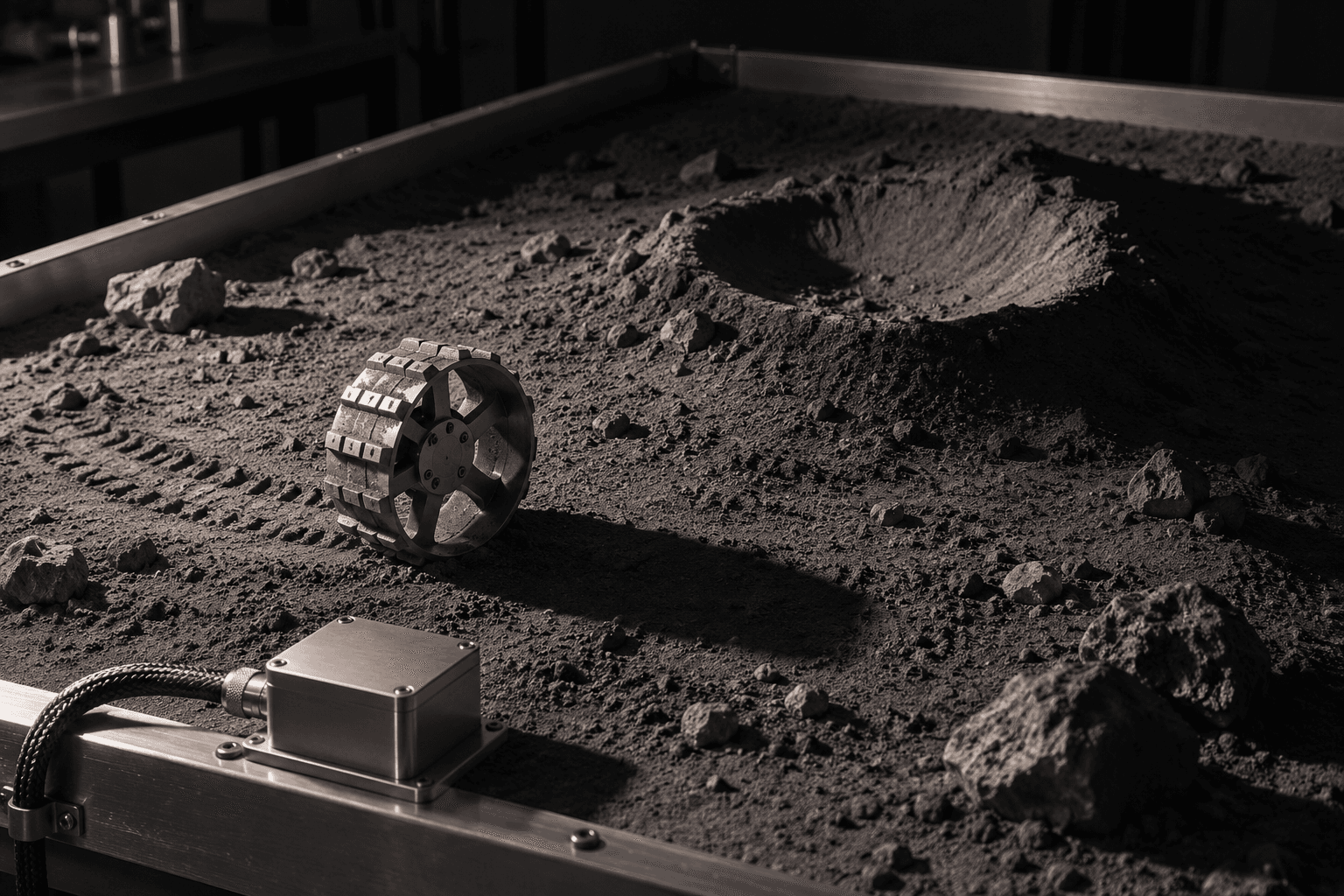
NASA's latest lunar awards put a delivery bill beside a harder operating problem. The agency announced on November 7 that Blue Origin would receive a $94 million base contract to deliver the PROMISE rover, with a further $140 million option tied to performance. That buys a defined transportation job. It does not establish the rover's total mission cost, guarantee a landing, or tell a future customer how much useful work will happen afterward. Those distinctions matter when a Moon Base starts becoming a collection of contracts.
The same announcement selected eight companies for CLPS 2, a ten-year lunar delivery framework with a combined maximum value of $10 billion. Eligibility to compete is different from winning a particular delivery. A supplier cannot treat that ceiling as booked revenue; a customer cannot treat it as available transport capacity. For builders assessing the market, the useful unit is the specific mission and its obligations. The broader framework creates a route for purchasing services. Individual orders still have to turn that route into hardware, schedules, and successful operations.
PROMISE makes those operating dependencies unusually tangible. NASA plans a late-2028 launch and an 18-month primary mission, with JPL adapting the body, electronics, and mobility system of Curiosity's Earth-based vehicle system test bed. Additional parts come from flight spares and test hardware associated with Curiosity and Perseverance. This is a reuse strategy with a specific engineering starting point, rather than a declaration that a Mars rover can simply be shipped to the Moon. The planned configuration still needs to function as a complete lunar vehicle.
The mission also treats movement as a measurement. NASA says interactions between the rover's wheels and the surface can reveal properties of the ground that matter to later vehicles and infrastructure; a wheel could even excavate a trench for investigation. That gives prospecting a wider purpose than producing an attractive map of possible ice. A future operator needs to understand what the ground contains and what equipment can do on it. PROMISE's planned observations could help answer both questions, but the mission has not yet produced that evidence.
Power determines which terrain can become a working environment. NASA's radioisotope-power guidance explains that these systems use heat from the natural radioactive decay of plutonium-238 to generate electricity. PROMISE is planned to use a flight-spare multi-mission radioisotope thermoelectric generator. The point is access to places and periods where sunlight cannot support the intended work, including dark polar terrain. Nuclear power in this context describes a heat source and conversion system. It should not be read as a claim of unlimited electrical capacity for every instrument and maneuver.
NASA frames the choice between solar and radioisotope power around the destination and the science objective. That is a more useful framework than choosing a technology by its label. A builder should ask which operations must remain possible when illumination changes, then examine the actual energy and thermal requirements. For PROMISE, the important proof will be sustained useful activity under the mission's conditions. A generator specification alone cannot establish how frequently a rover can drive, inspect a target, run its instruments, and send the resulting information home.
The instrument family supplies another necessary distinction: finding hydrogen is not the same as establishing a usable water supply. NASA's technical description of the Neutron Spectrometer System explains how changes in neutron energy and abundance can indicate hydrogen below the surface. That is an indirect signal requiring further investigation. PROMISE shares this instrument family with VIPER, alongside TRIDENT, NIRVSS, and MSOLO. The shared toolkit creates a chain of measurements, with different instruments addressing different parts of the interpretation rather than making one sensor answer every resource question.
TRIDENT rotates and hammers into material, bringing cuttings up for examination. NIRVSS uses spectroscopy to distinguish forms such as water and hydroxyl, while MSOLO examines gases associated with the material and its surroundings. NASA's VIPER documentation also explains the need to distinguish environmental gases from those introduced by a lander. Together, these mechanisms show why a resource claim needs context about sampling and contamination. Even a sound local detection would leave questions about geographic variation, extraction effort, and processing economics. Those are subsequent questions, not results established by announcing the rover.
Getting to those measurements requires a navigation system that understands more than a destination. NASA's HI-RATE project combines lidar and other sensors with onboard computing to estimate position, assess terrain, detect obstacles, plan routes, and control movement. Its development includes simulation, rover test facilities, and planetary analog field sites. The intended result is more productive travel with less operator intervention, including under difficult lighting conditions. NASA describes a capability in development, not a published guarantee of autonomous lunar driving speed or distance.
HI-RATE also aims to produce a reusable architecture for integrating software, sensors, and computing across mobility platforms. That is commercially relevant because a navigation algorithm is only one part of what a vehicle operator must accept. Sensor behavior, available processing, and movement control have to work together. The project identifies potential applications across science rovers, logistics vehicles, and other surface systems. Potential reuse should be judged through integration evidence on each platform. A working configuration on one vehicle does not by itself establish equivalent behavior on another with different operating demands.
The computing component has its own operating budget. NASA describes High Performance Spaceflight Computing as adjustable in both power consumption and processing capability, with unused functions disabled or placed in lower-power modes. Its architecture includes fault tolerance and error handling for a demanding space environment, along with connectivity to sensors and other devices. These details are more useful here than a single headline performance multiplier. A rover needs computing that can support its workload while fitting the resources and reliability requirements of the whole vehicle.
NASA's HPSC material describes onboard processing and autonomous decision-making as central applications. The engineering question is therefore about timely, dependable decisions, not merely processing more data. An evaluator should ask what information reaches the navigation software, how failures are handled, and what remains available when the power allocation changes. Those are editorial evaluation questions rather than newly disclosed contract requirements. They help connect a processor announcement to the behavior an operator actually needs, while avoiding the unsupported assumption that a faster chip automatically creates a more capable rover.
MoonFall illustrates a different operating bargain within the same lunar campaign. JPL plans four propulsive drones transported by Firefly's Elytra spacecraft, deployed during descent, and landed separately. They are intended to make repeated flights during one lunar day, up to 14 Earth days. The architecture trades a rover's continuous ground route for a series of independently selected landing locations. That makes it relevant to surveying terrain beyond ordinary rover access, but it does not turn the drones into indefinitely reusable aircraft or establish a continuous aerial logistics service.
JPL explicitly describes the boundary: lunar night will freeze remaining fuel and end further flights. A separate long-duration payload is intended to remain at each final landing site, waking and communicating during later lunar daytime periods. Flight lifetime and payload lifetime are therefore different things. A sensible assessment should measure each against its assigned purpose. The planned mission can have value after mobility ends, provided the stationary payload performs its role. Reporting only that the drones survive would conceal the loss of the capability that made them mobile.
Orbital infrastructure has a similarly specific job. NASA's CAPSTONE 02 mission is in development with two small spacecraft intended for lunar-orbit demonstrations of rendezvous, proximity operations, autonomous navigation, and communications, while also characterizing radiation. These are tests of how spacecraft operate around one another and exchange useful information. They are not evidence that a complete lunar communications service is already available. A surface program depends on more than the machines visible on the ground, and an orbital demonstration should be assessed against the particular uncertainty it is supposed to reduce.
The power infrastructure awards bring the discussion back to interfaces between suppliers. SpaceEnergy's November 8 report identifies Redwire for generation, Honeybee Robotics for storage, and Yank Technologies for wireless transfer in miniCAST, the Mini-Communications and Solar Tower. NASA's Marshall center is to assemble and test the equipment. The agency's announcement supports those assignments. This distribution of responsibility makes integration consequential: selecting capable components and obtaining a working combined system are related steps, but they are not the same accomplishment.
The initial miniCAST effort covers components, with a separate solicitation for complete power systems anticipated in early 2027. SpaceEnergy notes that individual award values, equipment power ratings, and a lunar deployment date were not disclosed in the announcement. Its coverage is an account of NASA's awards, not an independent hardware test. Those missing specifications limit what can be concluded about the capacity that future users might receive. The immediate development is the purchase and assembly pathway. Delivered electricity for an identified surface workload remains a later proof point.
There is a reasonable argument for developing these pieces together: transport, prospecting, navigation, power, and communications can expose requirements that isolated projects miss. There is also an integration cost. A supplier's successful test may depend on an input that another supplier cannot yet provide under the same conditions. The practical response is to make those dependencies reviewable. Teams should show what their equipment requires, what it produces, and how that behavior was tested with the surrounding system. That is more informative than presenting every award as another completed element of a base.
The evidence here establishes an agency procurement and development program. NASA's mission and technology pages describe planned capability; the accessible outside reporting covers the same utility-component announcement without supplying independent lunar performance measurements. The next useful evidence will be specific: integrated test results, demonstrated interfaces, completed transport, and observations returned from the operating environment. The November awards give companies and engineers defined work to pursue. Whether that work becomes dependable lunar infrastructure will be decided through the performance of the connections between the machines, as much as through the machines themselves.
LaunchPad positionAssess each award by its defined job, then demand evidence that power, sensing, navigation and communications work together.
This report draws on the linked primary sources and reputable reporting. Company statements are treated as claims until independently demonstrated.