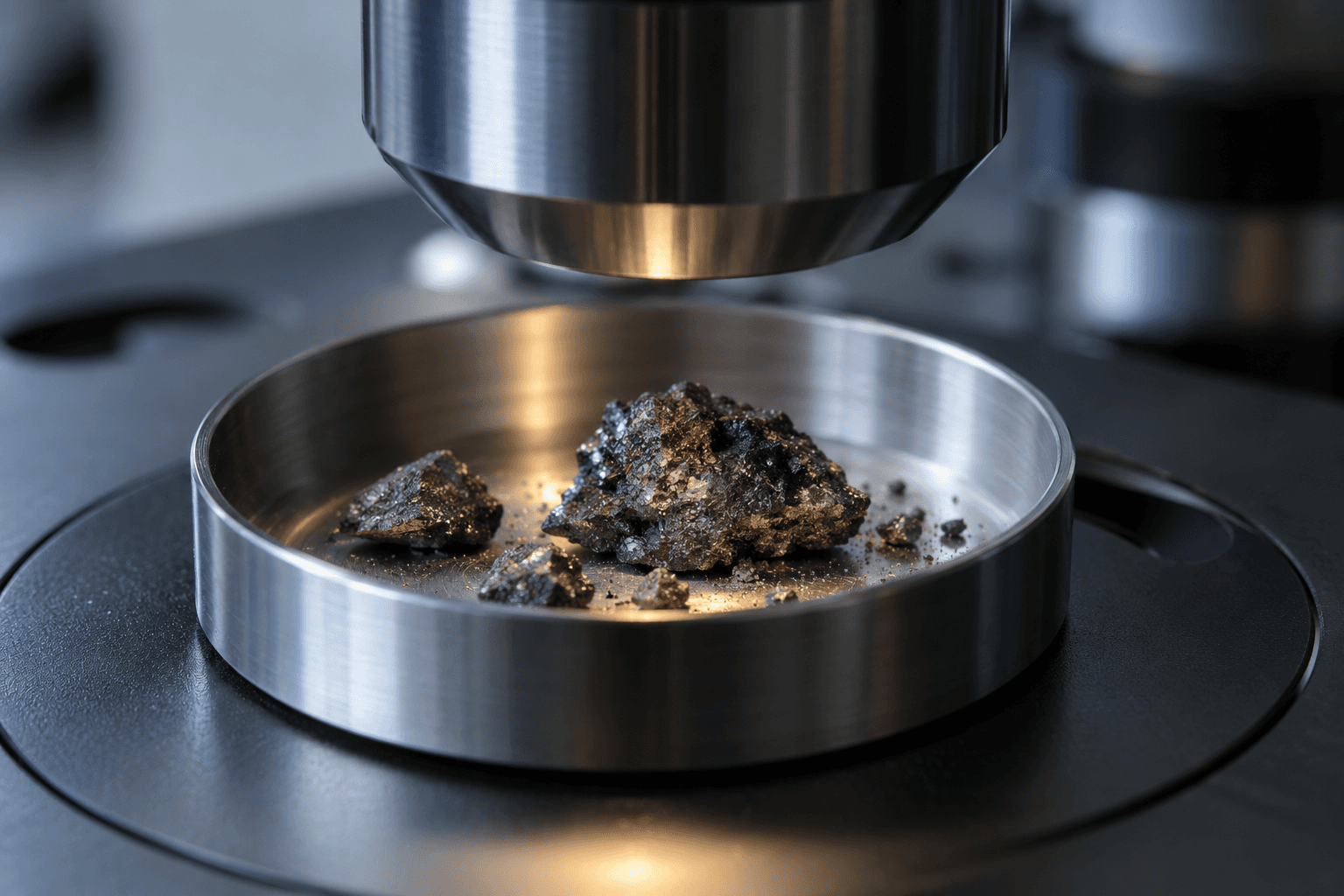
Ten grams is a small payload to bring home from another world. For Japan's Martian Moons eXploration mission, the value of that material will depend on knowing where it came from, what happened to it before collection and how it relates to the rest of Phobos. The mission's most consequential design choice is therefore the combination of remote observation, a surface scout and laboratory analysis. The return capsule is the connection between those ways of seeing.
MMX is approaching its scheduled launch, not reporting a successful departure. JAXA's notice targets its H3 flight No. 10 for October 20 at 4:41 a.m. in Japan, equivalent to October 19 at 3:41 p.m. Eastern daylight time, from Tanegashima Space Center. Its reserved launch period runs from October 21 through November 7, with timing subject to change. NASA's October 15 update and ESA's October 13 briefing both describe the flight as upcoming.
The destination makes the scientific question unusually direct. Phobos and Deimos might be captured asteroids, or they might have formed from debris expelled by a major collision involving Mars. NASA says the mission's observations and samples should help distinguish those possibilities. Neither explanation has been established by the launch preparations. Returning material would give researchers a different kind of evidence from another distant image, but the material still has to be interpreted.
NASA's contribution includes the MEGANE instrument, a pneumatic sampling demonstration, Deep Space Network communications and navigation support, and participating scientists. This is a JAXA-led mission with international contributions, not a NASA sample-return spacecraft under a different name. The division of work matters because the scientific result will depend on measurements and operations performed by several teams, followed by access to the returned material.
MEGANE measures the energies of neutrons and gamma rays emitted from Phobos to investigate its elemental composition. In plain language, it asks what the moon is made of before a sampler commits to a particular patch of ground. NASA's instrument description connects that chemical inventory to the competing origin explanations. The measurement is not a photograph and does not, by itself, reveal the complete history of every grain eventually placed in the capsule.
That distinction is central to the experiment. An orbital measurement describes material at one observational scale; a recovered grain can be examined at another. Their value increases when the two are compared. If researchers want to understand whether a sample is representative or unusual, they need the wider observations rather than just a beautifully measured speck. This is an inference from the mission's complementary instruments, not a claim that MMX has already demonstrated a particular mapping accuracy.
The hardware has a history separate from the countdown. NASA reported delivering MEGANE to Japan on March 14, 2024, for integration and system-level testing. The instrument was developed by Johns Hopkins Applied Physics Laboratory with Lawrence Livermore National Laboratory collaborators. NASA described a six-year design and development effort. Delivery was a completed milestone; successful measurement around Phobos remains a future one. Treating those as different achievements is more informative than calling the entire mission ready in one undifferentiated sense.
Reaching the right observing position is another part of the architecture. Astronomy's October 16 independent overview explains the planned quasi-satellite trajectory as an orbit around Mars that follows Phobos, making the spacecraft appear to orbit the moon. That is a useful correction to the shorthand of simply parking around Phobos. The reporting corroborates the agencies' launch preparations, but it is not independent evidence that the planned flight or surface operations will work.
The German-French Idefix rover is intended to investigate the surface before the main spacecraft samples it. DLR describes a 25-kilogram vehicle released from roughly 40 meters above Phobos, then righting itself autonomously for approximately three months of work. Its deployment is planned around the turn of 2028 and 2029. In gravity below a thousandth of Earth's, DLR says, this would break new ground for wheeled exploration. Those are design intentions and targets, not operating results.
The rover's reconnaissance also serves a practical purpose: helping prepare the larger spacecraft's landing. DLR describes separate propulsion, exploration and return modules, each responsible for a different portion of the journey. That separation makes the sequence legible. A good surface measurement cannot substitute for a successful return, and a successful return cannot recover context that was never measured. The relevant engineering question is what each stage must deliver to make the next stage scientifically useful.
Once the main spacecraft touches down, the two sampling methods address different material. NASA says the P-Sampler, mounted on a landing leg, uses bursts of high-pressure nitrogen to gather surface grains. JAXA's C-Sampler is intended to take cores from farther below the surface. The distinction is more important than a competition over which mechanism is cleverer. A surface grain and material beneath it may preserve different histories, so the sampling method belongs in the interpretation of the result.
There is a schedule qualification worth keeping visible. NASA's latest release says sampling will occur no earlier than December 2028. ESA's mission account describes the main spacecraft collecting samples in 2030, after rover deployment in early 2029. A lower bound is not the same thing as a scheduled date, and these accounts should not be collapsed into a single precise promise. Both place Earth return in 2031. ESA describes a minimum ten-gram return, landing in Australia before transfer to Japan.
Some of the strongest reasons to care about the surface layer predate this launch window. In 2021, NASA described research led by Quentin Nénon using measurements from the MAVEN spacecraft. The study investigated charged particles escaping the Martian atmosphere and encountering Phobos. The proposed opportunity was to find a record of that atmospheric loss within the moon's grains. It was not an announcement that such a record had already been recovered and read in a terrestrial laboratory.
The mechanics are specific. MAVEN's STATIC instrument measured incoming particles' energy and velocity, allowing researchers to infer their masses and distinguish Martian ions from particles associated with the Sun. The team then estimated how many ions could reach Phobos and how deeply they could become implanted. NASA's account described penetration of no more than several hundred nanometers. The prediction concerns a very shallow layer, rather than the composition of an entire rock or a uniform coating across the moon.
Location matters too. Phobos keeps the same side facing Mars. The researchers estimated that its near side received 20 to 100 times more Martian ions than the far side. NASA described the possibility of finding atmospheric information in a grain's outer layers while deeper material preserves clues to Phobos itself. This remains a research prediction that sample analysis could test. It provides a concrete reason to care about sampling location and depth without assuming the eventual samples will yield an uncomplicated history.
The laboratory program is equally specific. NASA's 2023 selection of ten participating scientists divided the work between seven researchers using flight instruments and three studying returned samples. That older announcement contains an obsolete launch and return schedule; its research assignments are the relevant historical context here. Reading it alongside the current mission release avoids importing an old date into a fresh countdown. It also shows that sample return was planned as a scientific program, not merely a delivery demonstration.
Among those assignments, Nicolas Dauphas was selected to examine elemental and isotopic abundances, including iron and potassium, and use rubidium-strontium dating. Jemma Davidson's planned work uses microscopy and mass spectrometry on opaque minerals to investigate origin and subsequent alteration. These are complementary questions: what material is present, how old it is and what changes it has experienced. The announcement establishes planned investigations, not their answers or a guarantee that every technique will resolve the origin debate.
Daniel Glavin's assignment covers organic compounds using chromatography and mass spectrometry, including amino acids and several other chemical families. That is not a promise to discover life. The announced work is chemical analysis, and the mission's origin questions concern the movement and evolution of material in the planetary system. Builders and readers should resist turning the presence of an interesting analytical capability into a predetermined discovery. An instrument list describes what investigators can attempt, not what nature will provide.
The flight-science assignments help connect those laboratory questions back to the landscape. NASA selected Olivier Barnouin to develop terrain models and study regolith interactions with the rover, and Christine Hartzell to investigate grain clumps and the forces holding them together. Sander Goossens would combine instrument and navigation data to constrain shape, gravity and internal mass distribution. These are different properties of the same destination. Their combination is what could make a local sample intelligible within a larger physical setting.
Sample preservation extends the mission's usefulness beyond its flight. NASA says it will receive and curate about 15 percent of the total returned material at Johnson Space Center, making it available for research over decades. That is a planned share of whatever is returned, not an already acquired collection. The implication is important: the spacecraft fixes the opportunity to collect material, while an archive allows later investigators to bring new questions and methods to material that survives it.
The strongest counterweight to the excitement is the number of uncompleted steps. Launch, arrival, surface reconnaissance, collection and return are distinct tests. Even a successful collection would not automatically settle every question about both moons, because the returned material comes from Phobos. The mission can make observations of Deimos without returning a Deimos sample. Keeping that boundary visible makes the scientific ambition clearer, rather than smaller, and prevents a single capsule from being credited with evidence it cannot contain.
For teams building complex instruments or research infrastructure, MMX offers a practical design lesson: specify the context that must travel with the measurement. Here that means relating composition to terrain, grain properties, collection method and subsequent analysis. The next public proof point is a confirmed launch and departure, followed by the later operational milestones. The eventual scientific payoff will be measured in explanations that survive comparison across those records, not just in the mass of material successfully brought home.
LaunchPad positionJudge sample-return missions by the observations that make collected material interpretable, as well as the ability to bring it home. MMX's launch and scientific milestones remain ahead.
This report draws on the linked primary sources and reputable reporting. Company statements are treated as claims until independently demonstrated.