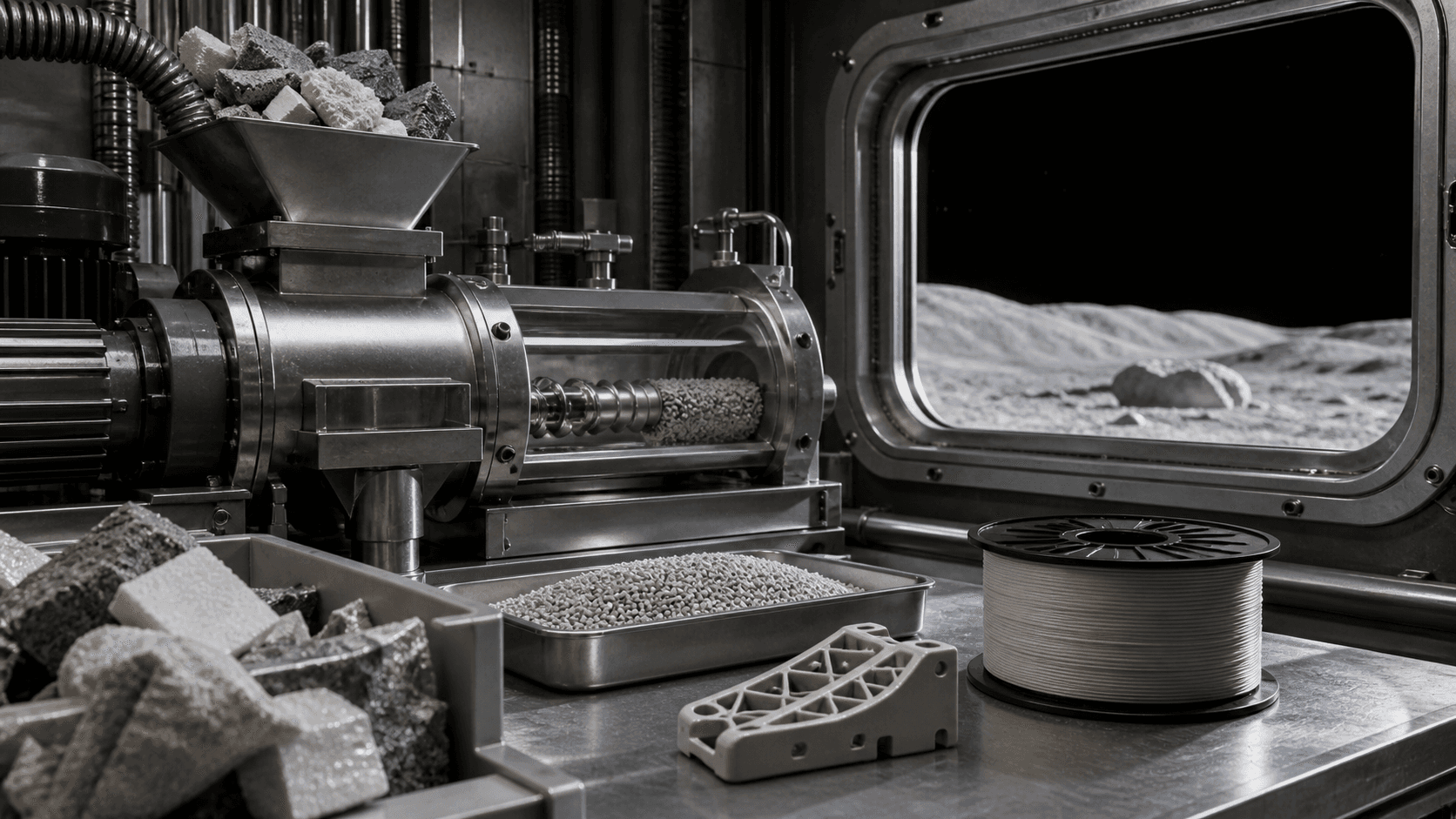
A lunar base cannot afford to think about trash the way a city does. There is no municipal pickup, no landfill over the hill, and no cheap replacement shipment arriving tomorrow. Every empty food pouch, foam insert, worn textile, and packaging layer is either dead mass or potential inventory.
NASA's LunaRecycle Challenge is starting to price that distinction. The agency awarded the top prototype and digital twin prizes in Phase 2 to MIT's CERBERUZ team, for a combined 775,000 dollars. The team's system grinds mixed waste into powder, treats Zotek packaging foam as reinforcement instead of contamination, and produces feedstock for injection molding or filament for additive manufacturing.
That is more consequential than the phrase space recycling makes it sound. The machine is attempting to collapse two expensive systems into one: waste handling and local production. If a crew can turn consumed packaging into a replacement bracket, tool body, or noncritical structural component, the mission carries fewer spares and extracts more utility from every kilogram launched.
NASA required finalists to demonstrate working prototypes during the August 24 to 28 testing window. Teams could also submit digital twins, which matter because a recycler on the Moon cannot be maintained like one in a terrestrial factory. Operators need to model throughput, power, wear, material variability, and failure before a jam becomes a logistics emergency. Fourteen finalists reached the demonstration stage across the challenge tracks.
The limitations are real. The winning result does not establish flight readiness, lunar dust tolerance, long-duration reliability, or safe production of mission-critical parts. Mixed waste is chemically messy. Material properties drift. A beautiful sample made during a controlled demonstration is not the same thing as repeatable output after months of radiation, abrasion, and maintenance by a small crew.
Still, NASA is asking the right systems question. Exploration becomes durable when missions stop importing every useful object and start carrying processes that can regenerate capability. Water recycling did this for life support. Local materials processing can do it for hardware.
The next milestone should be brutally practical: publish the energy cost, recovery yield, mechanical properties, contamination tolerance, and maintenance burden for repeated batches. If the numbers hold, lunar waste stops being a disposal problem. It becomes the first ugly, useful feedstock of an off-world manufacturing economy.
LaunchPad positionThe winning architecture matters less as a recycling appliance than as a prototype for closed-loop industrial capacity. The next proof is reliable output under lunar constraints, not another polished Earth demonstration.
This report draws on the linked primary sources and reputable reporting. Company statements are treated as claims until independently demonstrated.