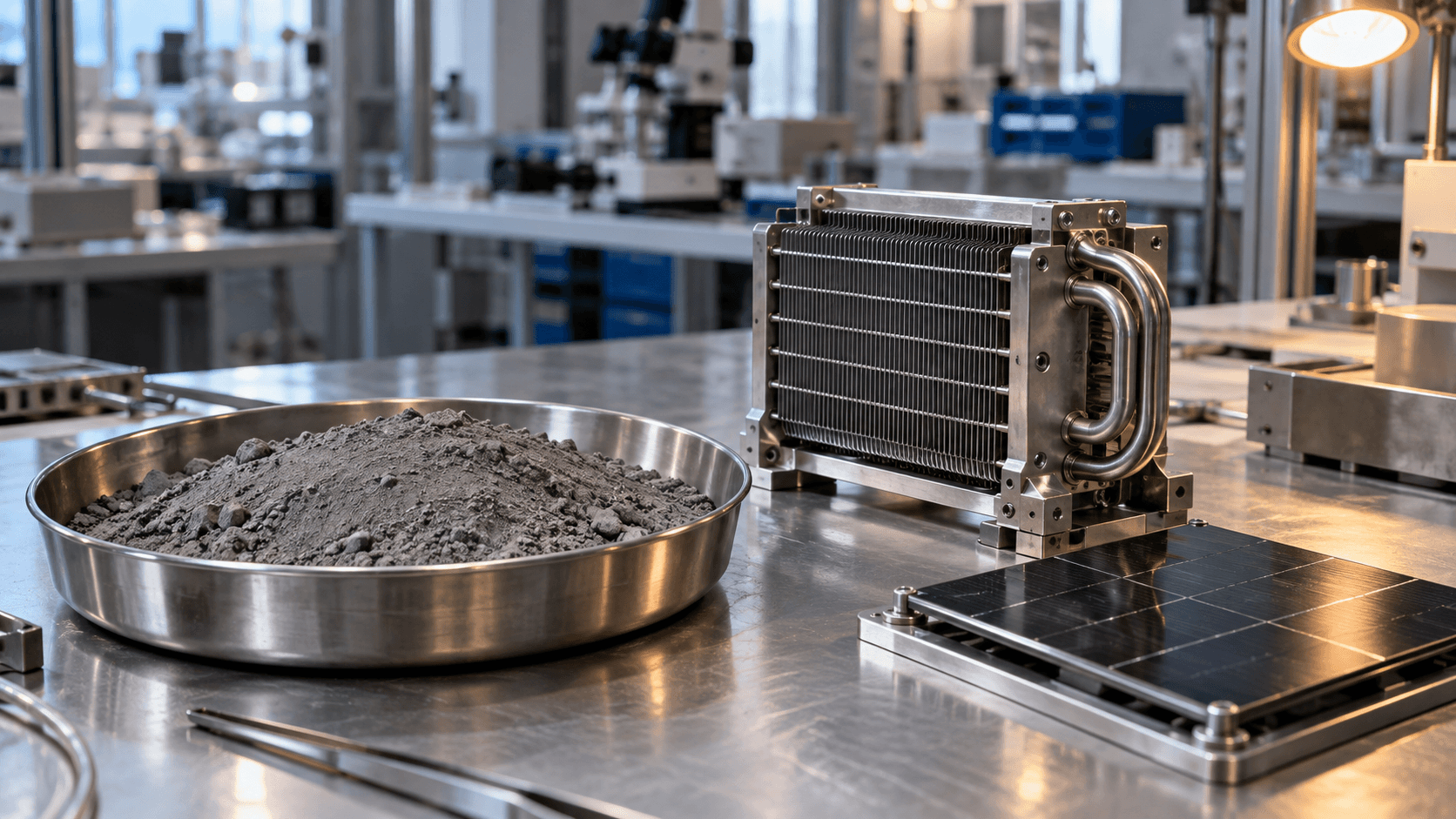
A lunar base cannot live on launch cadence alone. Somebody has to make the electricity dependable, turn local material into something useful, and prove that the equipment can keep working after the demonstration ends. NASA's new lunar technology solicitation is aimed at that less photogenic part of exploration. For companies building real hardware, it may be more informative than another rendering of buildings on the Moon.
NASA announced the final solicitation for its Lunar Enabling Infrastructure Accelerator, or LEIA, on September 8. It sits under NextSTEP-3 Appendix A and targets five areas: vertical solar arrays, oxygen production from lunar regolith, radioisotope Stirling generators, in-space advanced manufacturing, and nanomaterials production. This is a request for proposals to mature technology. It is not a contract award announcement, a completed lunar power network, or proof that the equipment in an artist's concept already exists.
The agency's program page gives the work an important boundary. Appendix A generally aims to advance technology through laboratory or controlled analog testing toward Technology Readiness Level 5 or 6. Appendix B, a separate effort, addresses more mature integrated demonstrations leading toward flight or the lunar surface. NASA specifically tells prospective offerors to distinguish the two. A company with a promising component and a company ready to demonstrate a complete lunar capability are not being asked to clear the same hurdle.
That distinction is a useful antidote to space-industry storytelling that jumps from a working part to an operating settlement. A component can perform well under one set of conditions while leaving its interfaces, power demand, or integration behavior unresolved. Appendix A creates room to work through those uncertainties before treating the technology as a mission-ready system. The commercial implication is straightforward: credible risk reduction is a deliverable. A team does not have to pretend its prototype is already a lunar utility to explain why the work matters.
The final call follows a June 29 draft and an industry-feedback process. NASA's September announcement says the competition is intended to develop US-led capabilities and is open to private industry, academic institutions, and nonprofits, with international partners participating through US-led teams. The agency says technical data and demonstration results from resulting contracts may inform later acquisition strategies. That last point makes evidence valuable beyond the immediate prototype. What a test reveals can influence what NASA decides to buy next.
The first lane, surface power, is broader than a solar panel. NASA's material identifies generation, power management, distribution, and energy storage as needs. Those functions should be understood together. Generation answers whether energy can be collected. Distribution concerns getting usable power to the equipment that needs it. Storage changes when that energy is available. Improving one element without accounting for the others can produce an impressive subsystem and an unimpressive operating capability.
Imagine, as an engineering example, an oxygen-production unit that performs well whenever its power supply is steady. That does not tell a mission planner what happens when the unit has to pause, restart, or share power with another load. Equally, a power system's peak output does not by itself establish the amount of useful production it enables. The point is not that NASA has selected a specific operating schedule. It is that integrated test evidence should connect power availability with the work an infrastructure customer actually wants done.
The oxygen lane is specifically about regolith, the rock and dust covering the lunar surface. NASA describes extracting oxygen that is molecularly bound in that material. This is not the same proposition as merely finding accessible water ice and collecting it. The resource and the processing chain matter. A company should be clear about the material its method consumes, the conditions under which it works, and the usable output it delivers. Treating all lunar resource production as one generic mining business hides the engineering question.
Here the useful commercial metric would be a system result rather than a chemistry headline. A prospective customer would want to understand the energy consumed, the consistency of output, the handling of input material, and the limits observed during testing. These are evaluation questions, not performance specifications announced in NASA's news release. The published call does not establish a winning extraction process or a production cost. It opens a route for competing approaches to generate evidence that could make those comparisons possible.
The radioisotope Stirling lane needs especially careful translation. NASA's technical guidance describes radioisotope power as using heat from natural radioactive decay. A Stirling converter turns a temperature difference into mechanical motion and then electricity through an alternator. This should not be confused with a reactor relying on a controlled fission chain reaction. The heat source and the conversion machinery are different parts of the system, and neither becomes understandable merely because someone puts the word nuclear in a headline. NASA's explanation of dynamic power describes gas moving between hot and cold regions, with the changing conditions doing work on a piston. A regenerator stores and releases heat as the gas cycles, improving the process's efficiency. The alternator converts motion to electricity. By contrast, the agency's familiar radioisotope thermoelectric systems use thermocouples without moving parts. This is a real architectural tradeoff, not a contest between old-fashioned and futuristic branding. Different conversion methods create different engineering and verification obligations.
The appeal of Stirling conversion, according to NASA's radioisotope FAQ, includes more efficient use of limited plutonium-238 and less waste heat. But the same guidance emphasizes reliability, robustness, and lifetime cost. Its dynamic-power material describes ways to keep moving components from contacting surrounding surfaces, including gas bearings and flexure bearings. Those details explain why a strong proposal cannot stop at a headline efficiency figure. The machinery has to preserve its useful behavior for the operating life a mission requires.
This is also why the current solicitation should not be read as confirmation that a newly developed generator is ready to power a base. Technology maturation is the stated purpose. A buyer would reasonably ask how a candidate behaves across its expected temperature conditions, how faults are detected, and what evidence supports the claimed life. The final answers belong in actual engineering results. The public announcement does not provide them, and a publication should not invent them to make the opportunity sound closer to deployment.
In-space advanced manufacturing addresses a different dependency: the need to bring essential tools and materials from Earth. NASA's June explanation connects local production with mission flexibility and resilience. That is a meaningful objective, but it should not be translated into the claim that every spare part can be printed on demand. A useful manufacturing capability has to specify what it can produce and how that output is accepted for its intended job. The value lies in qualified capability, not simply in putting a machine somewhere difficult to reach.
Consider a hypothetical repair tool made locally. The part's appearance would tell an operator less than evidence that its dimensions, material behavior, and intended use are understood. A process that can repeatedly make one needed item may be more valuable than a flexible demonstration with uncertain results. That is an editorial judgment about the direction of development, not a NASA selection criterion asserted from an unseen contract. It follows from the difference between showing that production is possible and relying on the resulting object during operations.
The fifth lane, nanomaterials, is easy to oversell because the label sounds like a capability by itself. NASA's June material is more concrete. It calls attention to commercial availability, performance, quality, and uniformity under demanding environmental, mass, and performance constraints. Uniformity is particularly important to the business case. If a material behaves differently from batch to batch, the purchaser inherits uncertainty even when an individual sample looks excellent. The opportunity includes making a useful material dependable enough to procure, not only demonstrating an unusual property.
Taken together, the five lanes describe a set of dependencies that should shape how teams present their work. Power supports processing and manufacturing. Processing determines which local resources become usable inputs. Manufacturing and materials affect what can be built or maintained. That does not mean one contractor should claim ownership of the entire chain. It suggests the opposite: define the interfaces clearly enough that a focused supplier can demonstrate where its contribution begins, where it ends, and what it needs from the surrounding system.
For builders on the Space Coast, the practical reading is not that a new local contract has been awarded. The announcement identifies no such winner. It is that lunar infrastructure has a federal development pathway spanning more than launch vehicles and landers. Teams with relevant power, materials, testing, or manufacturing expertise can assess their fit against the actual solicitation and its maturity boundary. Geographic proximity to launches is not a substitute for that fit, and the published material does not promise regional preference.
There are limits to what can responsibly be reported from the public announcement and program pages. They do not establish the eventual award list, delivered lunar capacity, or the economics of a functioning base. This report relies on NASA's published call and technical explanations; it does not have independent test results for proposed systems. Offerors should use the current solicitation identified as 80GRC026R0008 for binding requirements and deadlines rather than treating an earlier draft or a news summary as procurement instructions.
The direction is still consequential. NASA is asking the market to mature the machinery between an exploration ambition and an operating capability. The strongest teams should arrive with a bounded problem, measurable test results, and a candid account of what remains unresolved. A lunar industrial base will not be made credible by describing everything as revolutionary. It becomes credible when a mission planner can point to a component, understand its limits, and trust the evidence for putting it into a larger system.
LaunchPad positionMatch a demonstrable capability to the correct maturity stage. A technology-development call is not an award for an operational Moon base.
This report draws on the linked primary sources and reputable reporting. Company statements are treated as claims until independently demonstrated.