The new clue was hiding in light Hubble collected in 1999. Astronomers revisiting the white dwarf HS 0209+0832 have identified an unusual chemical signature that they interpret as evidence for a planet formed after its star began dying. That would make the world a second-generation planet, assembled from material expelled by the star rather than from the cloud that accompanied its birth. The intriguing part is the proposed origin. The important qualification is that this remains a planet candidate.
NASA and ESA announced the result on October 5, describing a study published in Nature Astronomy and led by Jamie Williams, a doctoral candidate at the University of Warwick. Their accounts connect three strands of evidence: unusual chemistry in Hubble observations, supporting ultraviolet measurements from the retired FUSE mission, and periodic brightness changes measured by TESS. This report assesses those mission accounts, the instruments' documentation and independent reporting. It does not independently reproduce the chemical analysis or substitute for a full technical assessment of the journal paper.
A white dwarf is the compact core left after a low-mass star exhausts its nuclear fuel and sheds its outer layers. A planet orbiting one does not automatically qualify as second-generation. It might be a survivor of the original system. The proposed HS 0209+0832 planet is interesting because the researchers think its ingredients came from the material the dying star expelled. Establishing that distinction requires an account of both what is orbiting the remnant and how that object could have formed.
The starting evidence is not a photograph of a new world. According to NASA, Hubble's original observation contained roughly 100 chemical features that researchers could not identify. Williams returned to those records with an updated chemical database and found that niobium matched many of the unexplained features. The observation had not suddenly changed. The reference information available for interpreting it had improved. That is a very different kind of discovery from spotting a previously invisible object in a sharper image.
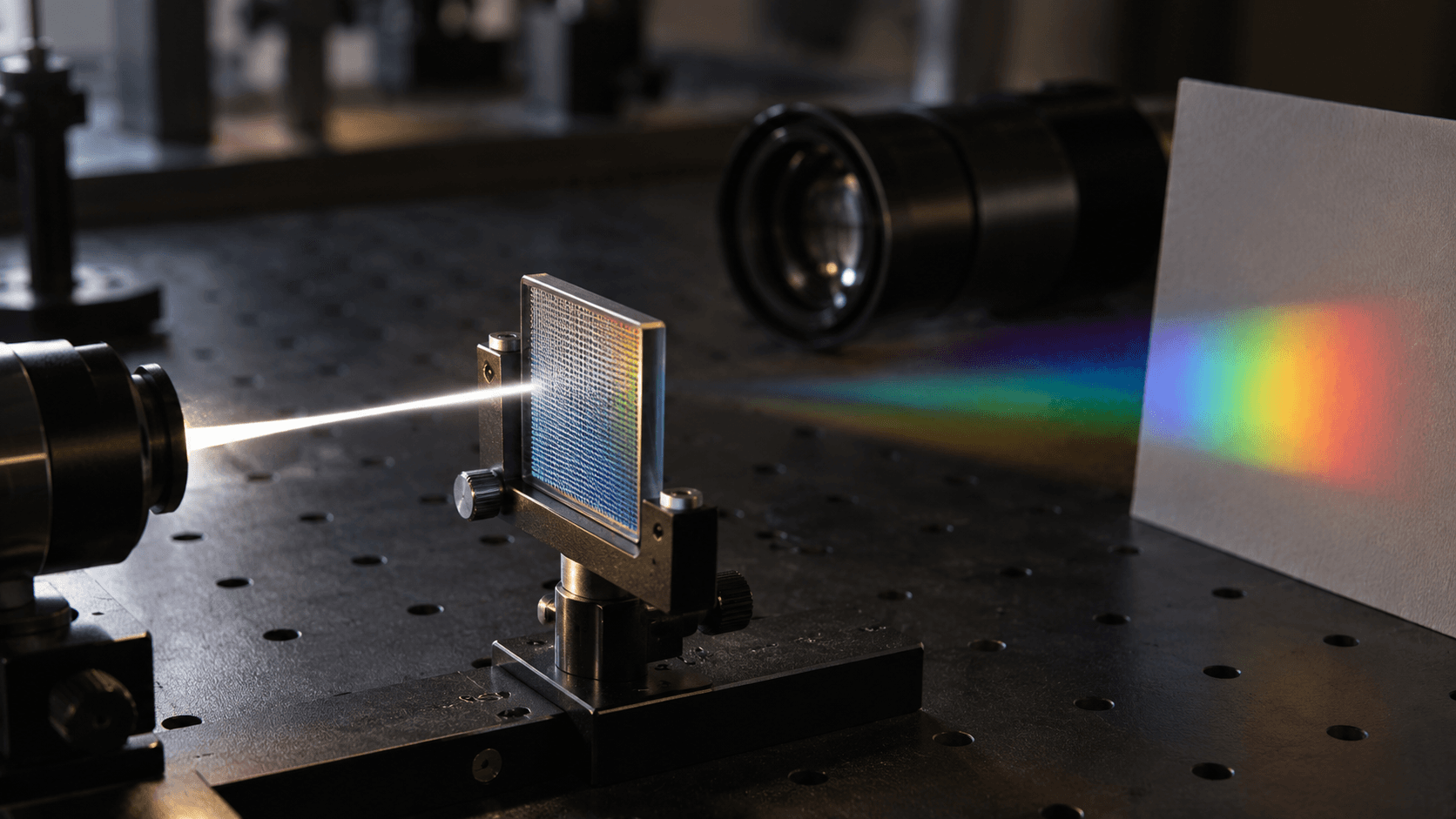
Spectroscopy makes such a discovery possible by separating light into wavelengths instead of recording only how a scene looks. NASA's explanation of Hubble spectroscopy describes a slit that isolates incoming light, a diffraction grating that separates it, and a detector that records the resulting spectrum. Different atoms absorb or emit light at characteristic wavelengths. The positions and shapes of features in a spectrum therefore carry information about composition and the physical conditions in the material being observed.
An absorption feature is a deficit of light at a particular wavelength. It is not a visible fleck of the corresponding metal. Matching a set of these features to an element gives researchers a way to identify material remotely, while the interpretation of its abundance and origin requires further analysis. In this case, the niobium identification and the second-generation-planet explanation are related but separate claims. Readers should not have to accept the entire formation story merely to recognize why the spectral result is worth investigating.
NASA links the updated reference work to the National Institute of Standards and Technology's Atomic Spectra Database. The database's line-search interface exposes observed wavelengths, calculated Ritz wavelengths, uncertainties and bibliographic references, among other fields. That infrastructure supplies reference information against which an astronomical measurement can be interpreted. It does not observe the star itself. Keeping those roles distinct makes the discovery more understandable: a telescope measurement and a laboratory-informed reference catalog can improve each other's scientific value without either being a complete explanation on its own.
The researchers also checked observations from FUSE and found strong niobium signatures there, according to the mission release. FUSE observed far-ultraviolet wavelengths of approximately 90 to 120 nanometers; its operations ended in October 2007. It is therefore contributing through existing observations, not a new observing campaign. The second instrument strengthens the chemical evidence. It does not independently photograph the suspected planet or settle the history of how that planet formed.
Why connect niobium to stellar death? The team interprets the unusual abundances as evidence of chemically enriched material produced during the predecessor star's late evolution and expelled as its outer layers were lost. In their proposed sequence, some of that material gathered into a gas giant while the remaining ejecta dispersed. The planet would preserve a chemical record of the dying star. This is the researchers' explanation for the observations, not a directly observed movie of a planet assembling.
The model also needs to explain why the chemical signature is visible in the white dwarf now. NASA describes a possible recycling process: the still-hot remnant irradiates a nearby gas giant, strips material from its atmosphere, and that escaping material forms a tail or disk before reaching the star. Hubble would then detect the unusual chemistry while studying the white dwarf. The chain is physically specific, but its components should remain conditional. A suggested tail is not an imaged tail, and a proposed source of material is not yet a complete inventory of the system.
TESS supplies a different kind of observation. NASA says it monitored this white dwarf for four months and detected periodic brightness variations. Science News reports a period of about 4.4 days. The researchers interpret the variation as consistent with a nearby orbiting planet, at an estimated separation of roughly six million kilometers. That is an inference from changing light, not a ruler placed between two resolved objects. The mission account estimates a gas giant approximately Jupiter's size; it does not establish an Earth-like world.
TESS is known for finding exoplanets, but its mission description also emphasizes monitoring many kinds of objects that vary in brightness. Its participation should not be treated as automatic confirmation that a planet has transited the star. The distinction matters here because the public accounts describe periodic variation rather than presenting a complete transit solution. The defensible account is that the brightness measurements support the team's planetary interpretation alongside the chemistry, while the object remains a candidate.
Independent coverage adds perspective without removing that caveat. Science News interviewed Zifan Lin, a planetary scientist at Washington University in St. Louis who was not involved in the study. He regarded the work as evidence for a formation process that had largely remained theoretical. The report also retained conditional language about confirmation. An outside researcher's interest strengthens the case that the result deserves attention; it is not the same thing as a second team reproducing the analysis or independently detecting the object.
There are several questions nested inside the announcement. Is the chemical identification sound? What material is supplying the unusual abundances? Is the periodic brightness signal caused by a planet? If so, did that planet form from the star's expelled material? Evidence relevant to one question can constrain another without answering it completely. That structure is the reason to preserve the word candidate. It tells a reader where the investigation stands, rather than treating uncertainty as an embarrassment to remove from a headline.
NASA says Williams plans further Hubble work to explore how these systems form, how common they might be and how they evolve. Those questions are not population-level results already delivered by this observation. One compelling system cannot establish how frequently stars produce a second generation of planets. Nor does a proposed formation path predict that our own solar system will follow it. The immediate scientific opportunity is to test the interpretation and look for related evidence elsewhere, not announce a new universal ending for planetary systems.
The suggested future of this object is also conditional. Williams expects that, if the planet is present, it could survive as the white dwarf cools. That is an assessment of possible evolution, not evidence that the current environment is hospitable or that life has been detected. The proposed object is a gas giant undergoing atmospheric loss. Turning a discussion of long-term survival into a claim about a habitable replacement Earth would add conclusions the reported observations do not support.
For people building scientific infrastructure, the archival aspect is unusually concrete. The Space Telescope Science Institute's Hubble archive provides ways to find observations, spectra, time series and program information, rather than only finished publicity images. Its mission overview also explains why space-based ultraviolet observing matters: Earth's atmosphere blocks ultraviolet radiation that Hubble can observe. Those measurements are not interchangeable with simply pointing an ordinary ground-based telescope at the same star. Preserving them retains access to an observing capability as well as a historical record.
This case illustrates two complementary kinds of persistence. FUSE's observing life ended, but its data can still help check another instrument's result. Hubble's old measurement can yield more information when the reference material used to interpret it improves. Neither point means archives automatically generate discoveries. The reported advance depended on someone noticing unexplained features, revisiting them and connecting the chemical result to a plausible physical account. Storage is necessary infrastructure; interpretation remains work.
The practical implication is to preserve the measurement and its context, not only the conclusion reached when it was first collected. For a scientific data product, searchable observations, instrument documentation and traceable references make later scrutiny possible. That is an engineering lesson drawn from this case, not a measured return-on-investment claim. No cost saving or discovery rate follows from one example. It does show why an unanswered feature in a dataset need not be worthless simply because the original analysis could not explain it.
HS 0209+0832 now presents a sharper question than it did when its spectrum first puzzled astronomers. The team has identified a chemical clue, checked it against another ultraviolet dataset and connected it to a possible orbiting source of material. The next achievement is to establish how much of that proposed system survives further tests. A second-generation world would be remarkable. Even before confirmation, the investigation demonstrates something valuable about scientific instruments: their measurements can outlast both the hardware that collected them and the explanation available at the time.
LaunchPad positionTreat the chemical identification, orbital interpretation and proposed formation history as distinct claims, while preserving the data needed to test each one.
This report draws on the linked primary sources and reputable reporting. Company statements are treated as claims until independently demonstrated.