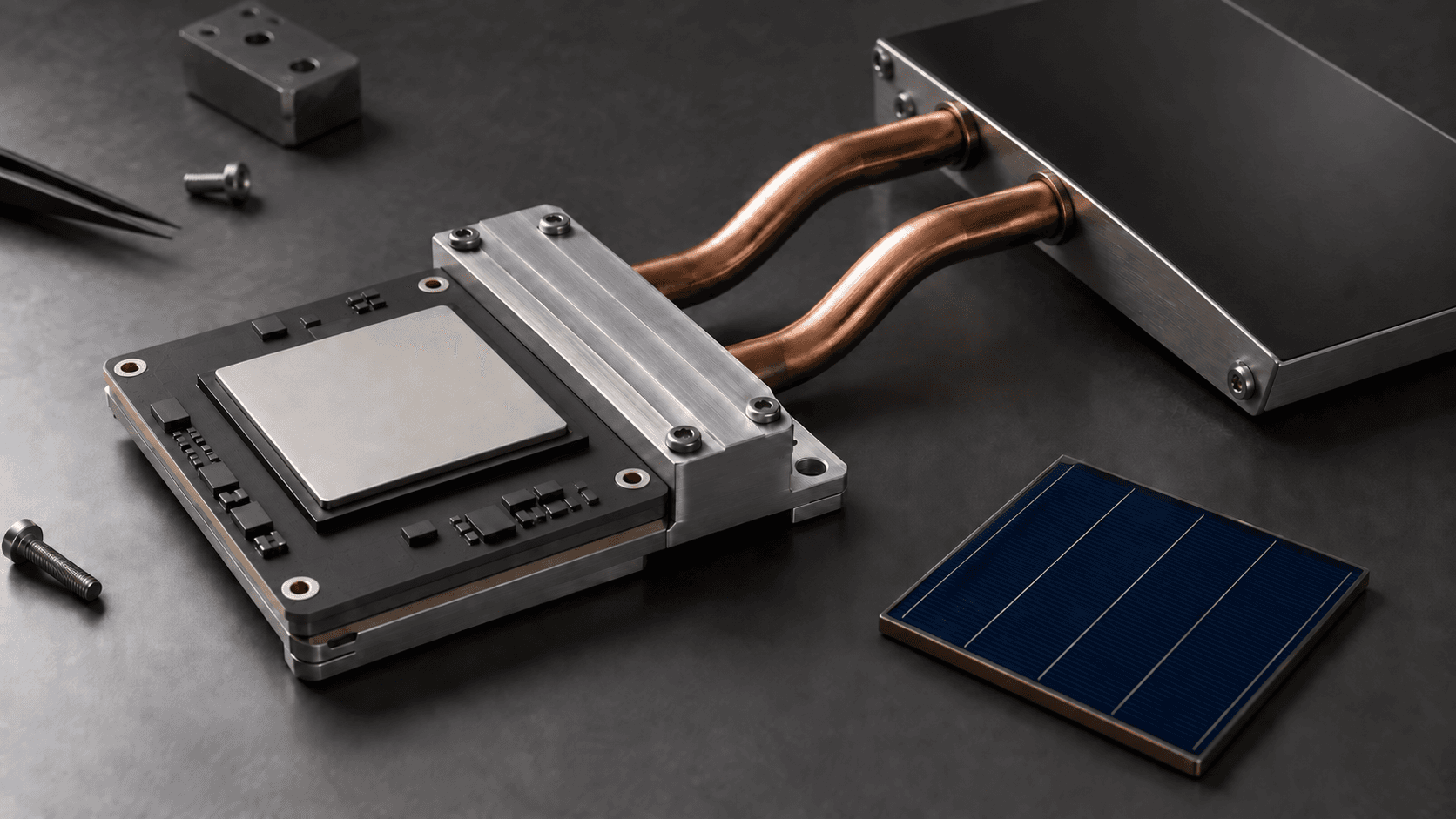
Putting an AI chip into orbit is a hardware experiment. Putting a dependable computing business there is a different undertaking. Google's next Project Suncatcher mission matters because it can begin answering the first question with flight data, while leaving the much larger commercial claim exactly where it belongs: unproven.
On September 24, Google said it plans to send a prototype carrying its Tensor Processing Units into low Earth orbit the following week. Developed with Planet, the mission is slated for SpaceX's Transporter-18 rideshare. Its job is to measure how the hardware handles launch, radiation and thermal conditions. It has not launched as of this report, and Google is not announcing a working orbital cloud service.
Reuters independently reported the planned test, while emphasizing the engineering, launch-cost and satellite-production obstacles between experiments and commercial operation. That reporting corroborates the announcement, not the hardware's performance in orbit. There are no flight results from this mission to evaluate yet. Keeping those two forms of evidence separate is the minimum price of admission to this conversation.
Suncatcher itself is not new. Google's November 2025 announcement outlined the ambition and a later learning mission involving two satellites. The new development is an earlier, focused hardware flight test. Google's latest update keeps a two-satellite laser-link experiment on the roadmap for 2027. Readers should not combine those steps into a single demonstration that has somehow already proved the entire architecture.
The appeal begins with energy. Google's system-design work favors a dawn-dusk, sun-synchronous orbit with nearly continuous solar exposure. The proposal is to use the electricity where it is generated, rather than beam power down to Earth. That is an intelligible engineering choice. It does not mean sunlight arrives packaged with cooling, reliable computers, a network and a customer contract.
Those missing pieces are where the interesting work lives. Consider a buyer who wants a batch of useful computations completed by a deadline. The buyer does not consume panel output or chip specifications in isolation. The service has to turn those inputs into correct results, deliver them and remain available when something goes wrong. Moving the equipment changes how that promise must be fulfilled.
Google says its hardware has undergone vibration testing and that it has run AI workloads during proton-beam exposure at UC Davis. It also reports thermal-vacuum testing of its cooling approach, which combines heat pipes with radiators. These are company-reported ground tests. Their purpose is to reduce uncertainty before flight, not to make the actual operating environment redundant.
Radiation is especially easy to oversimplify. NASA distinguishes sudden particle-induced effects from damage that accumulates over time. An individual strike can disrupt a circuit or corrupt data; long-term exposure can gradually degrade components. NASA's testing guidance also stresses that the destination matters. A statement about surviving radiation has little meaning without an environment, a duration and a definition of failure.
Shielding and redundancy help, but each involves a trade. NASA describes shielding as additional mass that engineers try to minimize through better characterization of the environment. It also describes using multiple parts so that a temporarily disabled component does not stop the whole system. These are established mitigation approaches, not evidence that Suncatcher has already achieved any particular service guarantee.
The revised Suncatcher preprint adds a necessary qualification to the survival story. Its authors report silent data corruption during end-to-end workloads and say the effects on training jobs, along with system-level mitigations, require further study. A device can avoid permanent damage while still returning an incorrect result. Those are different outcomes, and a serious evaluation has to measure both.
For the eventual service, our first acceptance question would therefore be about verified useful work. How much work completes correctly? How are errors detected? What gets retried, and what state survives a reset? These are proposed evaluation criteria, not disclosed mission results. A photograph of functioning hardware would be encouraging. It would not answer whether that hardware can be trusted with a long-running workload.
Cooling creates a similarly sharp distinction between an attractive environment and a usable system. NASA's SmallSat thermal-control reference explains that vacuum removes convection, while conduction moves heat through connected materials and radiation exchanges it with the surroundings. A chip still produces heat. That heat needs a designed path away from the sensitive electronics and ultimately out of the spacecraft.
NASA's heat-balance account includes more than the computer itself. Sunlight, reflected sunlight and infrared energy from the planet all matter, alongside stored and internally generated heat. Radiator area, surface properties and orientation affect rejection. The spacecraft cannot simply be described as sitting in a cold place. Its temperature comes from the balance of energy entering, accumulating and leaving.
That is why thermal telemetry should be read alongside workload telemetry. If an experiment reports successful computation, the useful follow-up is under what sustained load and with what temperature margin. Our recommendation is to ask for the operating envelope, not just the most flattering moment within it. For a builder, the distinction determines whether the next design can be repeated confidently or needs another round of testing.
Networking is another dependency, not an accessory. Google's research describes closely spaced satellites exchanging data through optical links to support distributed machine learning. Its laboratory demonstrator achieved 800 gigabits per second in each direction. That is a bench result, not an orbital throughput measurement. The proposed architecture uses proximity to make high-bandwidth connections more practical than they would be across much longer distances.
A fleet can contain plenty of processors and still be a poor computer if they spend too much time waiting for one another. The relevant test is therefore not merely whether a laser connects two moving objects. It is whether the connection supports the intended workload predictably. For a future buyer, interruptions, recovery and sustained performance would matter more than a single peak transfer figure.
Google's planned 2027 experiment is a place to begin testing that dependency. Until then, the first flight should be judged for the narrower questions it can answer. This is not lowering the bar. It is assigning the correct bar to the correct experiment. Demanding proof of the final business from the first prototype is as sloppy as treating the prototype as proof of the final business.
The economics deserve the same discipline. Google's revised preprint explores a conditional path toward launch prices around $200 per kilogram by the mid-2030s. It explicitly says the analysis is not a comprehensive economic feasibility study. Its comparison of annualized launch-related power costs with terrestrial electricity spending excludes infrastructure or building costs and chip costs. It is not an all-in price for delivered AI computation.
For an investment decision, we would want a model that keeps those categories visible rather than burying them in one optimistic total. Manufacturing, integration, launch, operations, replacement and customer delivery should each have an assumption attached. A sensitivity test should then ask which assumption changes the conclusion. A project that only works under one favorable scenario has a research case, not yet a durable commercial case.
That does not make early spending irrational. A well-designed experiment can purchase information that changes the next decision. The standard should be whether its findings distinguish between plausible architectures, expose a failure mode or narrow a cost estimate. Even an unsuccessful test can be valuable under that standard. The waste would be collecting a dramatic headline without learning enough to choose the next engineering step.
There is also more than one market hidden inside the phrase space computing. ESA's 2024 work with IBM and KP Labs examined scenarios in which satellite data is processed in space and only useful results travel to the ground. One example considered identifying potential wildfires before requesting more detailed observations. ESA presented this as a forward-looking study, not a deployed commercial service.
That use case starts with data already in orbit. A general-purpose service handling terrestrial customers' workloads starts with a different data journey. The distinction suggests a better product question: which workload benefits enough from the location to justify its additional constraints? Winning a narrow satellite-processing task would be meaningful without establishing that ordinary cloud demand should migrate upward. Conversely, a successful chip test does not identify the paying customer by itself.
Environmental claims need their own accounting. ESA's life-cycle assessment framework evaluates resource use and environmental effects from material extraction through disposal or recycling. Applied here, that means a favorable solar-power argument cannot substitute for an assessment of the complete system. Manufacturing and launch belong in the boundary, and the comparison should specify what happens when hardware reaches the end of its useful life.
Our preferred comparison would use a unit the customer can actually recognize: a defined amount of correctly completed work at a stated availability level. Then compare the resources and emissions required to provide it under each architecture. That avoids awarding environmental credit merely for moving an activity out of sight. It also leaves room for a genuinely better design to demonstrate its advantage with evidence.
For Space Coast builders, this is an opportunity to watch the interfaces between disciplines rather than just the rocket carrying the payload. Thermal hardware, electronic reliability, optical networking and test instrumentation all appear in the technical problem. That is a map of engineering questions, not a claim of local contracts or guaranteed demand. Any supplier opportunity still needs an actual requirement, customer and procurement path.
The next useful update will be specific: what flew, what operated, what failed and what the team changed as a result. Google's first orbital test could replace assumptions with measurements. That is worth taking seriously. But the milestone to celebrate is better evidence, not the premature declaration that the data center has escaped Earth.
LaunchPad positionEvaluate flight reliability, error handling and total delivered computing costs separately. A surviving chip does not establish a commercial orbital data center.
This report draws on the linked primary sources and reputable reporting. Company statements are treated as claims until independently demonstrated.