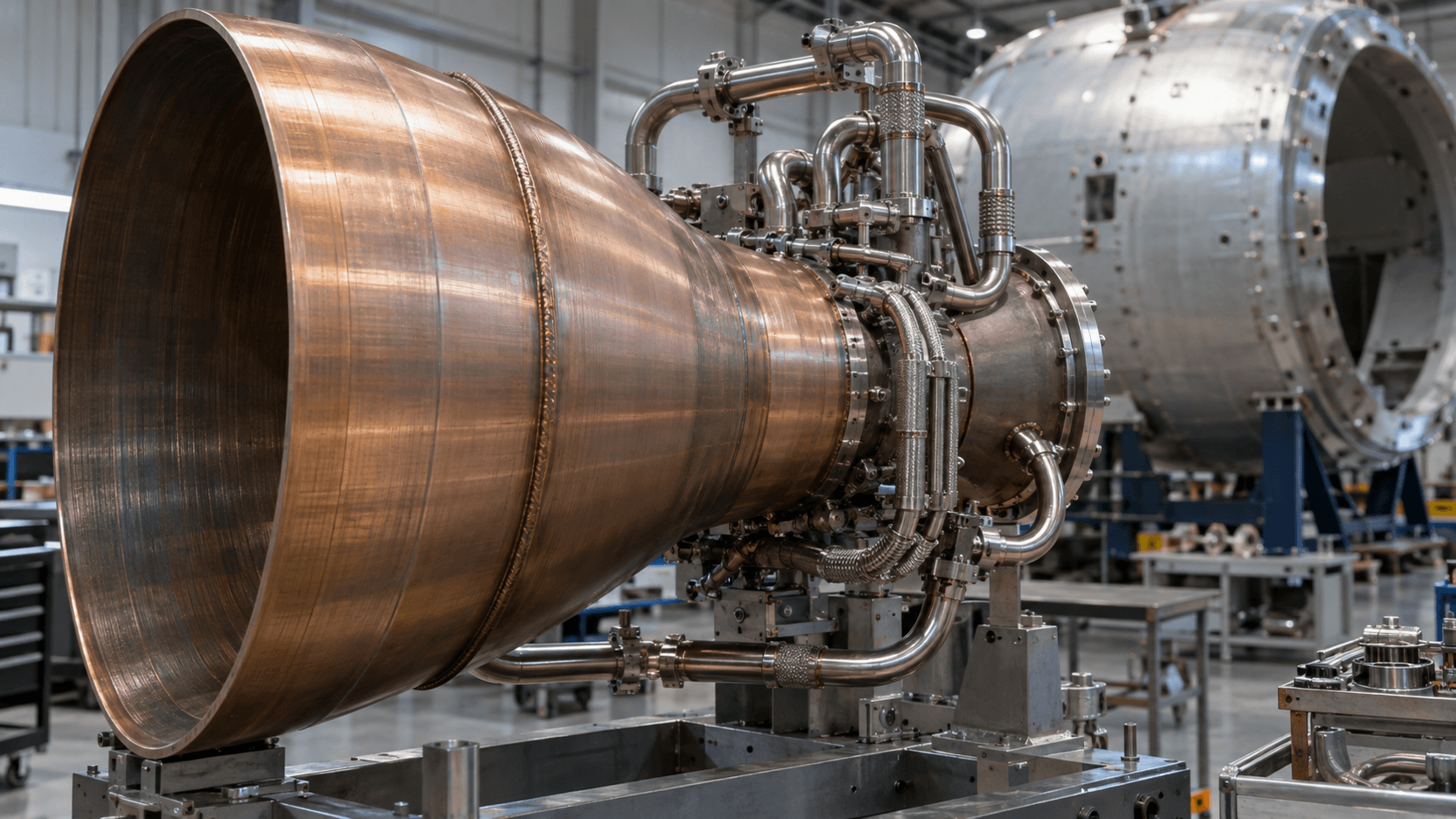
A cargo capsule and a rocket engine can belong to the same company without belonging to the same investment clock. The Exploration Company's new financing puts both under one headline. Understanding the announcement means pulling them apart again: one program is trying to deliver a complete orbital logistics mission, while the other is building propulsion for a much larger transportation system that does not yet exist as an operational product.
The company announced a $450 million Series C on September 8, co-led by Bessemer Venture Partners, Atomico and the Scaleup Europe Fund managed by EQT. Its release says the financing remains subject to applicable regulatory approvals. That qualification matters even when headlines describe the money as raised. The announced amount is a financing commitment with conditions, not public proof that every dollar has arrived and become unrestricted spending capacity. The company's approximately $680 million total funding figure is likewise not a cash-balance disclosure.
Nyx remains the near-term priority in the company's own account. The reusable capsule is designed to carry cargo to space stations and bring it back to Earth, with a full-scale orbital demonstration intended to include docking with the International Space Station. Storm is the second program: a reusable, high-thrust engine intended to support a future European heavy launcher. Neither a successful financing announcement nor progress on one program should be treated as proof that the other has cleared its engineering gates.
For Nyx, the meaningful unit of progress is an end-to-end mission rather than an isolated piece of hardware. Sending a vehicle toward orbit, approaching a station, transferring cargo and returning safely are distinct responsibilities inside one customer service. That is the commercial logic of the planned demonstration. A prospective customer needs confidence in the complete trip, not simply evidence that the capsule can be manufactured. The company's stated plan should be judged against that full sequence.
TechCrunch reports a target of November 2028 for Nyx to dock with the station and return. European Spaceflight independently places the demonstration in 2028, citing an earlier company announcement. This is a development target, not a booked result readers should place in the completed column. The precision of the month does not remove the uncertainty. The useful follow-up is whether the intervening qualification and mission-readiness work supports that target as the program progresses.
The company describes Nyx as launcher-agnostic. Strategically, that means the capsule's commercial proposition is not supposed to depend on the company first completing its own heavy rocket. That separation is valuable: it offers a way for orbital logistics to become useful before the entire transportation stack is vertically integrated. It also creates a discipline problem worth watching. The nearer-term service must retain enough attention and resources while management develops the larger propulsion ambition alongside it.
Crew transport is a future growth possibility in the announcement, not a capability being delivered by this financing news. TechCrunch's press-conference reporting describes chief executive Hélène Huby explaining the difficulty of asking venture investors to finance a long wait for a crew capsule. The practical signal is prioritization. Cargo is the program being positioned to establish a usable service first. Treating future crew ambitions as if they were part of the current product would erase precisely the sequencing management is describing.
Storm occupies a different stage of the engineering argument. The company describes a liquid-oxygen and biomethane engine using full-flow staged combustion, with the aim of supporting a reusable European heavy launcher. The release presents the engine as development work, not flight-qualified propulsion. It provides no basis for claiming that a complete launcher is ready, that a particular launch cadence has been achieved or that the advertised transport economics have already been demonstrated in service.
More useful than the superlatives is the test sequence. The company says the financing supports pre-burner and subscale thrust-chamber tests in the coming months, followed by an oxygen-rich power-pack test and a workhorse engine test over the next several years. Those are forward milestones. Their value will be the evidence they produce about whether the system behaves as intended, not merely the fact that a test stand becomes active or a dramatic firing video appears.
Investors and potential customers should therefore ask what each test actually establishes. Does it exercise a component by itself or an integrated assembly? Does a published result cover the intended operating conditions? What remains untested before the next stage? These are diligence questions, not assertions that the program has a particular defect. They keep the evaluation connected to the announced development sequence instead of allowing a component result to become a proxy for an operational rocket.
The eventual launcher ambition is substantial: the company describes a vehicle capable of carrying up to 40 tons to low Earth orbit in reusable configuration. That number is a company target for a future system, not Storm's standalone carrying capacity or a demonstrated payload result. An engine is one part of the machine that would have to deliver it. Reporting the target without the surrounding conditional language would turn a proposed architecture into an existing competitor overnight.
Huby made the financing boundary unusually clear in the press conference, according to TechCrunch: building the rocket itself and its launch pad will require more money. That is a more useful disclosure than a generic claim that the company is fully funded for its vision. The Series C can advance the path without financing every destination on it. Anyone evaluating the business needs to separate the next funded engineering steps from the later capital requirements that still have to be solved.
There is a reasonable strategic case for developing propulsion before the complete launcher is financed. If a critical technology matures, it can change which larger projects are credible and what future partners are willing to consider. The counterargument is just as important: a technically promising subsystem does not automatically create an economic buyer for the full vehicle. The company still needs a path that connects engineering evidence, customer demand and the capital required to assemble the final service.
Commercial demand also needs careful labeling. The company says it has more than $2 billion in contracts and commitments from public and private customers. European Spaceflight points out that this combined category does not reveal how much represents firm contracted business versus conditional or non-binding future demand. A reservation of interest, an agreement dependent on milestones and earned revenue can all tell useful stories. They cannot be added together and presented as though they have identical financial meaning.
For a builder reading the announcement, the relevant questions are conversion and timing. Which agreements become payable after a specific demonstration? Which depend on a customer's own infrastructure becoming available? What portion requires another procurement decision? The reviewed disclosures do not provide a complete breakdown. That missing detail does not make the demand fictitious, but it limits how confidently anyone can translate the headline into a revenue schedule or the amount of development spending it can support.
Institutional relationships deserve the same precision. The company points to a Space Act Agreement with NASA supporting technical and safety qualification and certification activities for future missions. That is not the same thing as a NASA cargo purchase award, and it is not proof that certification is complete. Work with an agency can reduce uncertainty about the route to acceptance while still leaving the company responsible for demonstrating that its hardware and operations satisfy the relevant requirements.
This is where the European sovereignty argument becomes more concrete. Owning more of the capability to supply and return from orbit could give institutions and commercial operators additional choices. But independence should be evaluated as an ability to deliver a service, not as a count of domestically branded components. The company's transatlantic investors and international customer ambitions are not automatically inconsistent with European industrial capability. The useful distinction is between building durable technical control and pretending that independence requires operating without partners.
There is also an execution tradeoff between breadth and focus. A company pursuing both a logistics capsule and advanced propulsion can potentially build knowledge across related areas. It can also end up competing with itself for management attention and scarce development resources. The announcement does not disclose enough program-level economics to settle that tradeoff. The sensible evaluation is to watch whether the near-term capsule milestones remain clear and whether propulsion progress is reported with its own boundaries and evidence.
For customers, procurement should follow the service actually needed. Someone buying cargo delivery and return should evaluate the capsule mission, its interfaces and the conditions of the agreement. Someone considering a future launcher relationship needs a different set of answers about propulsion maturity, vehicle development and funding. Treating both as one broad bet on space can make an investment presentation feel coherent while leaving an operating team uncertain about what it is actually purchasing and when it can use it.
The financing announcement is consequential because it gives these ambitions a larger capital base and a more explicit sequence. It does not collapse that sequence into one finished platform. The next credible updates should show regulatory conditions resolved, Nyx advancing toward its complete demonstration and Storm producing interpretable test evidence. Keep those scorecards separate. Europe does not gain another dependable route to orbit when a company announces that it intends to build one. It gains it when the hardware, operations and commercial commitments finally meet.
LaunchPad positionTrack cargo demonstration, propulsion test results and financing conditions separately. European space independence becomes real through qualified hardware and delivered missions, not a combined ambition figure.
This report draws on the linked primary sources and reputable reporting. Company statements are treated as claims until independently demonstrated.