Autonomous-vehicle security usually asks whether an attacker can fool a camera. A new paper asks a more dangerous question: can the attacker change the geometry that tells every sensor what the camera is seeing?
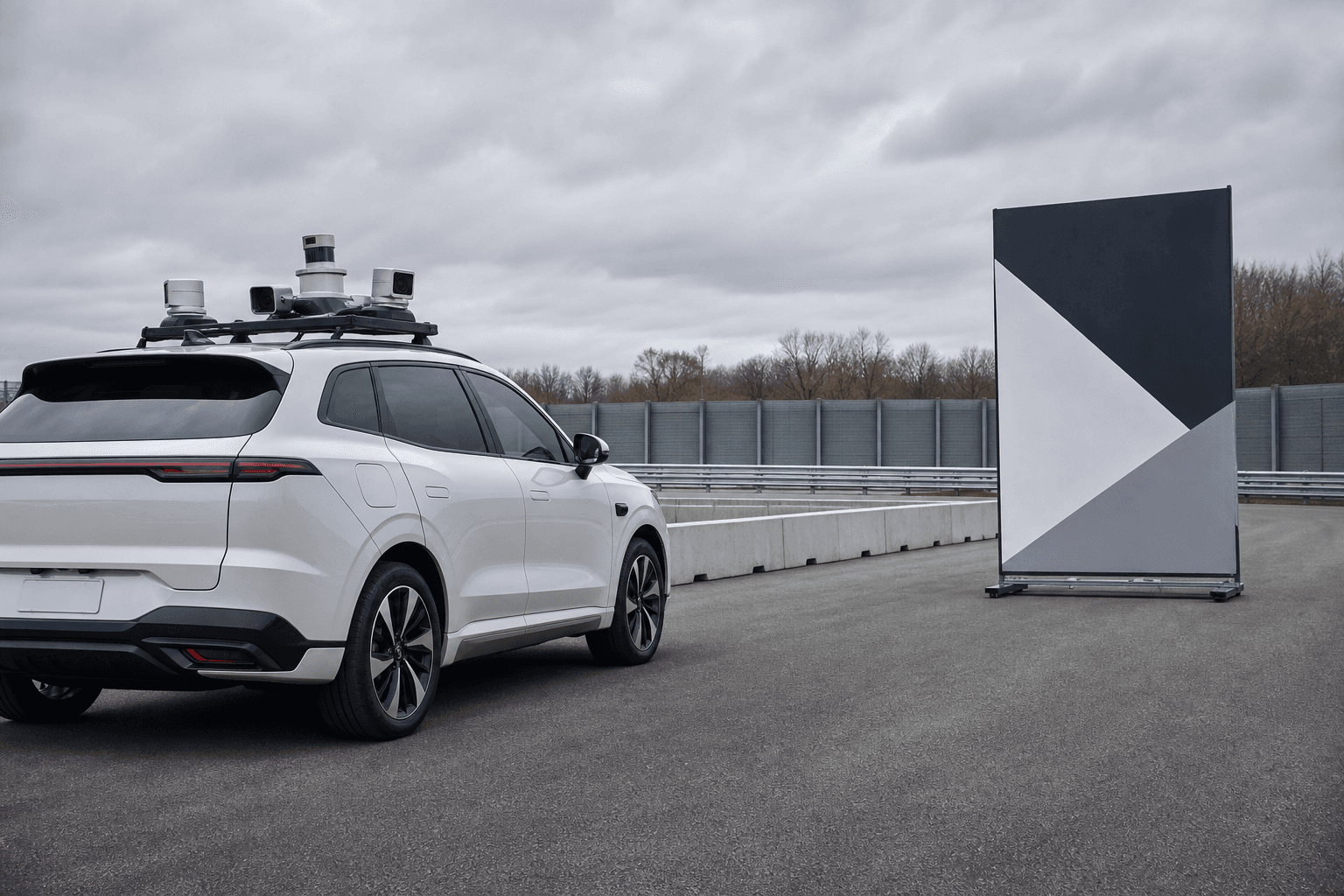
Researchers Liangkai Liu, Qingzhao Zhang, and Kang G. Shin describe what they call the first physical attack against online camera-lidar calibration. These calibration systems correct alignment drift caused by vibration, temperature, or small sensor movement while the vehicle keeps operating. The researchers designed one adversarial poster to first trigger recalibration and then steer the estimator toward a false transformation.
The corruption persists after the vehicle passes the poster because the poisoned transformation becomes the new state used by later sensor-fusion operations. In the authors' tests on KITTI and nuScenes data, the attack produced mean rotational errors as high as 33.9 degrees and degraded object detection. In a crafted CARLA simulation, a vehicle accepted the bad calibration and collided. A printed poster also reproduced calibration error on a Husky research robot.
Those results come from a preprint, benchmark data, simulation, and a ground robot, not a demonstrated attack on a production vehicle on public roads. The paper does not prove that every online calibration system is vulnerable. It proves that the update mechanism itself belongs in the threat model.
That changes the defense. Filtering suspicious objects in a camera frame is not enough when the attacker can poison the relationship between sensors. Calibration updates should be bounded, independently cross-checked, logged, and reversible. A large change should trigger a degraded safe mode instead of being trusted because an optimizer converged.
The broader lesson applies beyond cars. Robots increasingly update maps, tool offsets, camera positions, and world models while operating. Any system that learns its own geometry in production is accepting changes to the definition of reality. That deserves the same scrutiny as a software update, because the machine will act on it long after the trigger disappears.
LaunchPad positionAutonomous systems need to treat calibration updates as security-sensitive state changes. A correction process that can silently rewrite how sensors agree on reality requires validation, rollback, and safe fallback behavior.
This report draws on the linked primary sources and reputable reporting. Company statements are treated as claims until independently demonstrated.