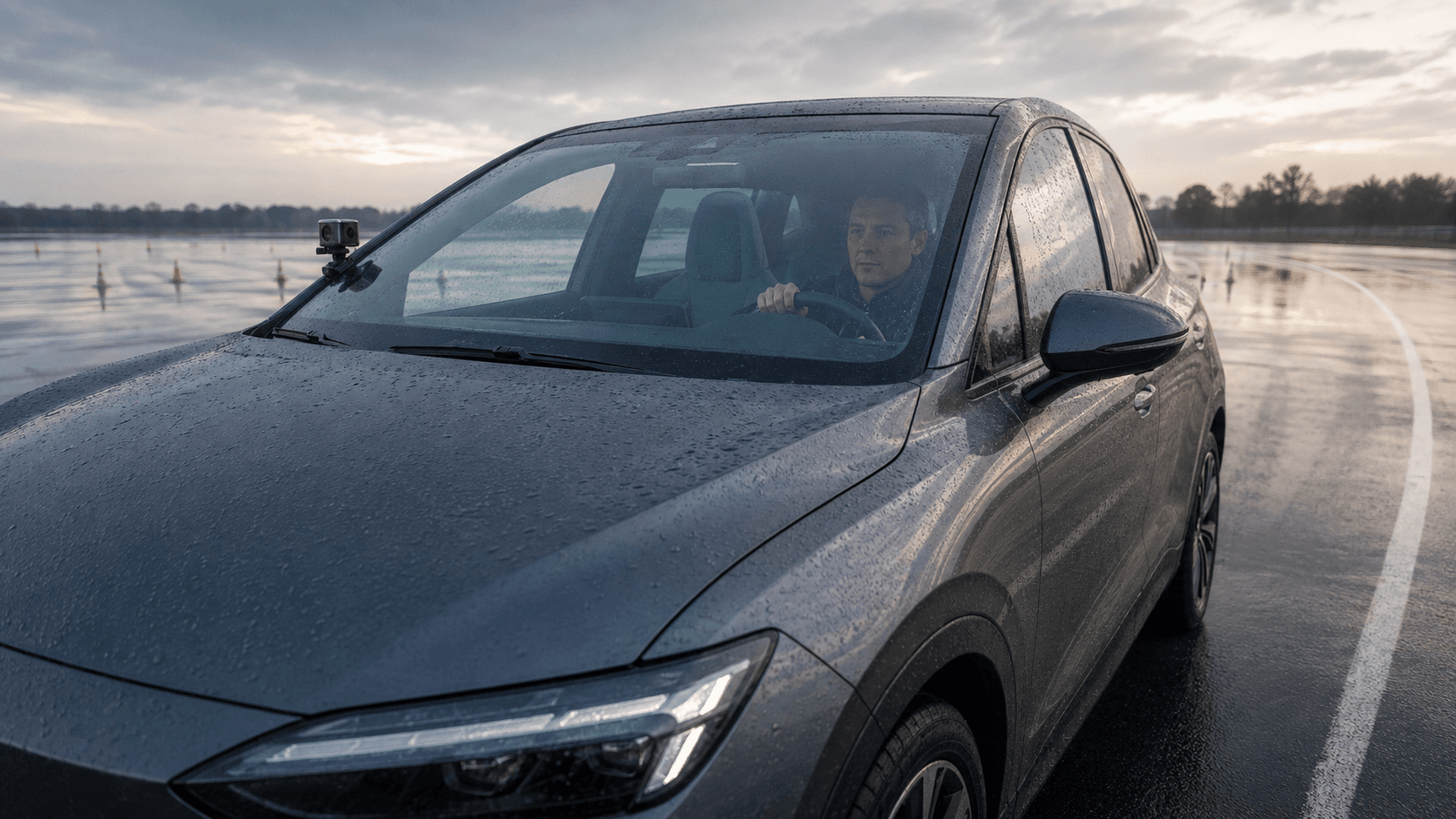
Londoners can now book a ride that lets the software drive while a human remains ready to take over. That sentence is less glamorous than 'the robotaxis have arrived,' but it describes a more useful milestone. Wayve and Uber have moved automated driving into an ordinary passenger transaction. They have not removed the person responsible for supervising it. The launch deserves attention precisely because it exposes the distance between a working AI driving system, a dependable transport service, and a business that can operate without an onboard driver.
Uber's September 3 announcement says customers requesting UberX, Uber Electric, or Uber Comfort may be matched with a Wayve-equipped Ford Mustang Mach-E at no additional charge. Riders can accept that match or choose a non-autonomous vehicle before arrival. The stated launch area covers London except airports. Each vehicle carries a trained, Transport for London-licensed private-hire driver overseeing the journey. Those are the published service conditions. They are not a claim that a car will be available on every street whenever someone opens the app.
The Associated Press separately confirmed the human-supervised arrangement and reported that the initial deployment would have fewer than 20 vehicles, citing Uber's autonomous-mobility executive. Its reporting also described driverless approval as unresolved, with no clear timetable for removing the safety driver. The useful headline is therefore a small public deployment, not fleet-scale driverless coverage. A passenger can encounter the product through a familiar booking service, while a consequential part of the operating system remains a trained person in the front seat.
That creates a different learning opportunity from a demonstration arranged for an invited audience. Our assessment is that a public service can test whether booking, pickup, boarding, route communication, and trip completion fit together coherently. A car that handles the driving but leaves a passenger confused about how to begin is not a finished transport product. Neither is a polished app attached to a vehicle that cannot complete the trip reliably. These are separate layers of execution, and the launch brings them into the same customer experience.
The human supervisor should be treated as an active component, not a temporary prop. The government's automated-vehicle trialling code calls for trained, licensed safety drivers who understand the system's limitations and can intervene. It addresses alertness, fatigue, training for transitions between automated and manual control, and avoiding other duties that distract from supervision. That is an operating discipline in its own right. The question is not simply whether someone occupies the seat, but whether the organization has made that person effective when the automation needs help.
A supervised trip therefore does not establish what the machine would have done alone. For evaluation, we would want to distinguish uneventful automated operation from interventions that prevented a problem, interventions made cautiously, and interruptions unrelated to the driving model. Lumping those events together can hide both progress and weakness. The reviewed launch materials do not provide a London intervention dataset that resolves those questions. That absence is not evidence that the system is unsafe. It is a limit on what an outside observer can conclude from launch day.
Wayve's technical proposition is different from manually scripting every driving situation. The company describes an end-to-end neural network that converts sensor inputs into driving outputs, trained on diverse experience. It says the system does not depend on detailed high-definition maps and describes a fleet-learning cycle of recording data, training, evaluation, and deployment. These are Wayve's descriptions of its approach, not independent proof that the system generalizes safely to every road or weather condition. Mapless also should not be read as permission to ignore geography or operating boundaries.
The engineering appeal is understandable. If useful driving behavior transfers across environments, a developer could reduce the amount of location-specific work required for expansion. But that is a conditional economic advantage, not a result established by one city launch. An unfamiliar junction, an unexpected obstacle, or a changed road layout still requires a correct response. The important test is whether learned behavior remains dependable under the conditions the operator actually permits. A successful trip demonstrates one outcome. An expansion decision needs a reasoned account of the situations in which that outcome can be expected.
Wayve's product documentation also shows why calling this just a model would miss the implementation. Its platform description includes safety mechanisms, interfaces for integration, data collection, and cloud-based monitoring and configuration alongside the driving models. The company positions the software for integration with vehicle manufacturers and markets a portfolio spanning assisted driving through higher automation. That breadth explains the ambition, but a product portfolio is not a certification for a particular service. The operating status of the London cars comes from their actual deployment conditions, not the most advanced label on a product page.
Software changes are another place where the business gets harder than the demo. In our view, a fleet-learning strategy needs a disciplined answer to which version is running in which vehicles and why it was approved. An improvement on a new test should not conceal a regression on an old one. The operator also needs a process for withdrawing a problematic release. These are evaluation questions, not claims that Wayve has failed to manage its software. They are what turns the promise of continuous improvement into something a passenger service can responsibly depend on.
The British government explicitly distinguishes supervised trialling from its driverless pilot scheme. The pilot application guidance says it does not apply to a vehicle that depends on a safety driver for immediate monitoring or control. It instead describes assessment of the vehicle, automated-driving system, operator, and passenger service. Its expectations include safe operation without individual monitoring, a documented safety case, protection against cyber threats, secure updates, and safety-related data recording. The supervised London launch should not be confused with having demonstrated or received every approval in that separate process.
This distinction matters commercially because removing the driver changes more than the payroll line. Someone still has to maintain the vehicle, resolve passenger problems, handle interruptions, and coordinate recovery when a journey cannot continue. We are not assigning costs to those functions here: the reviewed materials do not disclose enough London operating economics to calculate a credible margin. The correct conclusion is narrower. A paid trip can establish that there is a sellable experience, but it cannot by itself establish the cost or reliability of operating that experience without the onboard supervisor.
The government's first-responder guidance makes the surrounding work unusually concrete. For driverless pilots, it discusses identifying vehicles, stopping them safely, recovering them, training responders, and giving emergency services a contact while vehicles are operating or parked in public. It also addresses communication around incidents and changes to response procedures. Those provisions describe the separate driverless regime, not proof of Wayve's present readiness. They show what must replace the easy assumption that an officer, passenger, or recovery worker can simply ask the driver what is happening.
That is a useful corrective to the idea that autonomy eliminates coordination. It redistributes it. Consider a hypothetical disabled vehicle blocking a narrow street: detecting the blockage, informing the passenger, reaching the operator, and arranging recovery are different jobs. A competent driving model may be necessary without being sufficient for the whole response. The stronger transport company will make the handoffs understandable before a disruption occurs. This is where clear responsibilities and practiced procedures can matter as much as an impressive explanation of how the model learned to steer.
There is also a constructive case for beginning with supervision. The public can encounter the service while the operator retains a person able to intervene, and the companies can examine the passenger experience before taking on the full driverless operating model. That is a defensible sequence to evaluate, not a guarantee of success. The weak version would treat the initial phase as a marketing endpoint and stop explaining what remains unresolved. The stronger version would make the next evidence threshold explicit and show why any expansion is justified by more than demand for rides.
For prospective vehicle and fleet partners, we would separate three questions. Does the software drive adequately within a defined operating area and set of conditions? Can the service organization handle the trip, including exceptions? Does the operating model make economic sense at the required level of human support? Evidence for one should not be silently borrowed to answer another. The distinction prevents a technically promising system from being valued as a completed business before the support costs, utilization, and approval path are understood.
Uber gives the deployment an existing place for passengers to request transport, but distribution should not be mistaken for guaranteed capacity. Our practical reading of the small launch is that it tests an additional type of vehicle within a larger service, rather than immediately replacing the service's human-driven supply. The advantage is that the companies do not need each prospective rider to learn an entirely unfamiliar booking behavior. The corresponding obligation is to make the differences in the ride clear enough that a customer can choose knowingly.
The next meaningful developments will be evidence, not a louder use of the word autonomous. Watch for transparent operating limits, understandable safety results, progress through the relevant approval process, and demonstrated readiness to handle trips without the current human fallback. For now, Wayve has reached a real customer-facing milestone in London. It has not made supervision disappear. Taking both facts seriously is how to recognize progress without lending it capabilities or economics that have not yet been shown.
LaunchPad positionJudge autonomous transport separately on driving capability, service operations, and economics. Public rides are meaningful progress, but they do not establish readiness to remove human supervision.
This report draws on the linked primary sources and reputable reporting. Company statements are treated as claims until independently demonstrated.