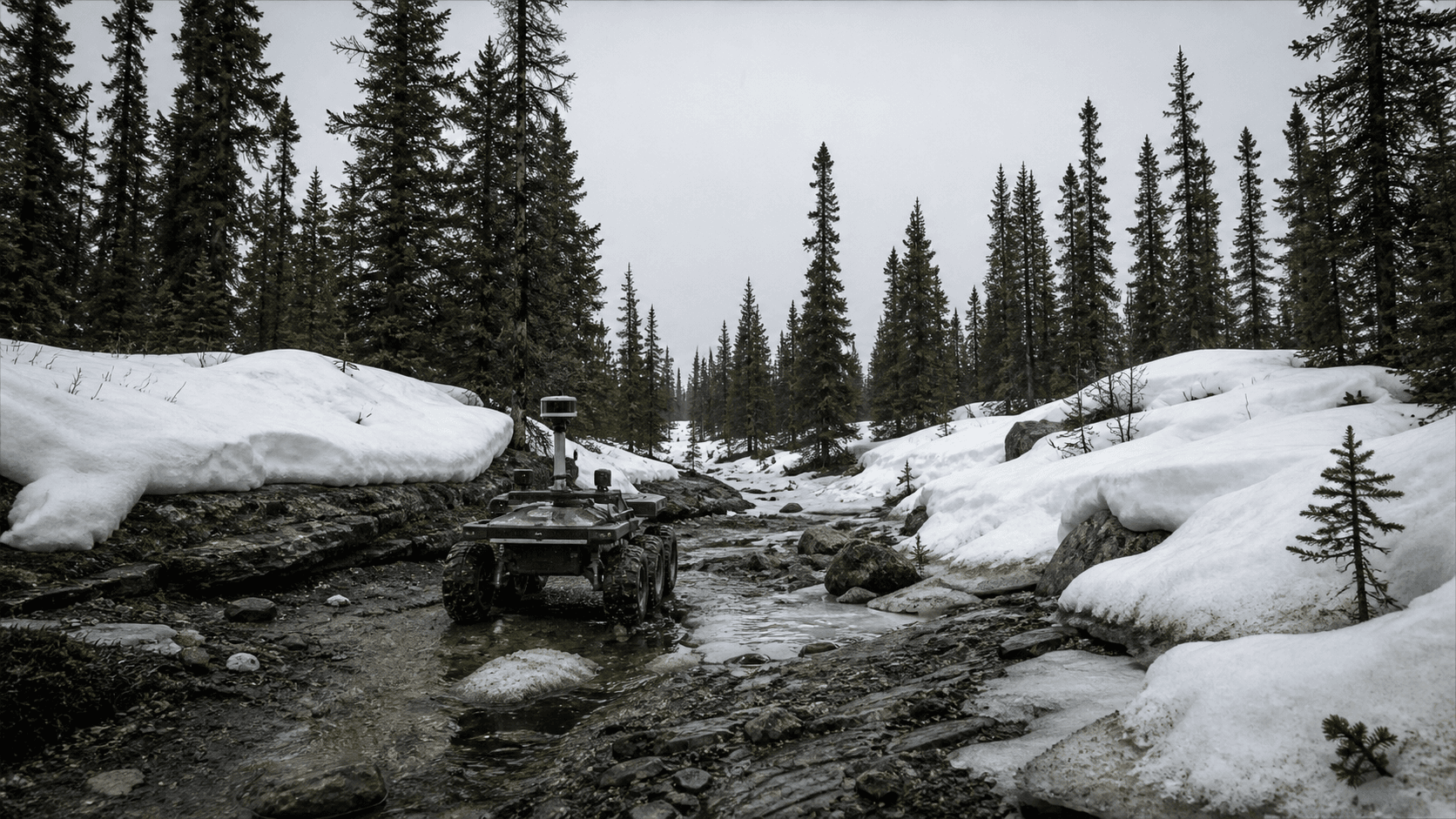
Autonomous navigation looks solved right up until the world changes color, texture, shape, and traction for six months. A new robotics preprint reports on a year-long mobile-robot deployment in a subarctic boreal forest, where the researchers collected 64 kilometers of data and compared nine odometry, localization, and mapping methods.
The environment is hostile to the assumptions inside ordinary benchmarks. Dense tree canopies make satellite positioning unreliable. Cloud access is not guaranteed. Tree corridors repeat. Snowbanks alter geometry, obscure landmarks, and turn last season's map into a confident lie. The robot has to sense and compute locally while the reference world keeps moving.
The researchers found that state-of-the-art methods became more fragile in self-similar scenes and around tall snowbanks. Complex simultaneous localization and mapping systems often produced limited accuracy gains over a simpler proprioceptive baseline while creating substantially more operational fragility. Better average error did not always mean a more dependable machine.
Cross-season results split by sensor. Lidar-based methods completed localization runs between seasons, while radar and visual approaches were prone to failure because too few features matched across runs, sometimes even within the same season. The authors also found visual SLAM especially vulnerable to seasonal change.
This is a preprint and one environment, not a universal ranking of sensors. Its value is the duration. A week can validate a demo. A year exposes the maintenance burden, calibration drift, weather transitions, and edge cases that decide whether autonomy becomes infrastructure. The next generation of field robots needs fewer benchmark victories and more seasons survived.
LaunchPad positionLaboratory accuracy does not equal field reliability. The study found that complex SLAM systems sometimes delivered small gains over a proprioceptive baseline while adding failure modes that mattered more than the average score.
This report draws on the linked primary sources and reputable reporting. Company statements are treated as claims until independently demonstrated.