SiMa.ai is asking hardware builders to change their minds about where the hard part of AI lives. The pitch is not simply a faster chip. It is a way to move an application onto different silicon without turning that decision into a software reconstruction project. Its new financing gives that argument more runway. The interesting question is whether the company can turn an attractive development experience into a repeatable reason to select its hardware.
On September 28, SiMa.ai announced a $150 million Series C at a $1.45 billion valuation, co-led by Fidelity Management & Research Company and Amplify. The company puts cumulative financing at $500 million. The money will support its Palette Neat software environment and a next-generation hardware program targeting 1,000 dense TOPS in the first half of 2028. That is a roadmap for future machine-learning IP, chiplets and systems-on-chip, not a specification for a product customers can install today.
TechCrunch independently reported the round and, citing PitchBook, put the previous valuation at $960 million following an $85 million Series B in July 2025. Its coverage describes SiMa.ai's bet on running AI inside devices rather than sending processing to the cloud. These are financing and positioning facts. They do not establish market share, profitability or an independently measured performance advantage. A higher valuation tells us investors are willing to underwrite a larger outcome, not that the engineering and commercial work is finished.
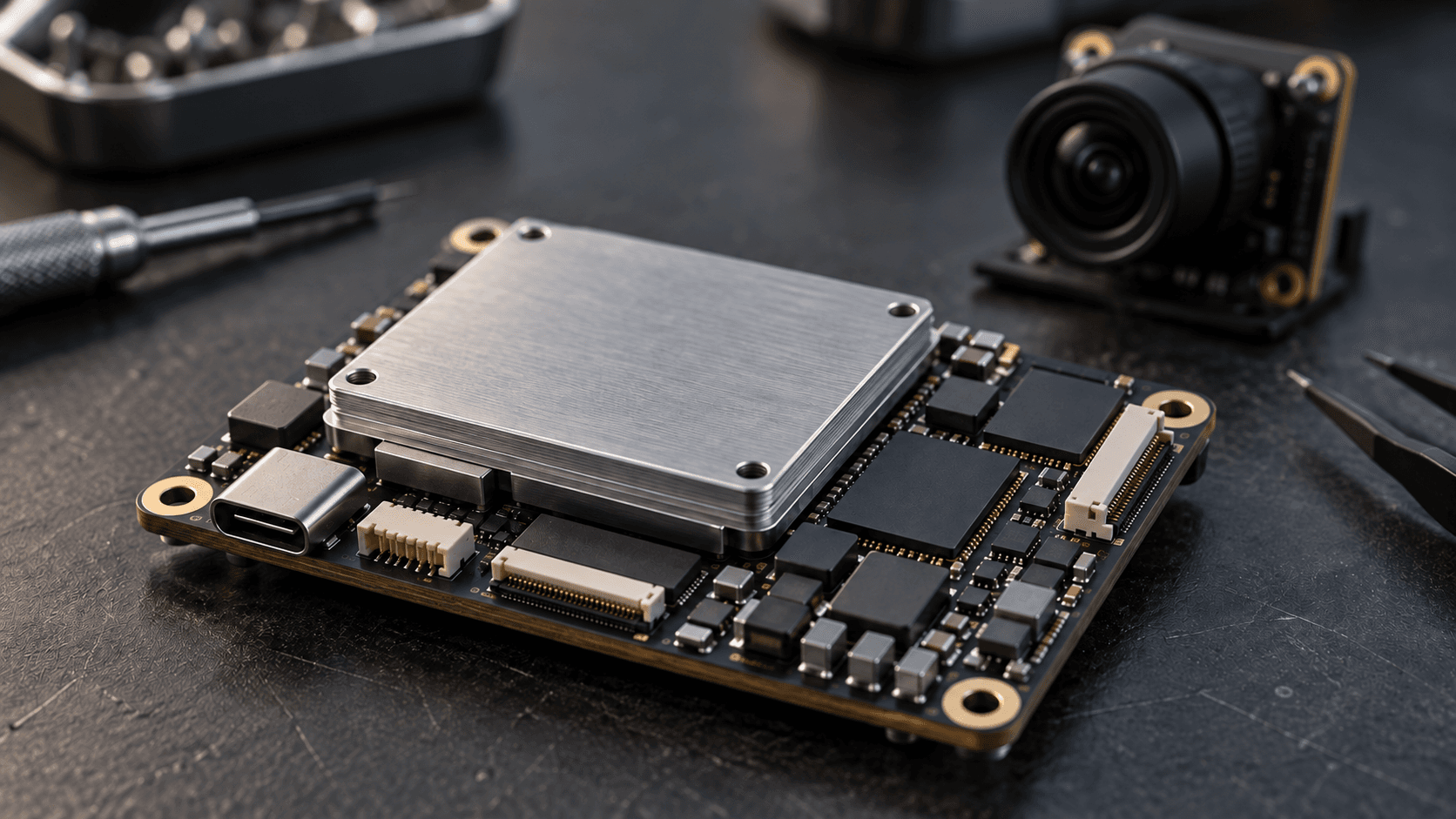
The hardware available for evaluation belongs to a different performance class from that future roadmap. SiMa.ai's current Modalix product page advertises 50 TOPS and operation below 10 watts, with multiple compute engines handling an application rather than only its neural network. Those are vendor specifications and claims. The practical attraction is the possibility of putting perception and application processing into a constrained device. The practical mistake would be treating the headline compute figure as a prediction of how every robot or camera system will perform.
TOPS is a count of operations per second, not a count of useful decisions. For a buyer, the useful comparison would hold the model, input data, output quality and latency requirement constant, then measure the power needed to sustain the complete application. A detector that processes more frames but misses the object that matters is not a better detector for that job. Likewise, an impressive accelerator result should not settle a purchase if the rest of the application cannot keep pace. This is an evaluation standard, not a finding from our own hardware test.
The Modalix module brief makes the surrounding system more tangible. It lists 8GB and 16GB memory configurations as standard products, with 32GB available by special order, using LPDDR5 memory. It also lists a 69.6 by 45 millimeter form factor, a 260-pin SO-DIMM connector and a 5-to-20-volt input range. These details belong in a design review because a module must fit an actual electrical and mechanical system, not just a comparison chart prepared for a funding announcement.
That same brief separates the machine-learning accelerator from application CPUs, a computer-vision unit, an image signal processor and video-codec functions. It specifies camera and peripheral interfaces, external storage connections and secure-boot capabilities. In plain English, this is a proposal to put several different jobs on the same module. The buyer should still verify the particular interfaces, memory configuration and security behavior its product needs. A list of supported blocks does not demonstrate that a customer's full workload has been qualified.
SiMa.ai's hardware page also offers a development kit at $1,499 and describes a module compatible with the NVIDIA Jetson Orin NX and Nano form factor. That potentially reduces one category of switching work: changing the carrier board. It should not be read as proof of software equivalence. Before budgeting a migration, I would separate mechanical fit, electrical compatibility, driver support, model conversion and application behavior. A successful result in one column does not automatically close the others, and keeping them separate makes a pilot much easier to price.
The company's software argument addresses that next layer. Its Palette page describes a workflow that takes an ONNX model through compilation, optimization and packaging, then runs an application across the host computer and the MLSoC. The development environment and runtime are separate pieces of that process. This matters because an application is more than a model file: the developer has to connect inputs, processing stages and outputs into something that runs. Palette's value proposition is making those connections easier to build and maintain.
The timing also deserves clarity. Palette Neat was announced on June 16, well before this financing. At that launch, SiMa.ai said natural-language development could compress work from months into days or hours and preserve approximately 90 percent of legacy software investment. Those remain company claims, not migration results independently reproduced for this report. September's capital raise is funding the expansion of an existing software strategy. It should not be packaged as the first appearance of the environment or evidence that every application can already be moved with one instruction.
There is a public implementation to inspect beneath that promise. The SiMa Neat GitHub organization describes Python and C++ interfaces, with GStreamer underneath the application layer. Its repository map separates model compilation, the development environment, example applications, inspection tools and language-model tooling. That division is useful evidence about how the product is organized. It is not a reason to call every part of the commercial stack open source, or to assume public availability proves that a production workload will meet its requirements.
The core library's documentation describes a concrete execution model. A Model loads a compiled archive. A Graph connects reusable processing fragments and custom nodes. A Run executes that graph, while tensors and samples carry data and stream information such as timestamps. This is less glamorous than an agent building a demo in a video, but it is the machinery a product team has to understand when a pipeline produces the wrong result. Generated application code still needs an intelligible runtime underneath it.
The same repository documents a measurement window for latency, throughput, counters, timing and optional board power. That is a useful starting point for a procurement test because it puts performance measurement alongside execution. I would ask the vendor and internal team to agree on that measurement window before comparing results: what starts the clock, what ends it and what equipment contributes to the power reading. These questions are not allegations that the published figures are wrong. They make competing answers describe the same experiment.
A particularly revealing test would use the buyer's existing application rather than a freshly selected showcase. Keep the inputs and acceptance criteria fixed, identify every change needed to compile and run it, and record the engineering hours spent on the transition. Then repeat with a second model or a changed sensor input. That second pass would help distinguish a reusable development advantage from an impressive one-off integration. If the software is the differentiator, the cost of the next change should be part of the evidence.
SiMa.ai's August 31 announcement with ARK Electronics offers another piece of context. The companies said their Modalix bundles were available to qualified drone manufacturers and system integrators, combining SiMa.ai's module and software with ARK's integration work. It is an example of a distribution and engineering route into a specific market. It is not a newly announced September deployment, a disclosed fleet size or a blanket certification of every aircraft that might use the bundle. Those are separate claims requiring separate evidence.
For a drone builder, I would turn that partnership into concrete questions about ownership. Which supplier supports the carrier board? Who reproduces a camera-driver failure? Which software version was used in the reference integration, and who maintains it through a product update? This is where a partnership can become genuinely valuable: not just by putting two logos on a slide, but by shortening the path from a fault to somebody who can fix it. The announcement alone does not answer every one of those support questions.
The application also needs a defined response when its perception system is uncertain or unavailable. A successful model demonstration should not silently become permission for unrestricted physical action. For any pilot, I would require the product owner to specify what the device may do, how it signals a failure and which decisions remain outside the model's authority. That is a proposed engineering requirement, not a claim that SiMa.ai's chip supplies an entire safety system. Buying inference capability and approving the behavior of a machine are different decisions.
The commercial disclosures leave meaningful blanks. SiMa.ai says revenue quadrupled between 2024 and 2025, but the financing release does not give an absolute revenue figure or the economics of individual deployments. Its customer-and-partner roster also combines different relationships. A company appearing in that list should not automatically be described as a volume customer. The information supports a story about financing and an expanding platform; it does not support inventing shipment totals, margins or purchase commitments to make the story feel more complete.
The strongest case for this strategy is that a credible alternative should make buyers negotiate on the whole development experience, not only on a chip specification. The strongest objection is that a convenient migration demonstration may not survive the awkward details of an existing product. Both can be true enough to justify a serious evaluation. A team should be able to preserve its application investment, measure its own result and obtain support without having to accept a market-dominance narrative as part of the purchase.
The next useful proof point is therefore quite specific: an application moved, validated and maintained under a disclosed set of constraints, followed by a customer willing to repeat the process. The new round gives SiMa.ai resources to pursue that outcome and a much larger hardware target to execute against. For builders, the near-term move is to test the platform that exists and keep the 2028 promise in a separate column. The opportunity is real enough to examine without pretending the roadmap has already arrived.
LaunchPad positionEvaluate the complete application, migration effort and support path on available hardware. Keep future compute targets separate from measured results.
This report draws on the linked primary sources and reputable reporting. Company statements are treated as claims until independently demonstrated.