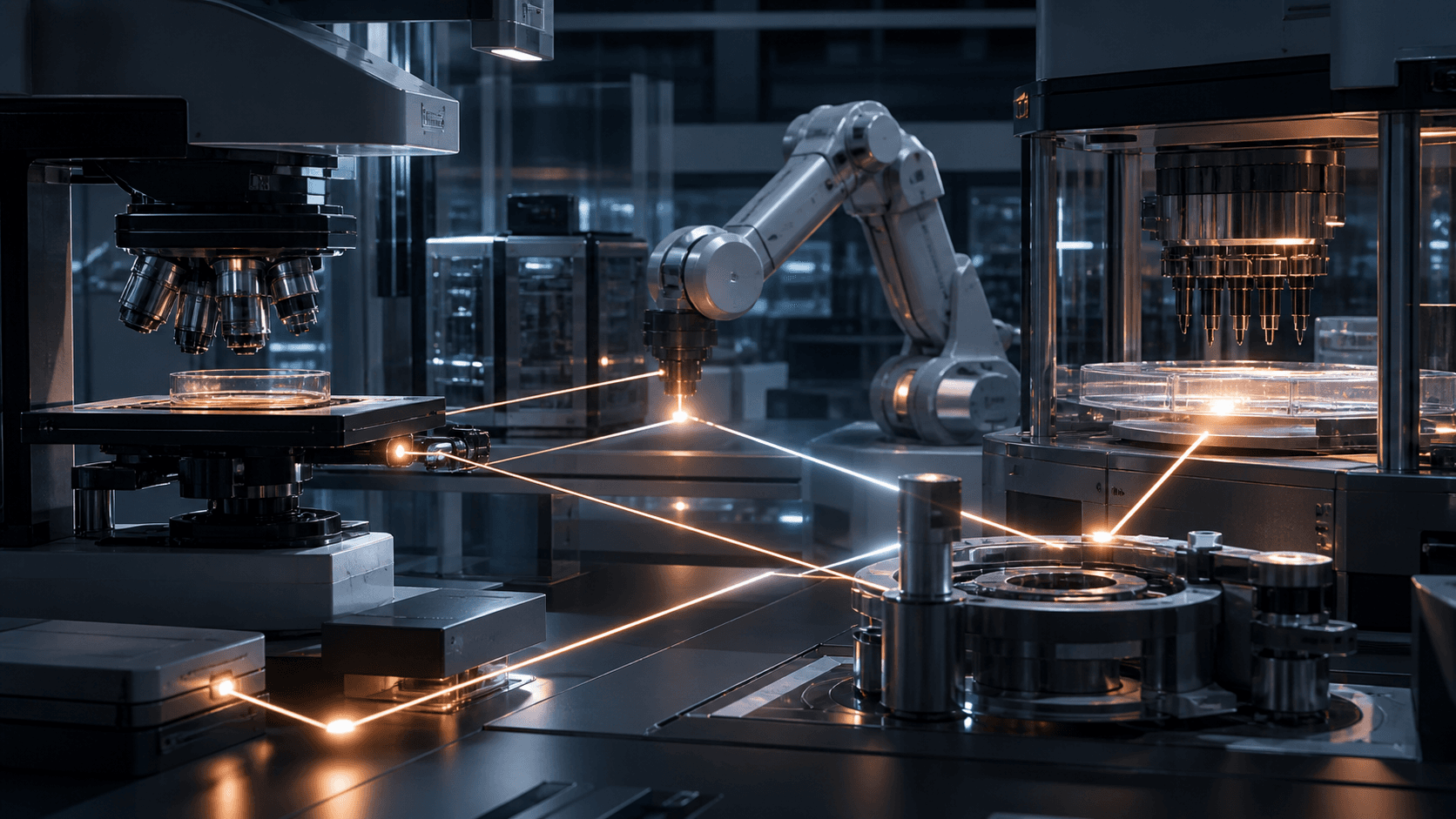
AI agents have been trapped behind glass. They can search, write, call APIs, and move through software, but the physical world still speaks in a thousand proprietary dialects. Anthropic is now testing a common language for the machines outside the browser.
The company opened a research preview of the Model Hardware Standard, or MHS, for scientific laboratories and advanced manufacturers. The specification is designed to let an agent discover a device, understand what it can do, read its state, and issue bounded commands. Anthropic says early integrations include microscopes, liquid handlers, robotic arms, and instruments used for quantum-computer calibration.
That does not mean Claude can walk into any factory and run the line. MHS is not yet open source, participation is limited, and physical reasoning remains uneven. The preview depends on device drivers that expose controls, safety limits, and machine-readable descriptions. Humans still define the experiment, approve critical steps, and decide what the agent is allowed to touch.
The architecture matters because hardware integration is where automation projects go to die. A lab may own excellent instruments that were never designed to coordinate. Every connection becomes a bespoke engineering job, and every upgrade threatens to break the workflow. Anthropic says MHS can cut some integrations from weeks or months to hours or minutes. That is a company claim from early deployments, not a universal benchmark, but it identifies the right bottleneck.
The bigger play is not remote control. It is turning an experiment into an executable system. An agent could monitor several instruments, adjust parameters, recover from a known error, and keep the workflow moving after the human team goes home. One partner reported roughly three times faster dose-response experiments. The important caveat is that these are controlled environments with defined protocols, not general-purpose autonomy.
Standards only become standards when other people surrender part of the interface. AWS, Hugging Face, Raspberry Pi, Automata, Doosan Robotics, and several scientific organizations are participating in the preview. That gives MHS a credible starting network. It does not guarantee adoption, compatibility, or safety across the long tail of industrial equipment.
Watch the driver ecosystem, the permission model, and the failure logs. If manufacturers expose serious controls and operators can audit every action, MHS could become for machines what common tool protocols became for software agents. If it turns into another vendor-specific wrapper, the physical world will remain a graveyard of expensive integrations. The specification is early. The category is not.
LaunchPad positionA common hardware interface could turn physical experiments into programmable workflows. The winner will be the standard that earns trust from equipment makers, operators, safety teams, and developers at the same time.
This report draws on the linked primary sources and reputable reporting. Company statements are treated as claims until independently demonstrated.