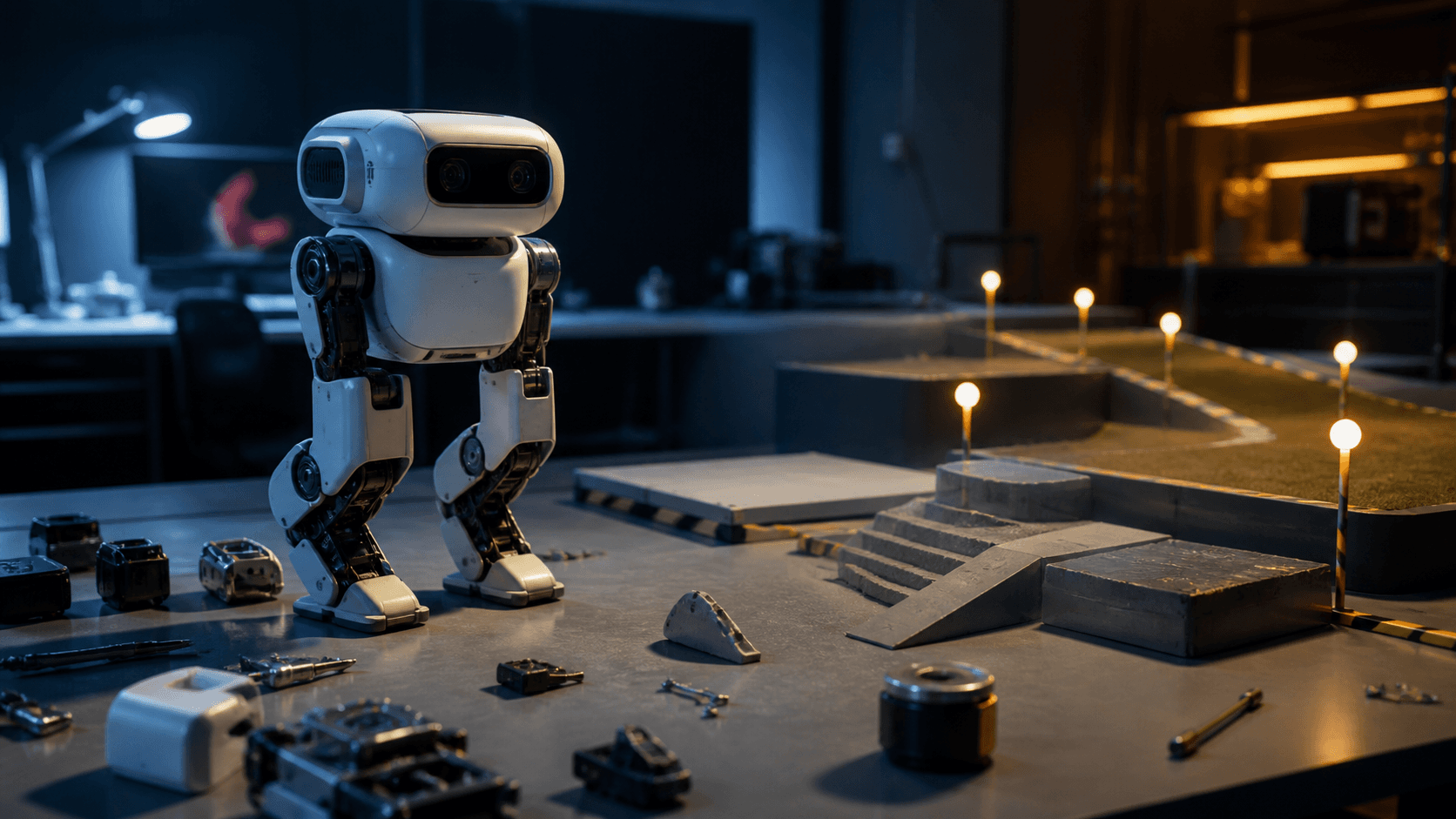
The robotics industry loves to unveil machines priced like real estate and then call the future inevitable. Microduck makes a smaller, more credible proposition: put a biped robot on a builder's desk for $399 and let thousands of people discover what does not work.
Pollen Robotics opened preorders on August 27. The company describes Microduck as a 25-centimeter, roughly 800-gram biped with 15 servos, a camera, wireless connectivity, and behaviors trained in physics simulation before deployment to the physical machine. The introductory price excludes tax and shipping. First deliveries are targeted before Christmas 2026, which means this is a preorder, not a shipped product.
The open stack is the real product. Pollen published the robot runtime and reinforcement-learning training repositories under Apache 2.0. Builders can inspect the control loop, retrain policies in simulation, export them, and deploy them to hardware. That is a much stronger claim than a marketing page with an SDK logo buried in the footer.
Microduck is not an autonomous household worker. It walks, sits, stands, kicks, grasps with its beak, and recovers from a fall through learned policies. The constraint is also the opportunity. A small, bounded platform gives researchers and students somewhere to test locomotion, sim-to-real transfer, update safety, and community distribution without risking a six-figure machine.
The project succeeds if the hardware ships reliably and the ecosystem produces behaviors the original team did not invent. Cheap access changes who gets to participate. In a field drowning in cinematic demos, the better growth strategy may be a lot of unglamorous robots getting knocked over by people who can finally afford one.
LaunchPad positionThe product has not shipped, and accessibility will depend on reliable hardware, documentation, and fulfillment. The important bet is that robotics progress compounds faster when more builders can afford to break things.
This report draws on the linked primary sources and reputable reporting. Company statements are treated as claims until independently demonstrated.