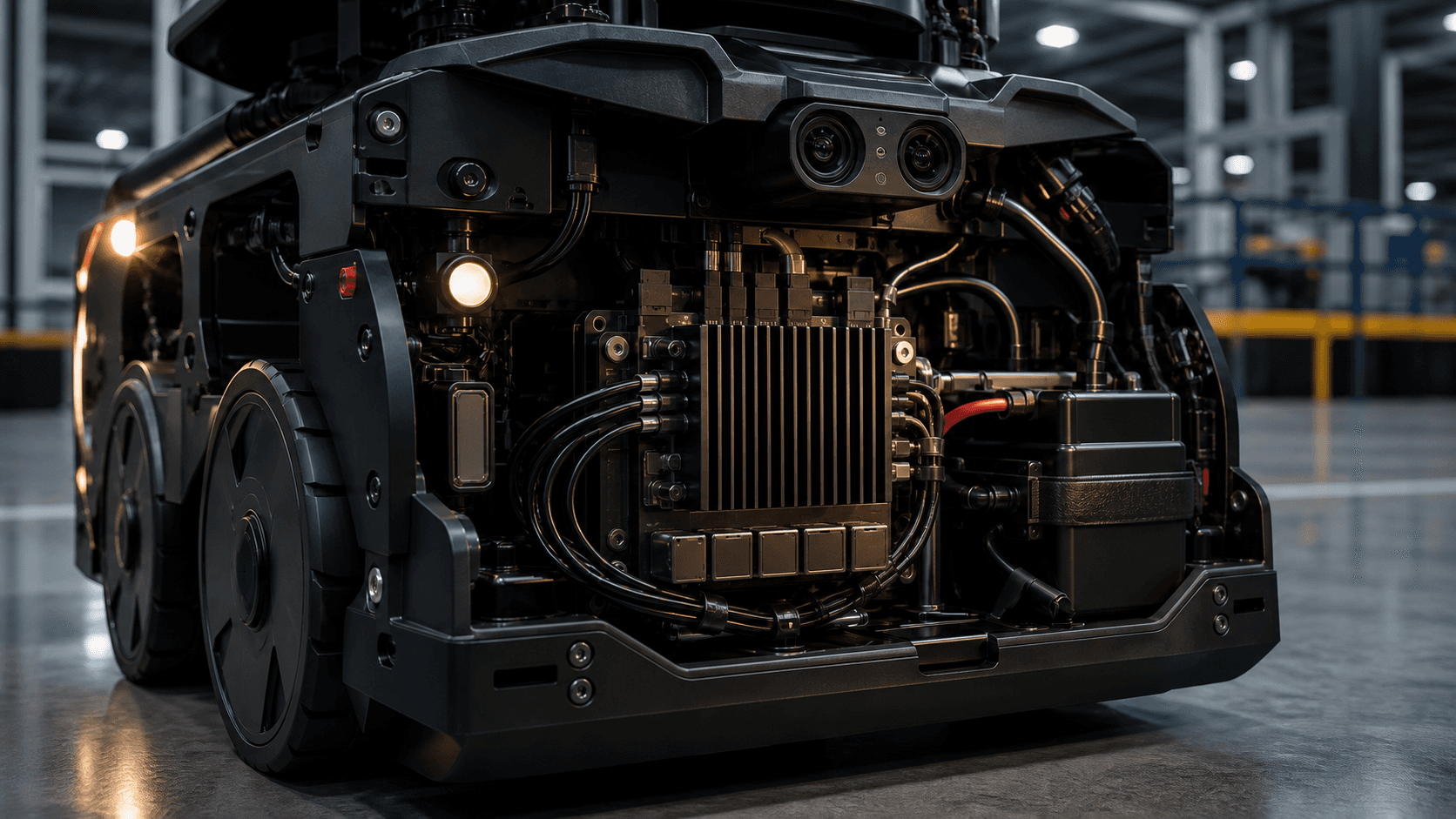
A robot cannot ask the cloud for permission every time the world moves. Latency, connectivity, privacy, and plain old physics force intelligence back onto the machine.
NVIDIA announced Jetson Orin Nano 2, a compact edge computer designed for robots, drones, and vision systems. The company says it delivers 78 trillion operations per second, includes 8 gigabytes of memory and an eight-core Arm CPU, and reaches twice the inference performance of the prior Nano Super in the same form factor.
NVIDIA also claims the system uses 40 percent less power at the same performance in a 15-watt mode. These are vendor measurements, not independent field results. The product is expected in the first half of 2027, so nobody should confuse an announced specification with deployed capability.
The direction is still important. Smaller language and vision models are becoming useful enough to run within the thermal and memory limits of physical machines. That lets a drone interpret a changing scene, a home robot reason about objects, or an inspection system react without streaming every frame to a distant data center.
NVIDIA says Matic plans to adopt the module, while Wing and other companies are evaluating it. Exploring hardware is not the same as shipping it in a fleet. The useful proof will come from sustained operation: perception accuracy under bad light, thermal behavior inside sealed products, memory pressure, power draw, and how the machine fails when the model is wrong.
The competitive moat is the stack. NVIDIA is pairing silicon with model tooling, simulation, optimized runtimes, carrier-board partners, and a large developer ecosystem. A compact module gets designed into products because the surrounding system makes integration predictable.
The next robotics breakthrough may look less like a humanoid demo and more like a machine that can operate all day on fifteen watts without becoming confused, hot, or dependent on perfect Wi-Fi. That is not cinematic. It is how categories escape the lab.
LaunchPad positionPhysical AI will be won inside hard limits: watts, heat, latency, memory, and the amount of failure a real machine can survive without a connection home.
This report draws on the linked primary sources and reputable reporting. Company statements are treated as claims until independently demonstrated.