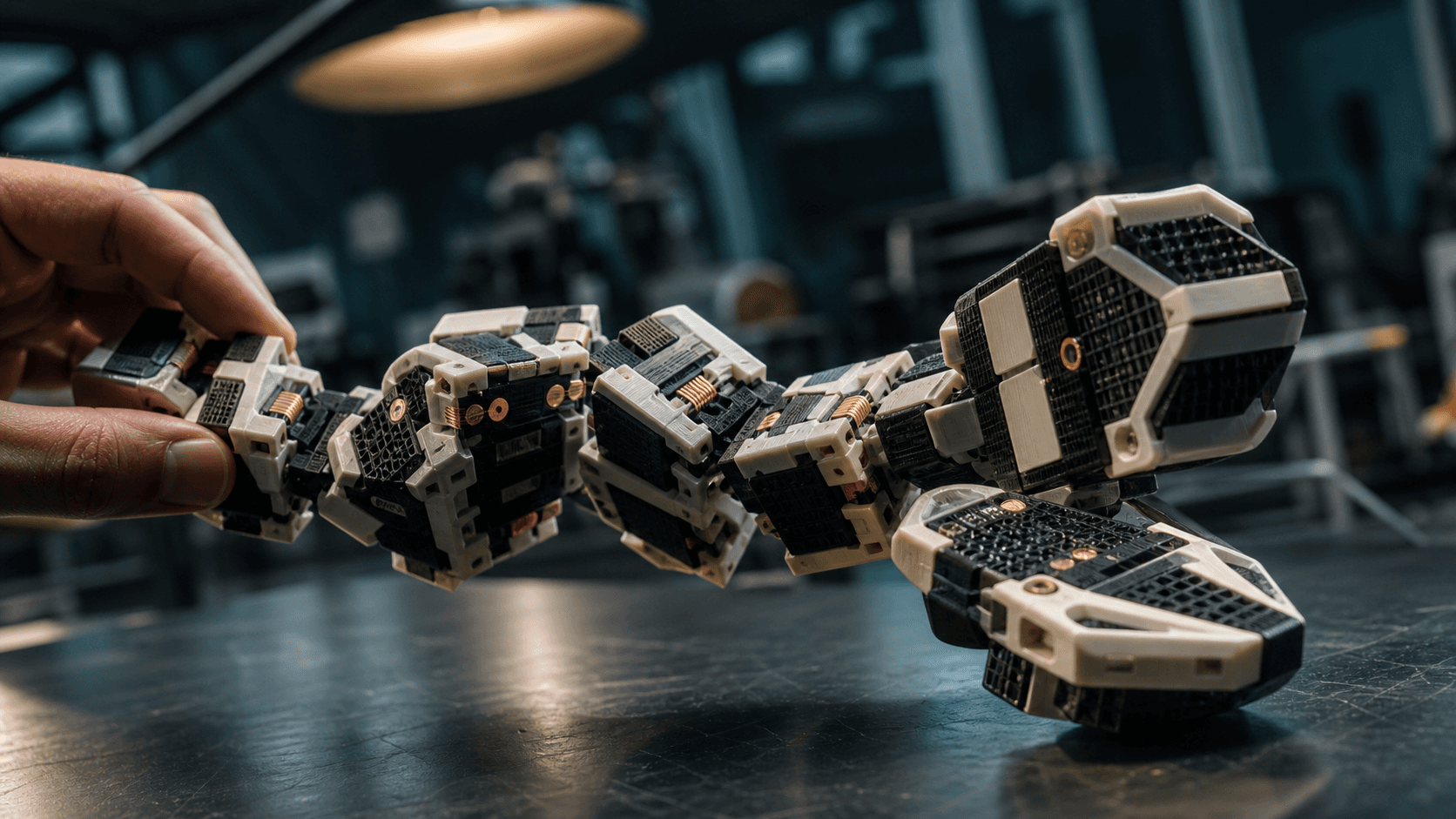
Most smart hardware is still dumb material wearing electronics. Build the object, bolt on sensors, route wires through whatever space remains, then write software that tries to infer what the physical thing is doing. MIT researchers are exploring the opposite direction: make geometry part of the circuit.
Their system, called bifur-circuits, uses modular 3D-printed building blocks with conductive paths routed through their interiors. The components can be compressed, stretched, rotated, or bent while electrical connections remain active. Different configurations activate different circuit paths, allowing the structure to identify the shape it has taken without a separate web of external wires.
The researchers demonstrated a structure that changes between a chair, a table with storage, and a flattened form. It can sense each configuration and send the corresponding signal to a display. They also built a shape-changing controller that launches different games depending on its configuration. These are research prototypes, not finished products, but they expose the capability cleanly.
The useful applications are less cute. Reconfigurable robotic grippers could adapt to different objects without losing sensing and control through the transition. Assistive furniture could support changing patient positions. Antennas could alter shape to tune frequency. Disaster shelters could respond to environmental conditions while retaining embedded electrical awareness.
The manufacturing insight is that intelligence does not have to sit on top of structure. It can emerge from the way repeated units connect. That can reduce wiring complexity, simplify assembly, and make reconfiguration legible to the system. It can also introduce new failure modes at every connector, which is why durability, load limits, conductivity, and repeatability matter more than the demo choreography.
The team still wants to add actuation and explore more mechanically stable shapes. Until then, bifur-circuits are a platform concept, not a robot revolution. The work becomes commercially interesting when the modules survive thousands of transformations under real loads and can be manufactured without laboratory care.
That is the next move: prove the geometry can carry intelligence through abuse. If it can, product designers gain a new primitive. The object does not merely change shape. It understands the configuration it has entered and can behave accordingly.
LaunchPad positionThe stronger future for smart hardware is not bolting more sensors onto a rigid object. It is designing material geometry, connectivity, and awareness as one system from the start.
This report draws on the linked primary sources and reputable reporting. Company statements are treated as claims until independently demonstrated.