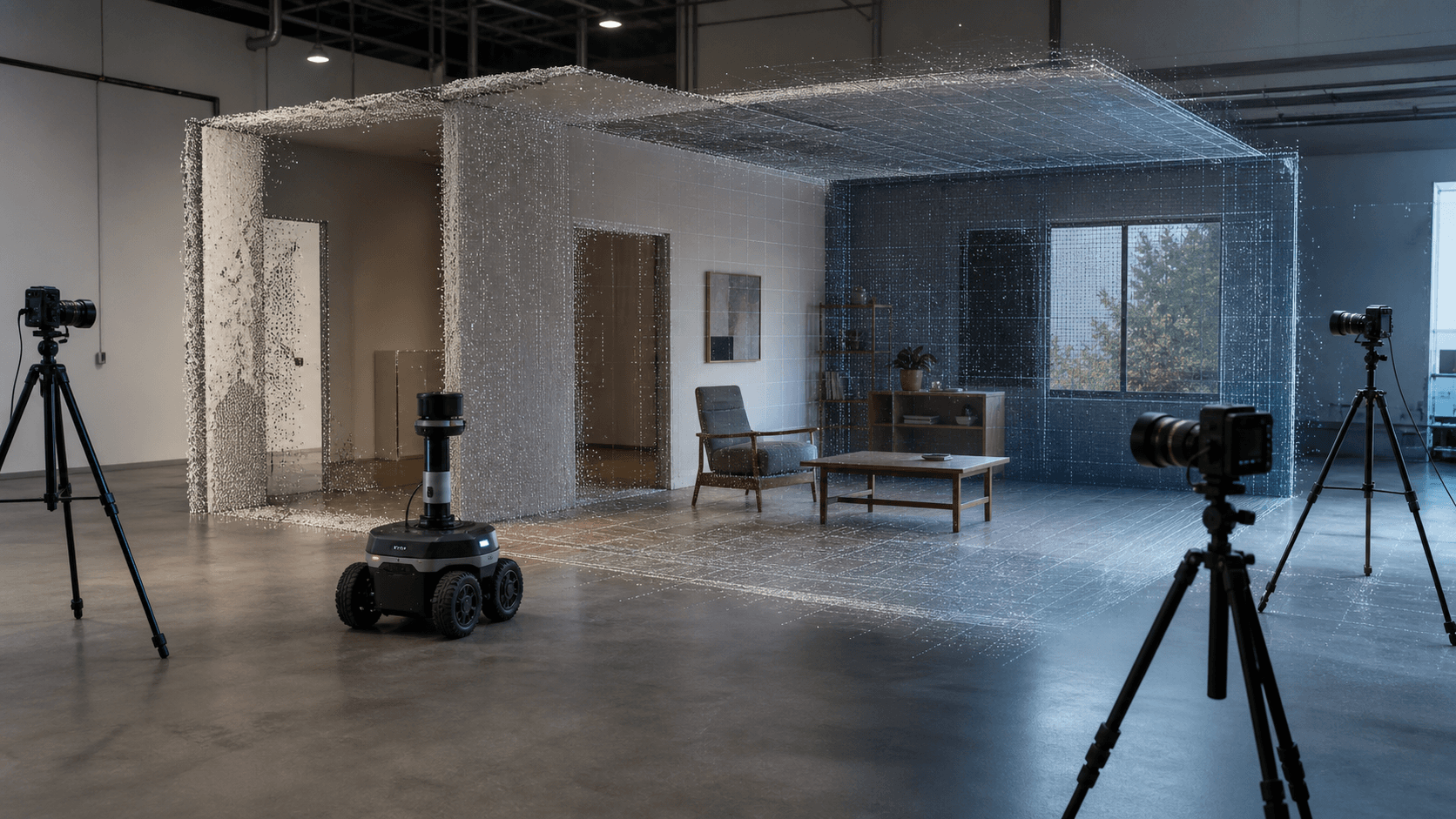
The world does not arrive one frame at a time. Rooms have geometry. Objects stay put when the camera moves. A robot turning a corner expects the hallway to continue existing after it leaves view. Most visual models can produce convincing pixels without maintaining that deeper continuity. World Labs is betting that the next important model will not merely generate a scene. It will represent the scene as a place that can be revisited, reconstructed, manipulated, and used for action.
The company introduced Atlas on September 1 as what it calls an omni world model for spatial intelligence. World Labs says it pretrained the system from scratch to work natively across text, images, video, camera poses, depth maps, and explicit three-dimensional outputs. The model combines those inputs into a shared spatial context, then generates new material conditioned on where each observation belongs. That architecture is the real announcement. The glossy video examples are a consequence of the spatial representation, not the entire product.
Atlas is described as a multimodal autoregressive diffusion transformer. Each part of that phrase does a job. Multimodal means it can accept different data types. Autoregressive means it generates a sequence one element at a time while using what came before as context. Diffusion provides the visual generation machinery. The unusual addition is that images and depth information are grounded at positions in three-dimensional space. Instead of asking a model to infer camera motion from a vague sentence, Atlas can receive the camera geometry itself.
That changes the control problem. A conventional video prompt might ask for a slow crane shot around a building. The model interprets the language, invents a camera path, and tries to keep the scene coherent while producing each frame. Atlas lets the user specify the camera position and angle as native inputs. World Labs says the system can generate from one to six reference images, follow manually designed camera paths, and output as much as one minute of video at 1440p. These are company-stated capabilities from an early-access model, not independently reproduced production limits.
Precise camera control sounds like a filmmaker feature because it is immediately useful to filmmakers. It is also a deeper interface primitive. If the camera can be positioned geometrically, a scene becomes addressable. A designer can request a view from a known point. A developer can connect the output to a three-dimensional editor. A simulator can ask what a robot-mounted camera should see from a specified pose. The shift is from generating a plausible sequence to querying and extending a spatial state.
World Labs demonstrates that state by placing unrelated images into the same context and asking Atlas to build the space between them. The model invents hallways, doors, and intermediate rooms that make the references feel connected. That is powerful for creative world building because the system can interpolate across visual ideas. It is dangerous if someone mistakes the result for measurement. Any geometry not observed by a camera is an inference. A beautiful continuation of a room can be spatially coherent and still be completely wrong about what was actually behind the wall.
The company is unusually clear about that distinction in its reconstruction examples. Atlas can accept one image, dozens of images, and in some demonstrations more than one hundred. With sparse input, the model uses learned world knowledge to imagine unseen areas. With more observations, less invention is required and the reconstruction can move closer to the real scene. ITmedia reported that Atlas can return novel image views as well as explicit three-dimensional forms including point clouds and 3D Gaussian splats. Those outputs make the spatial representation portable beyond a rendered video.
This boundary between reconstruction and generation is where the product becomes strategically interesting. Traditional photogrammetry tries to recover geometry from overlapping photographs. Generative models can fill gaps but may fabricate structure. Atlas is designed to do both within one system. That makes it potentially useful across two very different workflows. A creative user may want the model to invent a convincing world from two references. An industrial operator may need the system to preserve every observed dimension and clearly identify anything it inferred. The same model cannot treat those requirements as interchangeable.
World Labs also positions Atlas as a space-time simulator. In one class of examples, several ordinary cameras capture a scene from different angles so the user can stop time and move the virtual viewpoint around the moment. ITmedia says the demonstrations use three to five phone-class cameras for this effect. The company also shows what it calls real-to-sim workflows, where recorded footage is converted into a spatial environment and then varied to produce new views, lighting conditions, object placements, and robot sensor observations.
That robotics path may become more important than the creative demo. Robots need examples of the world from the perspective of their own cameras and depth sensors. Collecting those examples in the real world is slow, expensive, and sometimes unsafe. A spatial model that can reconstruct an environment and then generate controlled variations could expand the situations used for training and evaluation. It could change the light, move an obstacle, or reposition the robot while preserving the basic scene. The value comes from coverage, not spectacle.
Simulation still has a brutal failure mode: the machine can become excellent at the simulator and remain incompetent in reality. If Atlas invents a surface, smooths away an obstruction, or produces sensor data that lacks the noise of real hardware, a policy trained on that world may learn the wrong lesson. The closer a workflow gets to physical control, the more important provenance becomes. Builders need to know which geometry was observed, which content was reconstructed, which pixels were generated, and how uncertainty moves through the result.
World Labs reports benchmark advantages on camera-controlled generation and sparse-view 3D reconstruction. For camera following, third-party human raters compared outputs against several video models and selected Atlas between 75 percent and 94 percent of the time, depending on the competitor, according to the published results summarized by ITmedia and iThome. The company says its advantage grows as camera paths become more complex. That evaluation supports the claim that native camera inputs improve control, but the test design still belongs to World Labs and has not been independently reproduced in the material reviewed here.
The 3D results deserve the same discipline. World Labs says Atlas outperforms specialized open-source reconstruction systems across several established benchmarks. iThome reports an average reconstruction error of 8.6 times ten to the negative third across the results it summarized. A benchmark can establish relative performance on a defined task. It cannot establish that a model will reconstruct every warehouse, street, laboratory, or home with the reliability required for an operational decision. Real scenes contain reflective surfaces, moving people, transparent materials, bad exposure, and incomplete views that clean benchmarks may not capture.
There is another asymmetry in the comparisons. Atlas accepts camera geometry as a native input, while the video models in the company's camera-following evaluation receive camera instructions as text because they do not accept the same structured format. That may be exactly the point: a model designed around spatial control should beat a model asked to translate filmmaking language into geometry. It also means the benchmark measures a system advantage, not merely a universal increase in visual intelligence. Buyers should care about the system advantage, but they should understand what was tested.
Atlas also combines architecture ideas from language and image models. World Labs says its autoregressive design can benefit from serving techniques such as key-value caching, cache-aware routing, and disaggregated infrastructure. Its diffusion side can use advances in visual generation such as distillation, guidance, noise scheduling, and improved latent encoders. The company says larger training runs produced new capabilities and expects performance to keep improving with compute. That last point is a company forecast. Scaling trends are evidence about the models tested so far, not a guarantee that every capability will continue rising on the same curve.
The commercial structure remains early. Atlas is not generally available. World Labs is offering access to selected partners and says the model will power future versions of Marble and other products. That limits what outside developers can verify today. It also suggests the company is not trying to sell a single demo model in isolation. The likely platform is a spatial stack where users generate environments, reconstruct real spaces, edit them, stream them, and connect them to downstream creative or robotic tools.
If that stack works, the moat will not come from making the prettiest sixty-second clip. Visual quality moves quickly and competitors can close the gap. The harder advantage is a stable spatial representation that multiple products can use. A director, architect, game designer, robot developer, and simulation engineer may enter through different workflows, but each benefits from a world that remains coherent when the camera moves and can be exported into a usable three-dimensional form. Shared representation creates the leverage.
The interface challenge is equally large. Spatial systems can expose enormous complexity: camera paths, coordinate frames, depth, uncertainty, geometry, time, object state, and rendering controls. Most users do not want to become graphics researchers to direct a shot or reconstruct a room. The winning product will translate simple intent into precise spatial operations without hiding where the model guessed. Creative workflows can tolerate surprise. Robotics and measurement workflows need explicit confidence and hard boundaries. One interface cannot blur those modes for the sake of convenience.
Atlas is therefore best understood as a blueprint for where generative media and physical AI begin to merge. The model can create images and video, but its more consequential claim is that the same architecture can reconstruct and simulate a place. That could connect content creation to digital twins and digital twins to robot training. World Labs has published a technically coherent direction and encouraging internal evaluations. It has not yet provided broad external access or independent field evidence. The next move is obvious: put the spatial context in builders' hands and see whether it survives worlds the demo team did not choose.
The signal is not that video generation just got another upgrade. The signal is that visual intelligence is becoming addressable in three dimensions. When a model knows where an observation belongs, the output can become more than something to watch. It can become a space to navigate, a scene to edit, a simulator to test, or an environment where a machine learns what to do next. That is a category worth taking seriously, provided the industry keeps one distinction brutally clear: coherent imagination is not the same thing as ground truth.
LaunchPad positionThe commercial prize is not another cinematic clip generator. It is a programmable spatial layer that can move between generation, reconstruction, simulation, and robotics. Atlas is early access and its benchmarks are company-run, so the next proof is whether developers can use that layer reliably outside curated demonstrations.
This report draws on the linked primary sources and reputable reporting. Company statements are treated as claims until independently demonstrated.