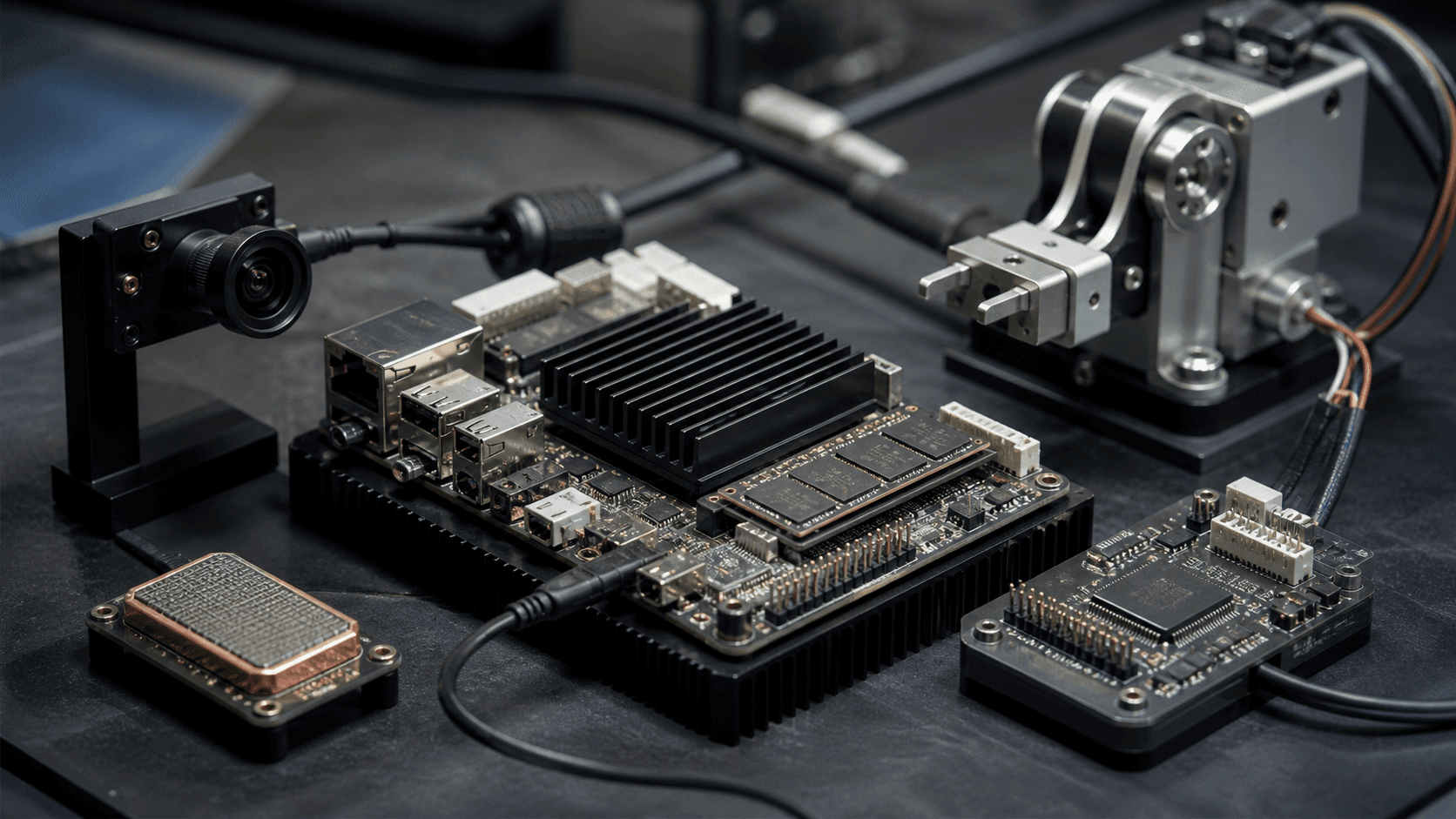
The physical AI market has no shortage of impressive demos. What it lacks is a clean path from a model running on a bench to a machine that can sense, decide, act, and survive production.
Arduino, now a Qualcomm subsidiary, has opened worldwide preorders for VENTUNO Q, an edge AI development platform built around Qualcomm's Dragonwing IQ8 series. The board pairs an IQ-8275 application processor rated by the company at up to 40 dense TOPS with 16 gigabytes of LPDDR5 memory, 64 gigabytes of embedded storage, and a separate STM32H5 real-time microcontroller.
That dual architecture is the actual story. Generative and perception models want flexible compute, memory, and a familiar operating system. Motors, buses, and safety-sensitive control loops want predictable timing. Trying to make one processor behave like both is how prototypes become fragile. VENTUNO Q runs Ubuntu on the application side and uses an Arduino Core on Zephyr RTOS for deterministic control of motors, CAN-FD, PWM, and high-speed input and output.
The software pitch is equally aggressive. Arduino says its App Lab can run optimized language, vision-language, speech, object-detection, and gesture models; accept GGUF models from Hugging Face; or integrate models trained through Edge Impulse. Developers can also use standard Linux tooling. Preorder availability is verified. Performance across those workloads, sustained thermal behavior, and delivery at scale remain claims to test.
The more important promise sits after the prototype. Under a new Works with Arduino program, partners including SECO and Toradex plan to offer production-grade system-on-module designs using the same Dragonwing IQ8 architecture. The goal is to preserve application logic, models, and software as a team moves from a development board into a commercial robot or industrial system.
That bridge is where embedded platforms earn or lose their value. A friendly board can accelerate the first 80 percent of a project and still leave a company rewriting drivers, certifying new hardware, and renegotiating component availability before launch. Compatibility is useful only when the production modules arrive, remain available, and behave closely enough to make migration boring.
Watch the preorder delivery dates, production module schedule, power draw under sustained inference, real-time jitter, and support life. If the hardware and software hold, VENTUNO Q could make physical AI less of a bespoke integration exercise. If they do not, it becomes another gorgeous development board living forever under fluorescent lab lights.
LaunchPad positionThe board is interesting because it tries to shorten the distance between an AI prototype and a machine that can ship. Developers should judge the claim by software stability, thermal limits, production availability, and real control latency.
This report draws on the linked primary sources and reputable reporting. Company statements are treated as claims until independently demonstrated.