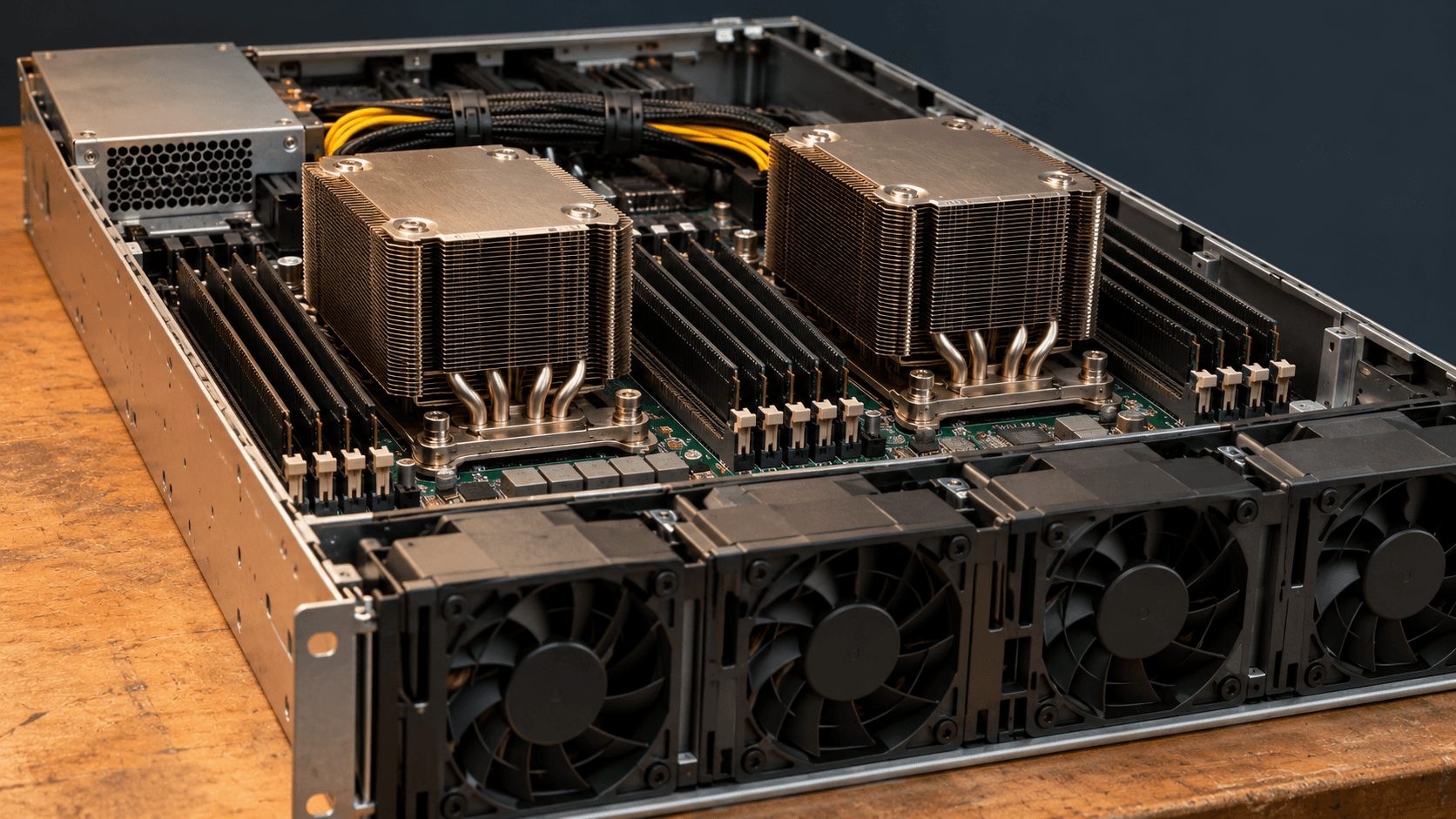
AMD's Venice launch turns a processor announcement into a server purchasing problem. On November 10, AMD announced general availability of its sixth-generation EPYC SP7 processors and said systems were shipping from server vendors. That creates a concrete option for infrastructure teams. But the headline gains span different workloads, memory systems and evidence standards. A buyer deciding how to run coding tools, feed accelerators or consolidate services needs to identify which comparison resembles the job being bought. The largest number on a launch slide cannot make that selection.
AMD's own portfolio describes three CPU roles: hosting many agent sandboxes, supporting GPU host nodes and running general-purpose services. Its product page associates density with concurrent execution and higher-frequency designs with latency-sensitive orchestration and accelerator support. It also distinguishes the SP7 family from SP8 enterprise options, cache-enhanced processors and a low-power-memory host-node offering. A family page is a description of choices, not evidence that every configuration is shipping together. The practical merit of a portfolio is the ability to match a constraint. The practical burden is that customers must do that matching: a machine selected to run many independent jobs may not be the best choice for a job whose next step depends on one CPU operation finishing quickly.
That distinction also appears in AMD's account of how the chips were designed. In firsthand reporting from media sessions, Tom's Hardware quotes chief Zen architect Mike Clark and corporate vice president Madhu Rangarajan explaining that the company did not foresee the agentic wave when development began. Their argument is that a broad CPU architecture and product range can serve the varied tasks surrounding models. This is a more testable proposition than treating agentic computing as a single instruction mix. It also places the competitive dispute in the right setting. A coding agent executing a build, a service retrieving records and a host moving model data need not reward the same processor characteristics. Calling all three agent workloads does not make their hardware requirements interchangeable.
The independent test evidence is substantial, with useful qualifications. Tom's Hardware tested dual-socket systems supplied by AMD and reports a 93 percent gain in SPEC CPU 2026 integer-rate throughput for the EPYC 9996 system over its previous-generation EPYC 9965 system. The new configuration had 1,024 threads against 768. It also had a different memory system: 2 TB of DDR5-12800 MRDIMMs versus 1.5 TB of DDR5-6000 RDIMMs. The publication used GCC 16 for Venice and GCC 15.2 elsewhere, reporting that regression checks found only minor compiler differences. These are measured system comparisons, not a clean isolation of improvement per core. The reviewer also tested the high-frequency EPYC 9686F, illustrating why the dense flagship cannot stand in for every use case. An infrastructure team should preserve that configuration detail when moving the result into an internal business case.
SPEC's description of the benchmark explains another boundary. Its CPU 2026 suites exercise the processor, memory subsystem and compiler. The speed suites compare the time needed to complete individual tasks; the rate suites compare work completed per unit of time. Both answer useful questions, but different ones. If the service objective is to finish an interactive operation promptly, an aggregate throughput improvement does not establish the latency improvement. If the objective is to process a backlog, a single-task timing does not establish fleet capacity. Buyers should decide which outcome matters before choosing a chart, and retain the benchmark name and generation in their comparison. Otherwise, results from different suites can acquire a false appearance of being directly interchangeable.
Even the word estimate needs unpacking. Tom's Hardware labels its SPEC results estimates because it has not submitted them to SPEC, although it says the numbers come from actual runs. SPEC's fair-use rules permit clearly identified performance estimates and encourage, rather than require, submission. The rules treat energy metrics more strictly: public CPU 2026 metrics expressed as energy or power must come from rule-compliant results and cannot be estimated. This does not make every other vendor power model invalid. It means the reader must distinguish a modeled infrastructure comparison from a specific standardized energy result. Rejecting all estimates would throw away useful testing; treating all estimates as measurements would erase a meaningful difference.
AMD's rack projection is a good example of that difference. The methodology linked from its product page is dated June and models dual-socket nodes inside a 100-kilowatt rack budget. It combines published results, internal tests and third-party testing across six workloads, including Java, web serving, caching and database work. Estimated performance per node is multiplied by the number of nodes the power model permits. The document explicitly describes the outcome as directional, rather than a directly measured rack benchmark. Its comparative figures therefore depend on both performance assumptions and estimated system power. A rack-density advantage can be commercially important, but it is a proposition about a configured deployment. It should be rechecked when a buyer changes the memory population, server design or workload mix instead of being carried into a forecast as a universal multiplier.
Another launch claim concerns output throughput when model weights are offloaded to CPU memory. The launch footnote says AMD measured a PCIe Gen 5 host connection and projected the effect of a Gen 6 connection using bandwidth. The cited work used Qwen3-30B-A3B and an Nvidia B200. That makes the advertised uplift a projection for a particular transfer-constrained setup. It is not evidence that replacing a CPU automatically delivers the same improvement for an arbitrary inference deployment. Before expecting that gain, a team needs evidence that the corresponding data-transfer path is actually limiting its own system.
The memory choice is equally consequential. AMD's memory white paper describes MRDIMMs reading two ranks of DRAM in parallel and multiplexing their data through on-module buffers. This raises the effective rate presented to the host without requiring the individual DRAM devices to operate at that same rate. The paper describes up to roughly 1.6 TB per second of bandwidth per socket on the 16-channel SP7 platform. It also explains the costs: more module components, a higher expected price per gigabyte and somewhat higher module power than comparable RDIMMs. Supported firmware, memory training and adequate airflow remain necessary. This is a capacity-versus-bandwidth decision as much as a speed decision. A workload short of memory space does not necessarily benefit most from the fastest transfer rate, while a workload waiting for data may leave expensive cores underused. The white paper itself calls for choosing according to the binding constraint.
Microsoft's Azure HDv2 announcement makes the full-system approach visible. HDv2 is in preview, with access requested through registration. Microsoft describes more than 500 physical cores, 3.8 TB of DDR5-8800 memory, 30 TB of local NVMe storage and 400 Gb networking. Those are complementary resources for moving, retaining and processing data, rather than a CPU specification alone. Microsoft labels its performance measurements preliminary and uses SPEC CPU 2026 integer rate as a proxy for agent and reinforcement-learning task throughput. The proxy is useful for comparing compute capacity; it does not by itself measure successful completion of a customer's entire agent workflow. The preview also gives teams a route to gather their own evidence, while planned availability through additional Microsoft services should remain a future step until those integrations are actually accessible.
The Oracle collaboration adds another way to change the amount of useful work a host can perform. AMD's October update describes upcoming OCI E7 instances and Pensando technology in Oracle Acceleron network interfaces. The stated purpose includes offloading networking, storage and security work so that host CPU capacity remains available for applications. That changes what the processor must do, not merely how quickly it executes the same instructions. A comparison between cloud instances should therefore examine the surrounding infrastructure services as well as the CPU name. The announcement also includes a future-product disclaimer and describes flexible compute and memory configurations. It should not be read as proof that a particular shape is generally available in every region or that a requested allocation can be obtained immediately.
For a builder, these sources suggest a more useful evaluation than one blended agent score. Start with a representative completed job and keep its success conditions fixed. Record how much time is spent waiting for model output, running tools, fetching data and queuing for resources. Then compare configurations against the same completion and response-time requirements. A coding workflow that spends most of its time compiling deserves a different experiment from one dominated by remote requests. This is an evaluation recommendation, not a claim that the launch materials establish either workload distribution for every customer. Its purpose is to prevent purchasing an improvement in a component that rarely determines the outcome.
The economic comparison should preserve those boundaries. Specify the memory configuration needed to reproduce a result, the available server or cloud shape, the power budget and the amount of completed work. Keep the cost of capacity that sits unused visible. Where the evidence is a projection, label it and test the assumption that matters most to the deployment. Where a cloud offering is a preview, separate evaluation access from the capacity needed for a production commitment. These steps do not presume a particular winner. They make the decision reviewable when software, demand or the available configuration changes.
Venice now has both a shipping-server announcement and independent performance evidence behind it. That is enough to justify serious evaluation. The useful next result is a workload-matched comparison with the memory, software and power settings attached, followed by confirmation that the tested configuration can actually be deployed. That is the result a procurement team can buy, and an engineering team can be held accountable for delivering.
LaunchPad positionCompare completed workloads with the memory, software, power budget and availability attached before turning processor gains into a deployment commitment.
This report draws on the linked primary sources and reputable reporting. Company statements are treated as claims until independently demonstrated.