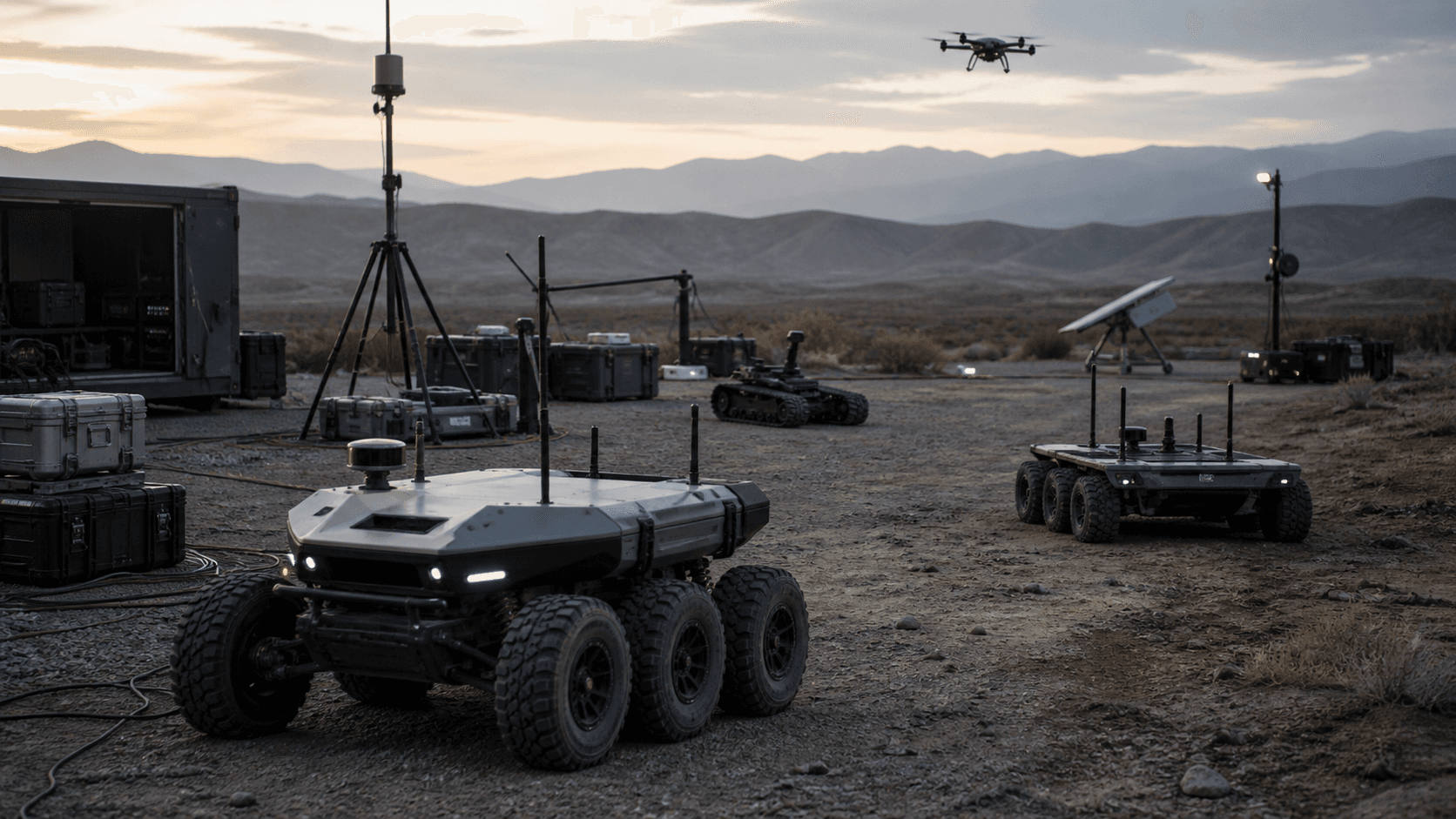
A country can buy a warehouse full of drones and still fail to build a robotic force. Hardware is only the visible layer. The harder system includes command and control, communications, software updates, local production, repair, operator training, mission data, and the ability to adapt when the adversary changes tactics. Aitan emerged from stealth on September 2 with a company built around that less cinematic reality.
The New Jersey startup says it closed a $41 million financing round co-led by Deep33 and Dell Technologies Capital, bringing total capital raised to $54 million. Axios independently reported the round and the company's emergence from stealth. Aitan describes its offering as Robotic Sovereignty-as-a-Service, a phrase that sounds like category marketing until the components are unpacked. The company is not only proposing autonomous machines. It is proposing the operating backbone a government would need to field and evolve those machines as a coordinated force.
Aitan says it develops edge-AI robotic systems and provides command-and-control networks, swarming, autonomy, and related infrastructure. Its launch announcement claims the technology has been used in Israeli defense operations since 2023, with more than 500,000 combat hours across the Israel Defense Forces and national security agencies. Axios carefully attributes the operating tally to the company. The public sources reviewed here do not include an independent technical audit of those hours, the missions counted, or the performance achieved, so the figures should remain company claims.
That caveat does not erase the underlying market signal. Buyers are moving beyond a fascination with individual platforms. A small aircraft, ground vehicle, sensor, or interceptor becomes useful only when it can communicate, receive a mission, share information, function under degraded conditions, and fit into a larger operating doctrine. Aitan's pitch treats the network and coordination layer as the product. The machines can vary. The sovereign system that connects and sustains them is supposed to persist.
The company was founded by Udi Oster and Daniel Almog, former officers in Israel's Unit 8200 who previously built the ordering marketplace Tapingo before its acquisition by Grubhub. Aitan says it is named in honor of Oster's brother Eitan, who was killed while serving in Lebanon. The founders told Axios that the experience made the mission personal and focused the company on using robotic systems to reduce human exposure. That origin explains the intensity of the pitch, but personal conviction is not a substitute for technical evidence or public accountability.
Aitan's primary claim is that robotic warfare changes too quickly for a traditional procurement model built around static equipment. Its announcement says systems evolve during a conflict as radio conditions, countermeasures, supply chains, and operating needs shift. Almog told Axios that the adversary, the radio-frequency environment, countermeasures, and even battery condition keep changing. The implication is straightforward: a machine delivered today becomes less useful if its software, communications, payload integration, and maintenance process cannot change next week.
This is why the word sovereignty matters. In this context, sovereignty is not a patriotic sticker on imported hardware. It means the buyer can operate and adapt the system without depending on a distant vendor for every critical decision. That can involve control of mission data, permission to modify software, access to interfaces, local repair capacity, replaceable components, domestic production options, and the ability to integrate machines from more than one supplier. A nation that cannot change the stack does not fully control the capability, even if it owns the equipment.
The service model creates tension inside that promise. Sovereignty implies independence. A recurring commercial service implies an ongoing dependency on the provider. The arrangement only works if Aitan can give customers meaningful local control while continuing to supply expertise, software, integration, and upgrades. Buyers should ask which parts of the system they can inspect, host, modify, and operate without the vendor. They should also ask what happens if political relationships change, export permissions narrow, a supplier fails, or a communications link disappears.
Aitan says it recently secured a joint contract to develop the command-and-control platform for the IDF's next-generation attack drone fleet, along with design contracts for robotic weapon systems. Axios reports that the company has also secured contracts abroad for command-and-control networks and robotic weapon designs. Neither public source reviewed here discloses contract values, delivery schedules, customer identities outside Israel, technical acceptance criteria, or deployed outcomes. The contracts establish commercial traction as reported. They do not yet establish that the broader platform works across every promised environment.
The technical center of the category is interoperability. Militaries rarely replace every platform at once. New autonomous systems have to coexist with legacy radios, existing sensors, different data formats, human command structures, and equipment procured from multiple countries. A coordination layer has to translate across that mess without creating a single brittle dependency. It also has to manage identity. Every machine, operator, payload, and software component needs trusted permissions, especially when the network is contested or partially disconnected.
Edge AI is part of the answer because a robotic system cannot assume continuous access to a remote data center. Local models can interpret sensor input, navigate, prioritize information, or continue a bounded task when communications degrade. Local inference does not mean unlimited autonomy. It means decisions that cannot wait for a round trip have to occur on the machine or nearby. The operating design must still specify which decisions are delegated, what confidence is required, how the system recognizes failure, and when it stops or returns control to a person.
Sustainment may be the real moat. Batteries degrade. Motors fail. Airframes break. Sensors drift. Radios become targets. A platform that performs brilliantly for one demonstration but cannot be repaired with available parts is not a sovereign capability. Aitan's launch language emphasizes production at scale and operation through disrupted supply chains. The proof will be whether customers can source components, train maintainers, replace damaged units, and push verified updates without turning the fleet into a collection of incompatible one-offs.
Software updates are especially complicated in defense robotics. A rapid update can counter a new threat or fix an operational weakness. It can also introduce a defect across an entire fleet. The stronger system needs staged deployment, simulation, signed software, rollback, audit records, and a clear line between experimental behavior and approved mission capability. Speed matters because the environment changes. Control matters because a machine acting in the physical world can create consequences that cannot be patched after the fact.
Swarming adds another layer of difficulty. The marketing version is a group of machines moving together. The engineering version is distributed coordination under uncertain communications, limited power, changing objectives, and partial failure. A useful system has to avoid collisions, share tasks, prevent duplicate actions, recover when members disappear, and preserve command intent without assuming perfect connectivity. Aitan says it anchors programs in swarming and command and control. The public material does not disclose the protocols, autonomy boundaries, or measured reliability behind those claims.
The governance question cannot be outsourced to the technology. When autonomous or semi-autonomous systems support lethal operations, decision rights have to be explicit. Who selects an objective? Who verifies the target? Which actions can a machine take locally? What happens when sensors disagree? Who can abort? How is each decision reconstructed afterward? A sovereign stack should make those controls more legible, not bury them inside proprietary software. Local ownership is valuable only if it includes local accountability.
The $41 million round will support product development, international expansion, and team growth, according to Aitan. The company is targeting the United States, Europe, and Asia, Axios reports. That expansion will test whether experience from one operating environment can transfer into different procurement rules, legal frameworks, terrain, communications systems, and force structures. Battle experience can produce valuable feedback. It can also produce assumptions that do not travel. International customers will need evidence from their own requirements, not a generic claim that the system has seen combat.
Investors are backing the thesis that physical AI will become a major technology layer and that coordinating heterogeneous machines is the harder problem. Dell Technologies Capital managing director Yair Snir framed the opportunity around networks of different intelligent systems operating together. That is a stronger thesis than betting on a single winning drone. Hardware categories fragment. Missions change. A control layer that can integrate across platforms has a better chance of becoming durable infrastructure.
The company still has plenty to prove. Public reporting does not provide detailed technical documentation, independent performance data, safety evaluations, unit economics, or customer case studies that disclose measurable outcomes. The financing is real as reported. The contracts are described by the company and Axios. The scale and battlefield record remain largely vendor-reported. A serious buyer should separate those layers and demand evidence for each one before treating category language as operating truth.
Aitan's emergence matters because it puts a name on the next phase of defense robotics. The market is moving from selling machines to selling the capacity to field, coordinate, sustain, and evolve machines. That is a larger opportunity and a larger responsibility. If Robotic Sovereignty-as-a-Service becomes a real category, the winners will not be the companies with the loudest autonomous demo. They will be the ones that help customers maintain control when communications fail, parts run short, software changes, and the environment refuses to behave like a test range.
The next proof point is not another launch video. It is a customer showing that different systems can operate together, accept updates safely, survive degraded conditions, and remain governed by clear human authority. Aitan has raised enough capital to pursue that proof and claims unusually deep operational feedback. Now the company has to turn experience into an auditable platform that works beyond the conditions that created it. That is how a provocative category name becomes infrastructure instead of branding.
LaunchPad positionDefense buyers are discovering that purchasing autonomous hardware does not create autonomous capacity. The strategic layer is the ability to integrate, repair, update, govern, and coordinate machines under local control as the environment changes.
This report draws on the linked primary sources and reputable reporting. Company statements are treated as claims until independently demonstrated.