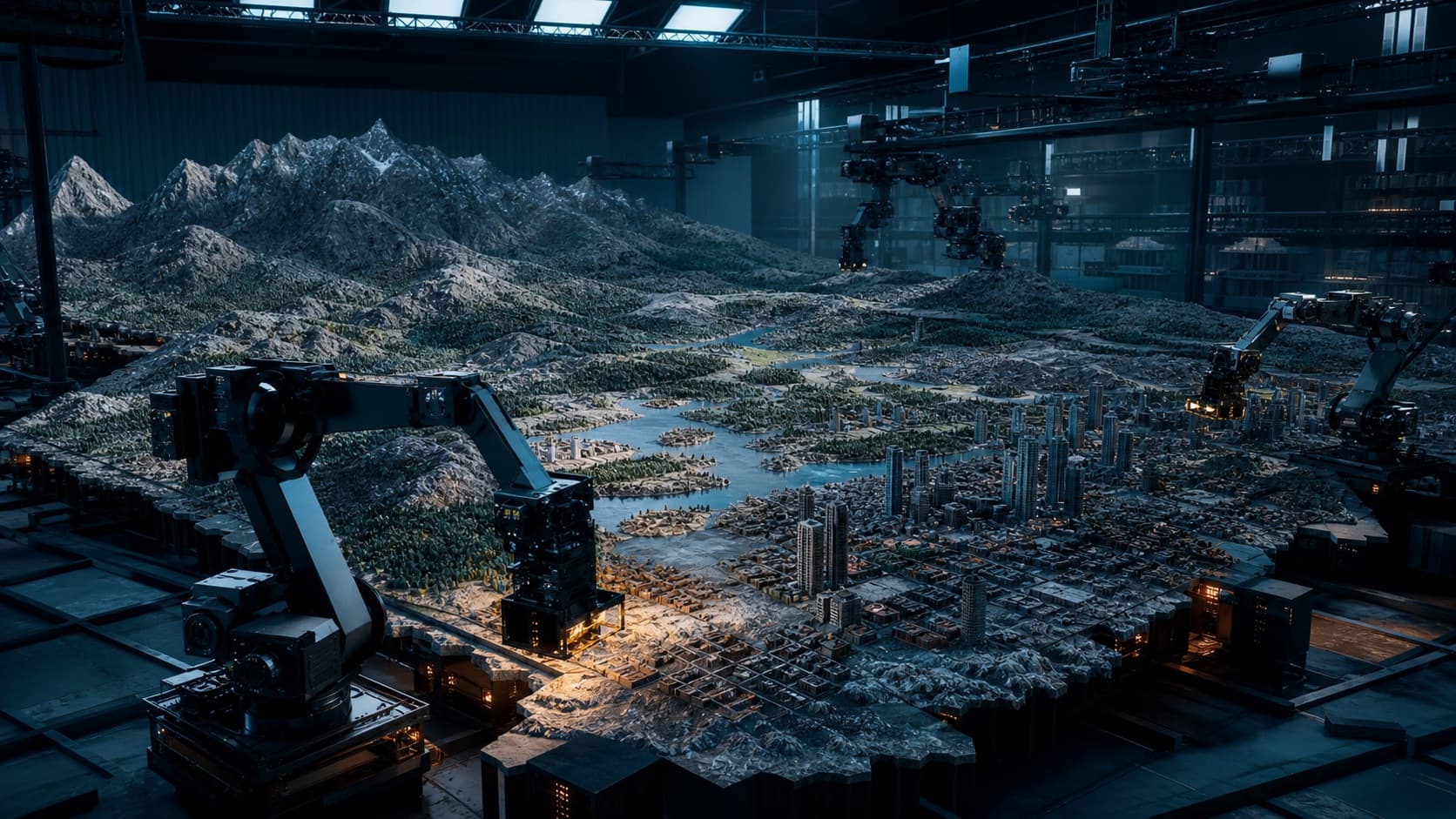
Generative AI has become remarkably good at creating individual pieces of digital content. Images, videos, code, music, 3D objects, and even short interactive experiences can now be generated from natural-language prompts.
But building an entire virtual world is a fundamentally different problem.
A world cannot simply look convincing from one angle. It has to remain coherent as you move through it. Terrain has to connect. Buildings need to sit correctly on the ground. Objects need believable scale and placement. Different regions have to feel like parts of the same environment. And if the output is going to be useful in games, simulation, film, robotics, or virtual production, the underlying 3D assets need to remain editable.
Tencent Hunyuan’s new WorldClaw project tackles that problem by treating 3D world creation not as a single generative task, but as an agentic construction process.
That distinction is what makes it interesting.
From a Prompt to a Structured World
WorldClaw starts with an open-ended text request and converts it into a structured specification for the scene.
A simple prompt might describe a pirate island, a mountain village, a desert battlefield, or a futuristic frozen valley. Rather than immediately trying to render the entire environment, WorldClaw first analyzes what the user actually wants.
It identifies regions, terrain types, visual style, objects, materials, spatial relationships, and other scene-level requirements. A planning agent then fills in the missing details necessary to turn that creative idea into something that can actually be constructed.
This is an important design choice because users rarely describe a world with enough technical detail to build one directly.
Someone might ask for a medieval village surrounded by mountains with a river running through it, but leave out how large the world should be, how much area the river occupies, where settlements should be placed, how terrain regions should transition, or what types of vegetation belong in each area.
WorldClaw turns that high-level request into a more explicit plan before generating the environment.
Build the World First, Then Fill It In
One of WorldClaw’s central ideas is that the entire environment does not need to be generated at maximum detail all at once.
Instead, the system works from global structure toward local detail.
First, it creates a semantic layout describing where different types of terrain and regions should exist. That layout becomes the foundation for a continuous global terrain system.
Mountains, rivers, forests, deserts, coastlines, settlements, and other areas are not simply created as separate scenes and stitched together afterward. They are organized within a shared spatial structure.
That matters because one of the biggest problems in large-scale generative environments is long-range consistency.
A system can generate an impressive village or canyon in isolation, but once it tries to expand outward, things begin to break. Terrain changes abruptly. Roads stop making sense. Scale drifts. Objects appear disconnected from surrounding geography. Different sections of the world can feel like completely different generations.
WorldClaw attempts to avoid this by establishing the world-level structure first and only then generating the detailed content inside individual regions.
It is essentially a coarse-to-fine world-building strategy.
Generative Images Become Construction Blueprints
The next stage is particularly clever.
Once WorldClaw has created the terrain, it selects regions that need more detailed objects and renders those areas from specific camera positions.
An image model then generates a richer composition for that region.
But the generated image is not the finished world.
Instead, it acts as a visual blueprint.
Objects inside that composition are identified and segmented individually. Those objects are then reconstructed as separate 3D assets and placed back onto the real terrain.
This creates an interesting hybrid workflow.
The image generator contributes visual imagination and composition, while the rest of the system converts that composition into explicit 3D geometry.
In other words, the image is not the final product. It becomes an intermediate reasoning layer inside a larger production pipeline.
That is a significant shift from how we usually think about generative media.
The AI Inspects Its Own Work
WorldClaw becomes even more interesting after the objects are placed.
The system renders the scene and evaluates the result.
Is an object floating above the terrain? Is a building partially buried? Is something too large or too small? Does an asset have an implausible orientation? Are terrain transitions unnatural? Does the material scale look wrong?
The agent can identify these problems, modify the environment, render it again, and inspect the new result.
If necessary, it can even adjust both the object and the supporting terrain so they fit together more naturally.
This creates a familiar agentic loop:
Plan. Execute. Observe. Evaluate. Correct.
We are already seeing this pattern become increasingly important in software engineering agents, research agents, and autonomous tool-use systems.
WorldClaw applies the same idea to 3D creation.
The environment itself becomes something the agent can inspect, reason about, and continuously improve.
This Is Not One Giant AI Model
WorldClaw is also a good example of where advanced AI systems appear to be heading architecturally.
The system does not rely on one model capable of doing everything.
According to the paper, WorldClaw coordinates several specialized capabilities. Claude Opus 4.8 serves as the underlying agent model, while other components include GPT-Image-2, SAM3, SAM3D, Hunyuan3D, procedural tools, and Blender.
Different components handle different parts of the workflow.
One capability interprets the user’s request. Another generates visual references. Another segments objects. Another reconstructs 3D geometry. Procedural systems generate terrain and materials. Blender becomes the environment in which everything is assembled, rendered, inspected, and refined.
The intelligence of the system comes partly from knowing how to coordinate those capabilities.
That may turn out to be one of the defining characteristics of the next generation of creative AI.
The breakthrough may not be one model that can do everything.
It may be an agent that knows how to use an entire digital production stack.
Why Editable 3D Matters
There is another important difference between WorldClaw and many visually impressive world-generation systems.
The output is intended to remain explicit and editable.
WorldClaw represents the terrain and scene objects as manageable textured meshes. That means individual assets can potentially be moved, replaced, modified, reused, or integrated into conventional 3D pipelines.
This is critical.
A generated image can show you a virtual world.
A generated video can take you on a tour through one.
But an explicit 3D environment can actually become part of a production workflow.
That opens the door to applications in game development, film production, simulation, architecture, robotics, digital twins, immersive training, virtual reality, and spatial computing.
The long-term value of generative 3D will not come from creating beautiful demonstrations.
It will come from generating assets and environments that people can actually use.
The Bigger Shift: From Generative Models to Autonomous Production Teams
WorldClaw is still early, and the researchers are open about its limitations.
The system depends heavily on the capabilities of its underlying models. Generated Blender code can fail. 3D reconstruction quality can vary. Materials may be simplified. Spatial placement can still require multiple correction passes.
The pipeline can also become computationally expensive because individual objects are generated, reconstructed, placed, inspected, and refined separately.
But those limitations do not make the architecture less interesting.
They make the direction clearer.
The paper points toward increasingly code-native 3D generation, where AI agents might create procedural geometry, shader systems, material graphs, modeling programs, and eventually larger portions of the environment itself through executable code.
The researchers also discuss tighter integration with production-oriented engines such as Unreal Engine.
That is where things could become much more powerful.
Imagine asking for a large open-world environment and having specialized agents handle different parts of the production process.
One agent creates the terrain. Another handles roads and infrastructure. Another generates architecture. Others manage vegetation, materials, lighting, interiors, physics, navigation, weather, animation, and optimization.
Quality-assurance agents continuously inspect the world and repair problems.
The system does not simply generate a scene.
It manages the process of building one.
At that point, we are no longer talking about a 3D generator.
We are talking about something much closer to an autonomous virtual production team.
From “How Do We Build It?” to “What Should We Build?”
For decades, creating large digital environments has required enormous amounts of manual production work.
Artists model assets. Environment teams construct terrain. Technical artists build materials. Designers place objects. Engineers implement interactions. QA teams find problems. Developers optimize the result.
Agentic systems like WorldClaw suggest a future where increasingly large portions of that process can be coordinated automatically.
That does not eliminate creativity.
It moves creativity higher up the stack.
Instead of spending most of the effort figuring out how to construct every underlying component, creators can spend more time deciding what the world should actually be.
That may be the most important shift.
The first era of generative AI was about generating individual outputs.
Images.
Videos.
Code.
3D objects.
The next era may be about generating systems, environments, and entire worlds through coordinated agents.
WorldClaw is not the finished version of that future.
But it offers a very clear glimpse of what it might look like.
The real milestone will not be when AI can show us an imaginary world.
It will be when AI can build one.
This essay was written by Blocpod and originally published on Medium. It is preserved here with its original publication date and a custom LaunchPad Observer cover. Read the canonical edition