Cybersecurity has spent years bolting general-purpose language models onto analyst workflows and calling the result transformation. CrowdStrike is making a sharper bet. Its new SafeMind system is built around the idea that defense needs its own model stack, its own training data, its own operating harness, and its own controlled environment for learning how an organization can be attacked. That is a much more serious proposition than adding a chat window to a security console. It also creates a much harder question: when the system can both discover an attack path and propose the fix, exactly how much authority should it receive?
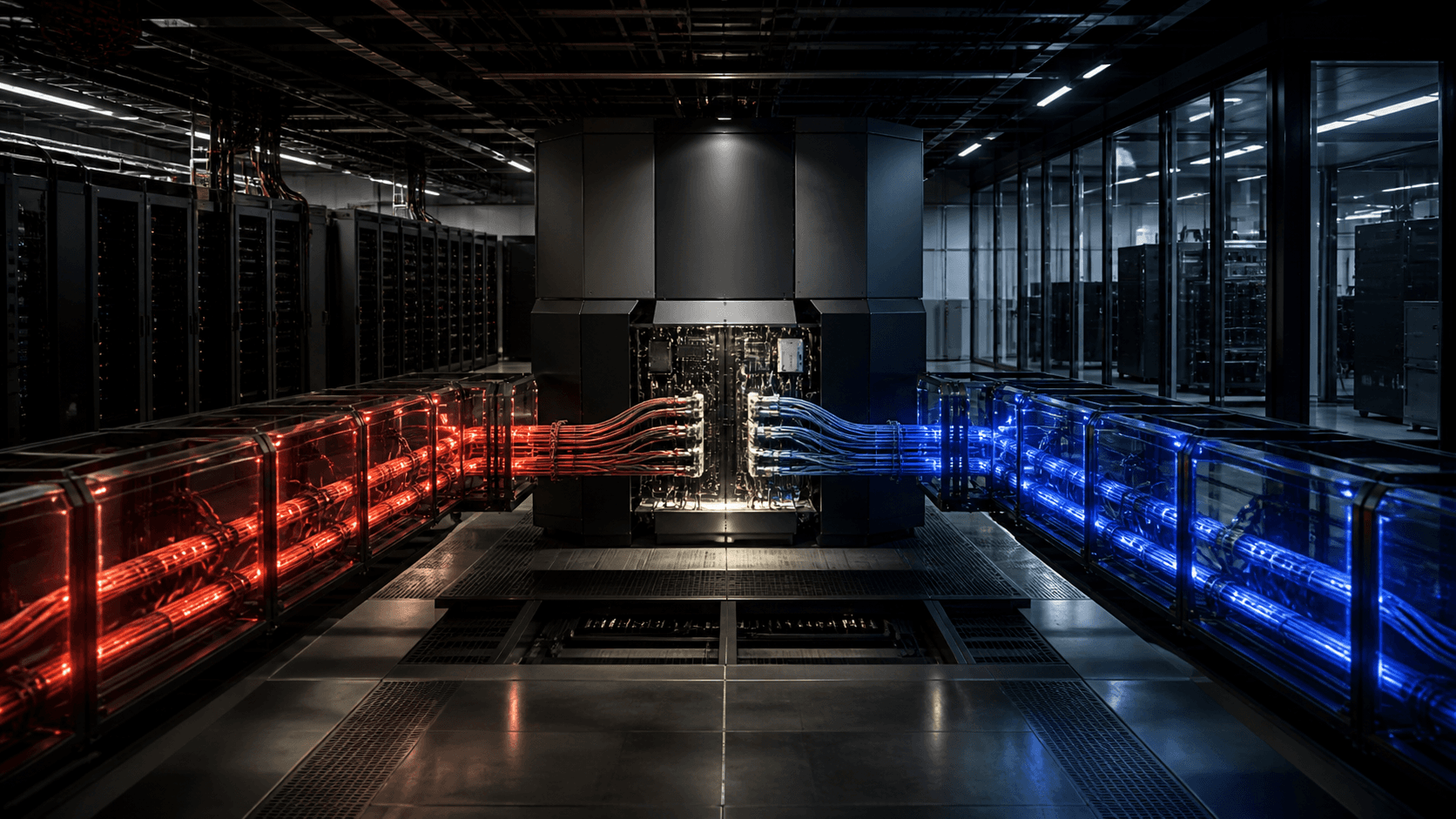
CrowdStrike introduced SafeMind at its Fal.Con conference on September 1 in partnership with NVIDIA. The company describes it as a family of purpose-built security models and harnesses that will operate natively inside the Falcon platform. The initial pair has distinct jobs. Red Tempest is the offensive model, designed to emulate advanced attacks and find paths through a customer's environment. Blue Solano is the defensive model, designed to turn what the offensive side discovers into protective measures. A software harness runs both sides in a closed loop, so the red model searches, the blue model responds, and the cycle repeats.
That basic design matters because a model does not become an agent merely because someone gives it a long prompt and access to a few tools. An operational agent needs an environment, permissions, sequencing, state, validation, and limits. NVIDIA CEO Jensen Huang described the harness as an exoskeleton around the model's brain. Strip away the keynote language and that is the correct technical distinction. The model can reason about the next move. The harness determines which tools it can touch, where it can operate, how one action triggers another, what counts as success, and whether a proposed change ever reaches a production system.
SafeMind is not described as attacking a live enterprise network without a buffer. CrowdStrike and NVIDIA say the red and blue models operate against a digital twin built from Falcon sensor data. CSO reported that this representation can include asset inventories, identity stores, threat graphs, and adversary intelligence. Red Tempest moves through the cloned environment to identify attack paths. Blue Solano uses those findings to create and validate candidate detections or defenses. NVIDIA says its own infrastructure was represented in a high-fidelity simulation used to test the system. That is the right place to begin because autonomous offense in a live environment can create the exact incident the security team is trying to prevent.
The training story is equally important. CrowdStrike says SafeMind draws from Falcon sensor telemetry, threat intelligence, managed detection and response annotations, and fifteen years of incident response work. The models use NVIDIA's Nemotron open models as a base, with post-training on CrowdStrike's domain data. NVIDIA says Nemotron 3 Ultra orchestrates the defensive agent harness while a fine-tuned Nemotron 3 Super powers a rule-generation sub-agent. CoreWeave provides cloud infrastructure for training and inference. The commercial logic is obvious. A general model may know the language of cybersecurity. A model trained and evaluated on years of real defensive operations may learn the structure of the work.
That does not mean more proprietary data automatically produces a safer system. Telemetry carries the shape of the environments that generated it. Incident annotations reflect human judgment, including its blind spots. Historical response data can teach useful patterns while preserving yesterday's assumptions. A system optimized on the attacks CrowdStrike has already observed still has to deal with novel techniques, unusual architectures, incomplete inventories, and adversaries deliberately trying to manipulate the defender. The value of the data is real. So is the need to understand its coverage and failure modes.
CrowdStrike reports eye-catching evaluation results. The company says SafeMind delivered a 29 percent higher detection rate, six times faster end-to-end remediation, and 99 percent lower cost than leading frontier models and open-source baselines. Those figures come from CrowdStrike's own evaluations. The launch material does not publish the complete task set, the specific baseline models, the denominator behind the cost comparison, the false-positive tradeoffs, or an independent reproduction. NVIDIA similarly attributes its accuracy and cost statements to CrowdStrike internal testing. The responsible conclusion is not that the numbers are false. It is that they are unverified comparative claims, not settled performance facts.
The missing details matter. Detection rate can improve because a system catches more malicious activity, because the test set favors the training distribution, or because it labels more ambiguous behavior as dangerous. Faster remediation sounds great until the remedy disables a legitimate process, blocks a critical account, or pushes a bad rule across thousands of endpoints. Lower inference cost can come from model efficiency, smaller context windows, a different hardware assumption, or a workload that excludes the expensive parts of deployment. Security teams should ask for the complete evaluation protocol before converting a keynote number into an operating assumption.
This is where autonomous defense collides with governance. SafeMind's offensive model is intended to find attack paths. Its defensive counterpart can generate detection candidates and protective rules. The harness can validate and promote those outputs. Every verb in that sequence represents a decision boundary. What data can the red side see? Which actions are simulation only? What evidence must the blue side produce? Who approves a change? Can the system quarantine an endpoint, alter an identity policy, or block traffic without a person? How quickly can a bad action be rolled back? An autonomous security product is not only an intelligence layer. It is a chain of delegated authority.
The safest implementation will probably be graduated rather than binary. Low-risk actions can be automated when the evidence is strong and the rollback is immediate. High-impact actions should demand a higher threshold, independent corroboration, or explicit human approval. A generated rule can be tested against historical traffic and the digital twin before it enters production. A proposed identity change can be presented with the attack path it would close and the legitimate workflows it might break. The point is not to slow the system back to human speed. The point is to reserve machine speed for actions whose blast radius is understood.
The digital twin is therefore more than a demo environment. It is the control surface that could make the entire architecture viable. If the twin accurately represents assets, identities, dependencies, policies, and current exposure, the red model can search aggressively without touching production. The blue model can compare possible defenses and measure consequences before promotion. If the twin is stale or incomplete, the loop optimizes against a fictional company. The quality of the model then becomes almost irrelevant because the system is solving the wrong environment with impressive efficiency.
That creates a less glamorous source of competitive advantage: data hygiene. Autonomous security depends on accurate asset discovery, identity mapping, configuration state, policy history, and event context. Most enterprises have gaps in at least one of those layers. Shadow systems exist. Service accounts accumulate privilege. Acquisitions bring incompatible stacks. Temporary exceptions become permanent. A digital twin built from incomplete visibility can miss the route an attacker actually uses or recommend a defense that breaks a dependency nobody documented. The frontier model gets the headline. The inventory determines whether it is useful.
SafeMind also reveals why open base models are attractive in security. CrowdStrike can post-train Nemotron on its own data and shape the surrounding system around a specific defensive workflow. NVIDIA argues that this lets a security team customize the model without sending sensitive data to an outside provider. That is a meaningful architectural option, especially for organizations that cannot casually expose telemetry or incident records. It does not eliminate risk. The deployment still has to protect model weights, prompts, tools, logs, training pipelines, and the data used to build the twin. Control moves closer to the operator, and so does responsibility.
The system also supports more than one model strategy. CrowdStrike says the harnesses can work with frontier and open-source models, while standalone access to SafeMind models and harnesses will be offered through Project QuiltWorks. That flexibility could matter more than the identity of the first model. Security workloads vary. One model may be strong at reasoning over identity graphs, another at writing detection logic, and another at planning an attack sequence. A useful harness should route work based on capability, cost, risk, and the sensitivity of the data involved instead of treating one model as an oracle.
There is a strategic shift hiding inside that modularity. The model market is moving fast enough that intelligence can become replaceable. The surrounding control system is harder to replace because it contains the organization's integrations, permissions, evaluations, workflows, and accumulated operational evidence. CrowdStrike is positioning Falcon as that control layer. If SafeMind works, the company does not merely sell another model. It owns the environment where security models are trained, tested, governed, and converted into action. That is a much deeper form of platform leverage.
It also changes the buyer's due diligence. A chief information security officer should care less about whether a product uses the hottest model name and more about whether the system can explain its authority. Ask which actions are available to each agent. Ask how the digital twin is built and refreshed. Ask what happens when red and blue disagree. Ask how false positives are measured. Ask whether evaluation results survive on the buyer's own environment. Ask where data is retained, how model updates are controlled, and whether every automated action produces an immutable record. The real product is the operating discipline around the intelligence.
CrowdStrike's launch materials say the system will operate natively in Falcon, while NVIDIA says the result ships in the platform. Public reporting establishes the architecture and intended packaging, but it does not yet provide independent production results from a broad set of customers. That distinction matters. A system can be available and still be early. It can work in a design partner environment and still encounter different identity models, network structures, regulatory limits, and legacy systems elsewhere. The next proof should come from measured deployment, not another benchmark slide.
The broader direction is hard to dismiss. Attackers can automate reconnaissance, variation, and execution. Defenders cannot answer a machine-speed campaign with a queue that waits for an exhausted analyst to click through every alert. Specialized models, simulated environments, and tightly governed agent harnesses are a credible response. SafeMind is one of the clearest attempts yet to assemble those pieces into a coherent defensive system. The architecture deserves attention precisely because it goes beyond the chatbot era.
But this is cybersecurity, where confidence is not evidence and automation can multiply mistakes as efficiently as it multiplies good decisions. SafeMind's real test will not be whether Red Tempest can find a clever path in a controlled demonstration. It will be whether Blue Solano can close that path without breaking the business, whether the twin stays faithful to reality, whether the cost advantage survives production, and whether operators can audit every consequential action after the fact. If CrowdStrike can prove those things, the company may have built more than an AI feature. It may have built the operating system for autonomous defense. Until then, the architecture is the signal and the benchmark claims remain a hypothesis.
That is the useful framing for the market. Purpose-built cybersecurity models are coming because generic intelligence is not enough for work this specialized and this dangerous. The winning stack will combine domain data, controlled simulation, explicit decision rights, reversible actions, and evidence strong enough to survive a hostile review. CrowdStrike and NVIDIA have shown a serious blueprint. Now they have to prove that the machine can defend at machine speed without turning speed itself into the next vulnerability.
LaunchPad positionThe model is only one layer. In autonomous security, the durable advantage will come from the data, permissions, simulations, evaluation discipline, and control system surrounding it. SafeMind is a serious architecture, but buyers should treat its dramatic benchmark numbers as vendor claims until the underlying tests can be inspected and independently reproduced.
This report draws on the linked primary sources and reputable reporting. Company statements are treated as claims until independently demonstrated.