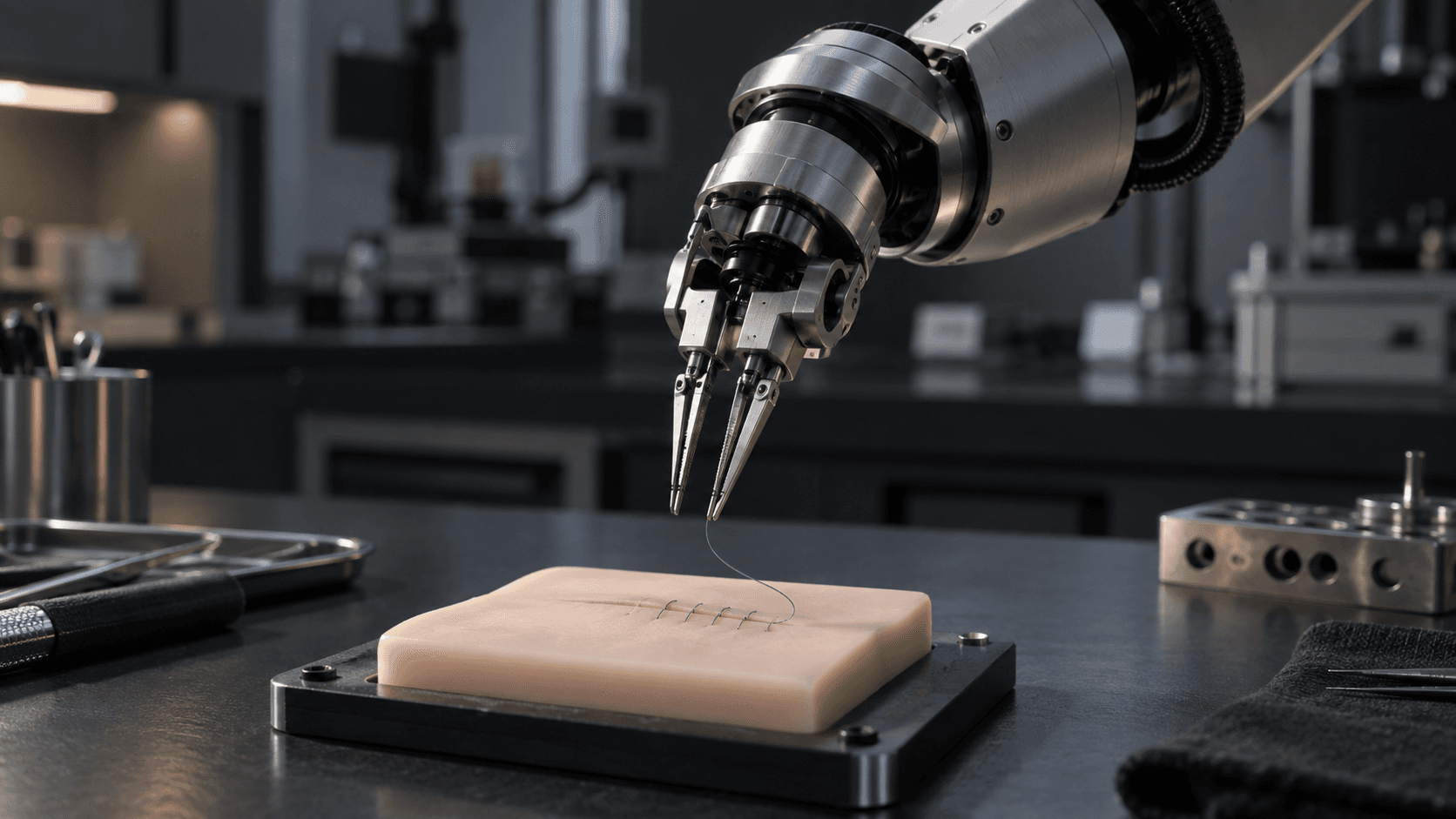
The most revealing requirement in DARPA's new surgical robotics competition is not that a machine perform an operation. It is that the machine stop when told, then get out of the way without causing damage. That is a more useful starting point than another confident prediction about replacing surgeons. Before autonomy can expand someone's capacity, it has to survive working beside them.
Announced on September 15, the DARPA Surgical Competition offers a $3.5 million prize pool to explore robotic assistance and increasingly independent trauma procedures. The allocation is $1.5 million for a collaboration lane, $1.5 million for an independence lane and $500,000 for component-level tests. The ambition is consequential. The announcement, however, is a research challenge, not evidence that a deployable autonomous surgeon now exists.
The Debrief's September 17 coverage describes the competition as a route toward robots that could eventually help in military medicine. That is reporting on DARPA's plans, not independent validation of a machine's performance. The strongest evidence available now is the test design. Read its detailed rules and the story becomes more interesting than the headline: this is an attempt to measure useful pieces of autonomy without pretending all the pieces already work.
The current program calendar puts the qualification deadline at October 30, 2026, at 4 p.m. Eastern. An in-person workshop is scheduled for January 15 through 24, 2027, followed by scored competition from March 20 through 26. DARPA plans to accept up to ten teams, and the rules reserve the option to close qualification early when that capacity is reached. These are scheduled milestones, not completed evaluations.
Three component gates separate different kinds of competence. The medical-knowledge gate uses an oral-board-style examination in which a proctor asks the system to identify instruments and anatomy, assess sterile boundaries and explain procedural next steps. This portion requires autonomy. It is a test of recognition and reasoning under defined conditions, rather than a person quietly supplying the answers through a control console.
The physical-capability gate asks a different question: can the platform handle the tools and forces involved? Its tasks cover strength, tension and dexterity, including holding, pulling, suctioning, passing tools and suturing on simulators. Teleoperation is permitted for the surgical-skills portion, while autonomous execution doubles the efficacy and efficiency points. Teams may switch modes between tasks. That makes the control method part of the result, not a detail to conceal.
The rapid-learning gate raises the difficulty again. Teams receive a 60-minute window to train a previously unprogrammed skill, with three consecutive autonomous successes required within that allotted time. There is an important qualification buried in the detailed rules: passing this gate is not required to enter the two full-procedure lanes. Their stated entry requirements are the medical-knowledge and physical-capability minimums. The overview's broader language about all three gates should not erase that explicit exception.
Why does that distinction matter? Because a demonstration of a rehearsed skill, a successful adaptation and a complete procedure answer different questions. A machine might be competent at one and weak at another. Keeping those results separate gives a buyer or researcher something concrete to interrogate. Compressing them into the label autonomous surgeon throws away precisely the information needed to judge what was accomplished.
In the collaboration lane, a human surgeon leads a scripted trauma procedure and requests assistance from the robot. The run has a 60-minute maximum. If the machine fails a step, the surgeon can complete it to move the scenario forward, but that step earns no points for the robot. Physically repositioning the robotic arms also disqualifies the step from scoring. Autonomous steps receive double points.
The independence lane puts the robot in the primary role with a simulated trauma patient. It is tasked with assessing the scenario, forming a plan and executing the procedure. A proctor surgeon remains present for safety and can be asked to complete a stalled step, again without awarding points for that intervention. Independence is the lane's objective. It is not permission to omit the human assistance from the eventual account of a run.
Both lanes set a minimum prize-eligibility threshold of completing 50 percent of the relevant tasks, with at least one successful task performed autonomously. Meeting that threshold does not guarantee a prize, and it certainly does not establish fully autonomous completion of an operation. When results arrive, the useful report will identify the tasks completed, their control modes and the interventions. A trophy alone cannot supply those details.
The safety tests are unusually concrete. The minimum requires the system to respond to an audible stop command and freeze in less than two seconds, then respond correctly to commands to leave the surgical space without damaging tissue. Other scenarios examine responses to lost communications, lost power, force and speed adjustments, and contact with the lead surgeon. These are requirements to demonstrate, not assurances that any entrant has already satisfied them.
The operational rules also require a physical, hardwired emergency stop that cuts actuator power and is accessible to operators and evaluation personnel. A communications failure must cause a safe pause; loss of power must stop active motion while allowing low-force manual movement out of the surgical cavity. The engineering issue is not simply whether software recognizes an instruction. It is whether the physical system leaves the human a workable recovery path.
That emphasis suggests a better way to assess a prototype: watch the handoff as carefully as the successful maneuver. What happens after a tool slips, a task stalls or a person needs access? The competition's scripted conditions will not answer every possible failure scenario. They do make some of those boundaries observable. For anyone building collaborative machinery, the quality of a safe interruption is part of the product.
Compute is another meaningful constraint. All processing during evaluation must remain on the system or inside the room. External cloud compute and internet services are prohibited, and the evaluation network is closed and monitored. This does not mean every processor must fit inside the robotic arm. It means the proposed capability must operate with the local resources the team brings, rather than depend on an undisclosed remote service.
Teleoperation must also happen inside the assessment room. Teams therefore need to be precise about what their autonomy stack supplies and what a local operator supplies. A useful technical account should describe both. The restriction gives evaluators a clearer boundary around the tested system, but success within that boundary would not, by itself, demonstrate operation across battlefield communications conditions or every environment in which the technology might eventually be useful.
Physical integration gets its own constraints. The deployed system's length cannot exceed 84 inches, or 213 centimeters, and it must preserve human access on one side of the operating table. Transport packaging must fit through standard doorways and office hallways. These provisions make space and access part of the assessment. A capable manipulator that occupies the surgeon's working corridor has not solved the same problem as a capable assistant.
The qualification guide asks for a technical narrative and video evidence, including the platform's mechanics, sensing, control, autonomy and safety arrangements. Its initial demonstrations can use low-fidelity materials rather than a finished clinical setup. That lowers the entry barrier for showing a technical approach without removing the need to explain integration. Significant hardware changes after qualification may require approval and further demonstrations. Teams cannot assume the admitted configuration is irrelevant once they reach the final.
There is also a regional connection worth watching. The qualification guide identifies the Naval Air Warfare Center Training Systems Division and Central Florida Tech Grove in support of the submission portal. That is a concrete Central Florida role, not a reason to present the competition as a Space Coast clinical deployment. For regional robotics and simulation builders, the relevant opportunity is the published technical problem and qualification process.
None of this is a patient trial. The assessments use a simulated operating room with surgical trainers and phantoms. The rules explicitly say human tissue will not be used in the assessment and do not require FDA-approved systems or medical-grade subcomponents for competition participation. Those entry conditions allow prototype experimentation. They are not an authorization to use a contest robot on patients, and a high score cannot establish clinical outcomes that the contest does not measure.
The financing is equally important for founders. Teams fund their own path to the workshop and competition. Prize payments may arrive weeks after the awards ceremony and are subject to available appropriated funds. DARPA lists possible follow-on arrangements, but a possible transition route is not an awarded procurement contract. Budgeting as if the prize pool were an advance purchase order would confuse a competition opportunity with committed revenue.
Intellectual property and training-data rights require separate attention. The terms say self-funded teams retain their intellectual ownership and publishing rights. Government-furnished datasets, however, are limited to competition use; the rules prohibit repurposing them for parallel commercial products or secondary research and require local data to be purged at the end or on withdrawal. Owning an implementation does not automatically confer unrestricted rights over the material used to develop it.
The data terms also acknowledge that sensitive information or facial imagery could remain despite de-identification efforts. They prohibit re-identification, unauthorized sharing and use outside the competition. A team should therefore plan its data handling alongside its model and hardware work. Treating a government-provided dataset as automatically suitable for every future product would skip a constraint that the documents explicitly impose.
The result to watch next March is not whether a robot looks convincing in an operating room. It is which tasks it completes, which require intervention, whether it handles the prescribed failures and how much of the procedure remains outside its demonstrated competence. A narrowly capable machine with clear limits can be a serious research result. Calling that machine a finished surgeon would make the evidence less useful. DARPA has put a test on the calendar. Now the builders have to earn the claims.
LaunchPad positionJudge the eventual results by completed tasks, control modes and human interventions, not by the promise of an autonomous surgeon.
This report draws on the linked primary sources and reputable reporting. Company statements are treated as claims until independently demonstrated.