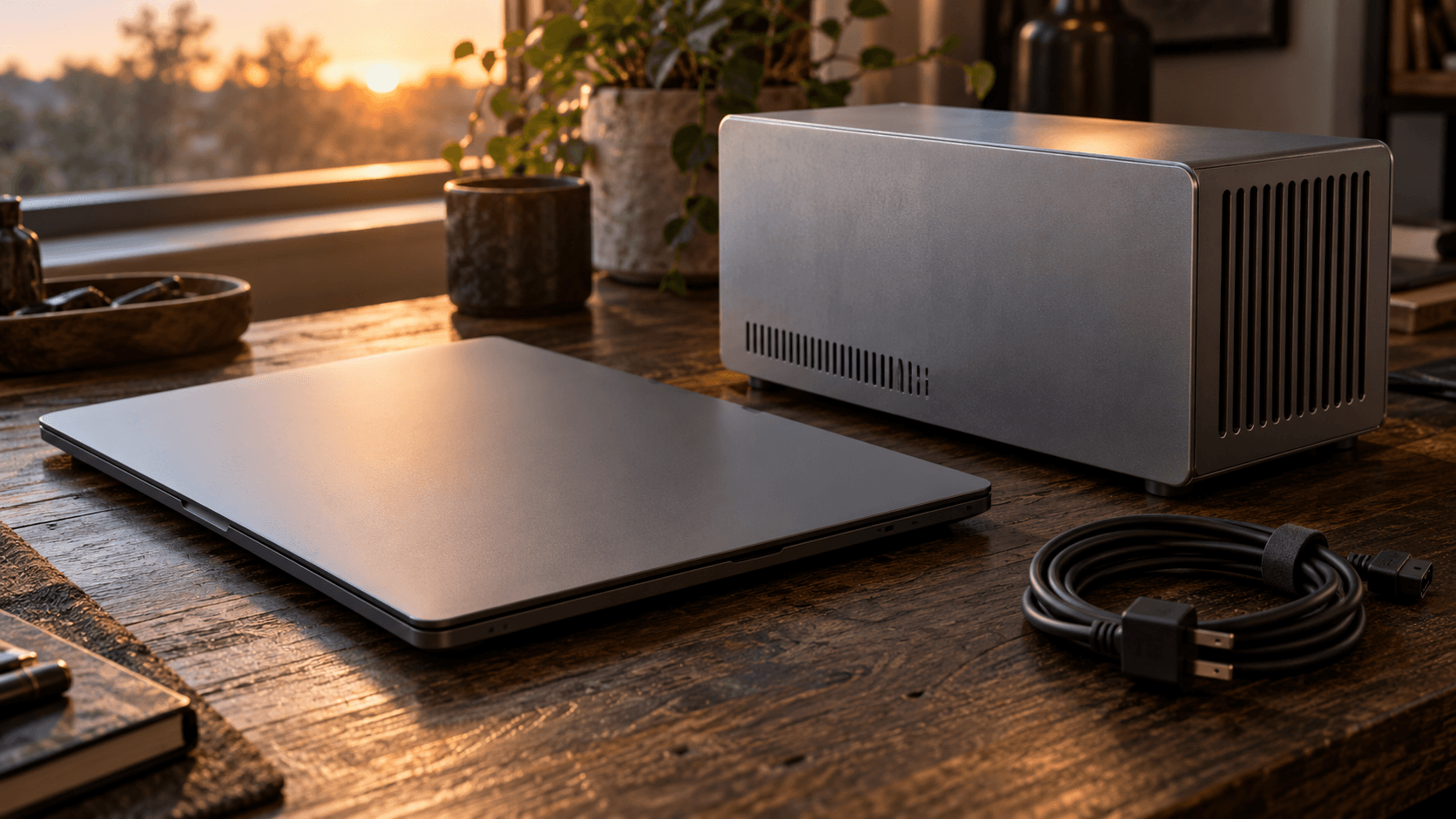
The most consequential line in Microsoft's new AI laptop pitch is buried below the headline memory number. Surface Laptop Ultra can have 128 GB of unified memory, but Microsoft explicitly says the GPU cannot address all of it. That qualification is where a serious buying decision starts. A large shared pool can make a local workload possible. It does not tell a builder how much room remains once the actual work begins.
Microsoft opened preorders on October 7, with Surface Laptop Ultra availability beginning October 16 and U.S. Surface RTX Spark Dev Box shipments planned for November. These are purchase and delivery milestones, not evidence that customers already have production machines. TechCrunch's launch reporting identifies developers as a central audience. The price and specification pages now give that audience something concrete to evaluate, although the performance evidence reviewed here remains vendor-supplied.
The Surface laptop starts at $2,599.99. Its maximum memory specification is a separate statement, not a promise that the entry price buys the largest configuration. Microsoft's product page also describes upgradeable storage and configurations with up to 2 TB. For a developer comparing local inference machines, the relevant quote is the complete configuration needed for the workload, including storage. Combining a starting price with every maximum in a specification table produces an imaginary bargain.
NVIDIA describes RTX Spark as a combination of up to 6,144 Blackwell RTX GPU cores and a Grace CPU with up to 20 cores, joined by a 600 GB/s interconnect. Its advertised ceiling of one petaflop uses FP4 precision. Those are architectural and arithmetic specifications. They should not be read as a promise of sustained application performance, or as a count of useful answers a machine can produce.
The practical attraction is the shared memory arrangement. Dell's announcement describes the CPU and GPU using one pool rather than framing the laptop around a separate graphics-memory allowance. That changes the capacity question for large models and creative workloads. But capacity is still a budget: loading a model is only the beginning. A purchasing test should leave room for the runtime, the working context and the other applications that make the machine useful as a workstation.
Precision belongs in that test too. A throughput claim at FP4 is conditional on the relevant low-precision computation. It cannot answer whether the chosen model, runtime and task will deliver acceptable results in that form. A developer should bring the exact model representation they intend to run, not merely another model with a similar parameter count. The real question is whether the proposed configuration completes the work at the required quality, within the available memory.
Microsoft advertises up to 2.1 times faster time to first token, 4.3 times faster image generation and 6.2 times faster video generation against a 16-inch M5 Pro MacBook Pro with 64 GB. These are separate tests. September testing used preproduction Windows systems with 64 GB. Microsoft commissioned the text comparison; NVIDIA conducted the image and video comparisons.
The text workload used Qwen3.5 27B, Q4K-Medium and an 8,192-token prompt in llama.cpp. Images used FLUX.2 Klein 4B, NVFP4, four steps and 1024-by-1024 output. Video used LTX 2.3 22B, NVFP4, eight steps and 121 frames at 25 fps, at 1280 by 720. Those settings define the comparisons. They do not establish the same advantage for a different model, output size or generation procedure.
Time to first token measures the wait before output starts. A coding task can still spend time producing the rest of an answer, invoking tools, running tests and correcting a failed attempt. The benchmark may matter greatly to an interactive application, but it cannot substitute for timing that whole sequence. Likewise, a video result should be judged alongside the quality and duration of the requested output. A faster sample that fails the creative brief has not finished the job.
Application compatibility is another reason to test a real project before buying a fleet. Dell says Blender, DaVinci Resolve, Photoshop and Premiere run natively on its RTX Spark platform, while MATLAB is supported through Prism emulation. That is a useful distinction, not a blanket guarantee for every plugin or dependency. A credible trial should include the less glamorous parts of a workflow: importing an existing project, opening its assets, running its extensions and exporting the result.
Dell is taking U.S. XPS 16 Creator Edition preorders through Best Buy, with Dell.com availability to follow. Its compact Creator Edition Desktop is still described as coming soon. The company pitches that desktop for continuous work without a laptop's battery and thermal constraints. That is a reason to compare sustained operation across form factors, not an independently measured advantage established by the announcement. Portability has value, but it should not be purchased accidentally for a job that never leaves a desk.
Microsoft's Surface RTX Spark Dev Box starts at $5,999.99 and lists 128 GB of unified memory. Its product page specifies a 100 W thermal envelope and a Windows 11 Pro environment preconfigured with VS Code, GitHub Copilot CLI, WSL and PowerShell 7. The external monitor and keyboard are separate. This is a distinct purchase from the entry laptop, with a different price and deployment proposition.
Preconfiguration can remove setup work, but installed software is not proof that every connected service is included without further charges. Nor is a thermal envelope a measurement of electricity at the wall. A team building a cost comparison should keep those categories separate. Otherwise, the local machine gets credited with free software and an invented operating-cost figure before anyone has run a workload on it.
The economics should be written around accepted work. Start with the acquisition cost over the intended useful life, then include power, maintenance, setup time and any paid services still used. Compare that with the cloud spending the machine actually displaces. If a task falls back to a hosted model, both attempts belong in the account. This is a proposed evaluation method, not a payback estimate: the launch documents do not establish a universal break-even point.
Utilization makes that distinction tangible. Consider two hypothetical teams buying the same configuration. One repeatedly runs a stable, well-tested local workload; the other uses it occasionally and sends difficult jobs to the cloud. The hardware specification is identical, but the amount of displaced service spending is not. A local-compute business case therefore needs a workload inventory and a quality threshold before it needs a triumphant comparison of token prices.
GitHub's earlier HydraFusion research preview explains why hybrid accounting can become complicated. Its September announcement describes three execution patterns: one model solving a task, an efficient model escalating through a quality gate, or a draft reviewed by a critic from another model family. The service charges for the tokens used by participating models at their standard rates. GitHub's evaluation accounting includes revision, retries and fallback rather than pretending the first attempt was the whole workflow.
That research preview is not the same milestone as the local Windows integration announced today. Microsoft places the latter's experimental preview later in October. GitHub's reported quality and estimated-cost results come from controlled offline coding evaluations using tuned configurations. They do not demonstrate the savings a purchaser will obtain by moving parts of that workflow onto a new laptop. The useful lesson is the accounting discipline: every stage consumes resources, including stages whose output never reaches the user.
Local execution also creates a permissions problem that additional memory cannot solve. Microsoft's newly generally available Execution Containers layer lets developers specify resource access outside an agent's own control. Its documentation separates containment backends with different security properties, and labels the MicroVM backend experimental. The announcement does not mean every agent on a Windows machine is automatically confined, or that all isolation choices provide equivalent protection.
The Windows process-container modes deserve particular attention. Microsoft's Learning mode blocks ungranted access and records it; Permissive mode records that access but allows it. Enforcement blocks it without producing that activity report. Treating a successful run in Permissive mode as a successful security test would miss the purpose of the mode. Organizations should test their intended restrictions, including what happens when a necessary operation is denied, before relying on an unattended workflow.
Some management capabilities remain prospective. Microsoft describes Intune policy for MXC process containers and Entra-based separation of agent activity as coming soon. That creates a practical sequencing choice. A team can evaluate the hardware and presently available containment features while withholding workloads that depend on those future controls. Buying a device, enabling a preview and approving an agent to handle sensitive work should be three separate decisions.
The strongest case for this generation of machines is therefore specific: a workload fits, its software works, its output passes review and its repeated use justifies ownership. The strongest counterargument is equally specific: the workflow may still need hosted models, the desired integration may not yet be available, or the complete configuration may cost more than the work can justify. Neither conclusion follows from the largest memory number alone.
For builders, October's preorder window is an opportunity to define a serious acceptance test before the machines arrive. Choose representative projects, preserve their expected outputs, record the actual configuration and measure a full working session rather than a favorable isolated operation. Keep the cloud fallback visible in the results. RTX Spark now has prices and delivery targets attached to its promise. The next useful evidence is what a purchased machine can reliably finish.
LaunchPad positionCompare the complete configuration against accepted work, including cloud fallback and software still awaiting release.
This report draws on the linked primary sources and reputable reporting. Company statements are treated as claims until independently demonstrated.