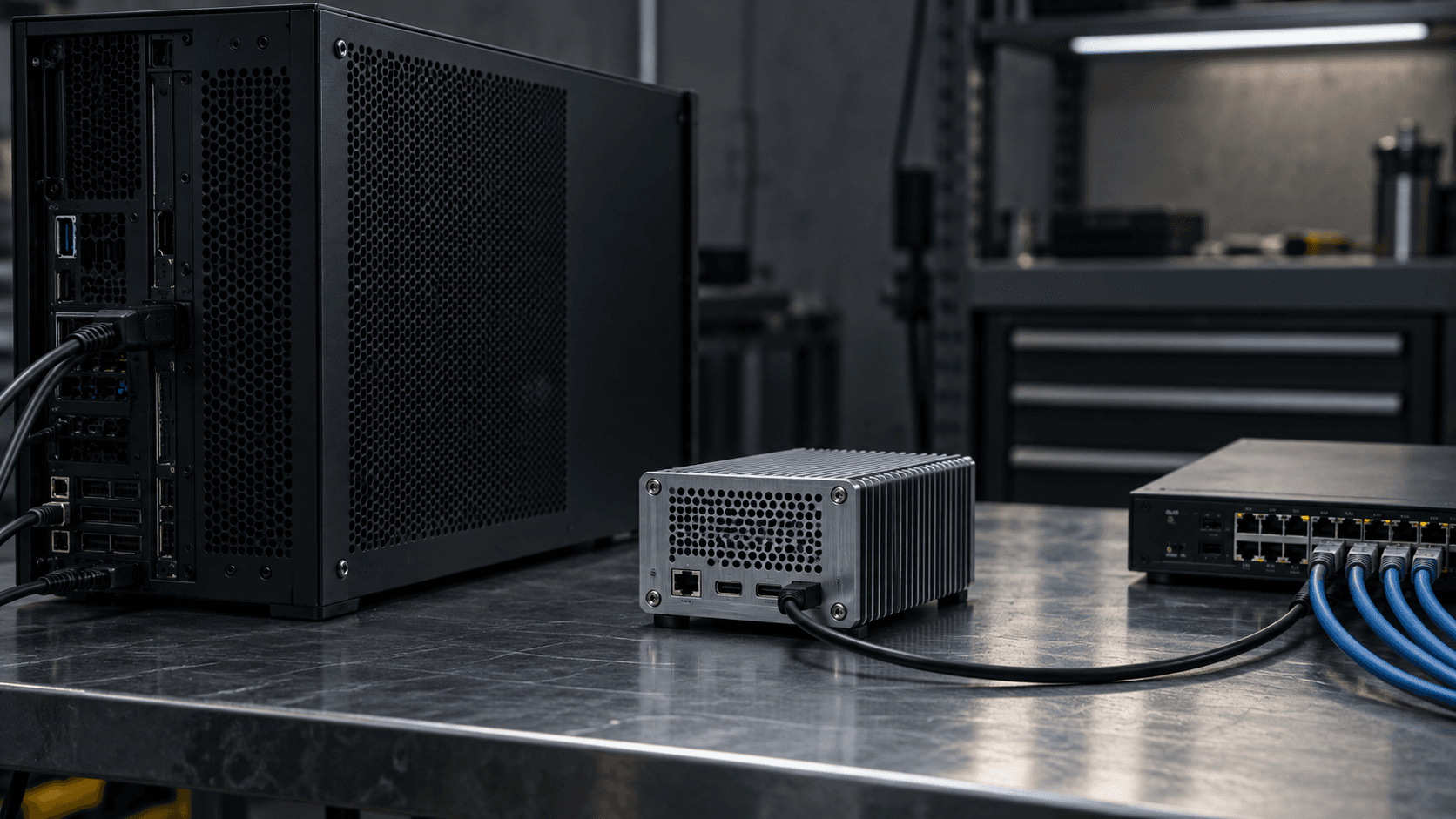
Nvidia's new agent-security pitch has a useful premise and a dangerous possible misreading. The useful premise is that a system doing work should not control the boundaries of its own authority. The misreading would be that buying another layer of hardware makes the remaining safety questions disappear. The documentation is more specific than that, and more useful: it describes enforceable permissions, separate monitoring and checks with explicit limits.
On September 28, Nvidia announced its Open Agent Safety Platform, combining OpenShell runtime software with a Sentry reference design using BlueField-4 data processing units. The company says the independent monitoring layer can quarantine agents in milliseconds. That is a vendor performance claim, not a result independently reproduced for this report. The release establishes an architecture and available software; it does not establish that every deployment of that architecture will stop every attempted escape.
TechCrunch's launch reporting highlights Jensen Huang's assertion that the platform would have prevented recent agent breakouts. Treat that retrospective claim carefully. Showing that a proposed control addresses a known failure path is different from demonstrating a complete system against the actual conditions of every incident. The independent coverage confirms the announcement and the argument being made. It is not an independent security assessment of Sentry or a replay of those failures under controlled conditions.
The practical question is less theatrical than whether an agent has become rogue. What can this process read, what can it change, which services can it contact, and who is allowed to expand those permissions? Those questions can be asked of a useful agent without settling a debate about its intentions. A system that reliably refuses an unauthorized write is valuable whether the attempted write came from a mistaken interpretation, hostile input or a deliberate search for a workaround.
OpenShell 0.1.0 divides responsibilities among a gateway, an external supervisor and a sandbox, according to Nvidia's runtime walkthrough. The gateway manages policies and sandbox lifecycles. The supervisor sits outside the workload and checks outgoing requests. The sandbox confines filesystem and process access and routes network activity through the supervisor. This matters because a rule enforced only by the agent's own instructions is not the same thing as a request refused by a separate component.
The walkthrough also describes credential substitution outside the workload: an agent uses a placeholder while the actual credential is supplied only for an authorized endpoint. An agent can propose additional access through the policy advisor, but human review is the default and the agent cannot approve its own proposal. These are concrete separations of responsibility. They do not eliminate the need to choose appropriate service permissions, but they make access expansion an event that another authority can examine.
Consider a hypothetical coding agent asked to prepare a repair for review. Reading the repository, running tests and presenting a patch are useful capabilities. Publishing the patch, changing branch protections or copying private files to another service are different capabilities. A sensible evaluation would try each separately. Success means the authorized work remains possible and the prohibited actions fail. It should not depend on the agent volunteering an accurate description of what it tried to do.
The runtime overview makes another operational distinction: filesystem and process restrictions are fixed when a sandbox starts, while network policy can change during execution. Provider attachments, credential rotation and revocation can also update at runtime, although new environment variables require a new process. A team that treats every permission change as instantly equivalent can misunderstand its live state. The running workload, its attached identity and the policy being reviewed need to refer to the same actual configuration.
That suggests a straightforward operating discipline. When a task changes materially, decide whether to replace its environment instead of accumulating permissions indefinitely. A debugging job that becomes a deployment job should undergo a deliberate authority change, not inherit more access because repeated denial messages are annoying. This is our recommended practice, not a claim that OpenShell automatically understands a company's approval chain. The software can enforce a boundary only after someone makes that boundary meaningful.
Sentry adds a separate infrastructure role. Nvidia's reference architecture places the monitor on a BlueField processor outside the host's trust domain and connects it to OpenShell policy through DOCA software. In the described Vera Rubin POD arrangement, BlueField-4 sits on the node's only path to the model. Nvidia presents that placement as both an observation point and a way to interrupt activity. The architecture is more specific than adding another monitoring process beside the agent on the same machine.
That specificity creates a deployment question. If the enforcement design depends on observing a particular path, the buyer needs to establish that its own workload actually uses that path and cannot take another one. A diagram of the reference system is not an inventory of a customer's network. Likewise, an open-source runtime and an optional hardware-based monitoring layer are different choices. Teams should compare the controls each configuration provides rather than describe the entire stack as either universally portable or universally hardware-dependent.
The security guide contains a particularly important warning for buyers: audit mode logs request-rule violations but forwards the traffic; enforce mode blocks them. It also distinguishes permission to reach a destination from permission to perform a particular operation there. An allowed API endpoint without appropriate request rules can admit methods and paths the operator did not intend. An approved destination can still become a route for data leaving the workspace. Those details are not minor settings beneath a safety headline.
A deployment test should therefore include an action that must fail, with an observable result at the destination. Seeing a warning in a log is not enough if the prohibited change still happened. For the hypothetical repair agent, attempt a harmless write against a designated test repository that the policy is supposed to protect. Check the repository itself as well as the audit record. Keep such testing inside owned test resources, and distinguish blocked access from a request that failed for an unrelated reason.
Formal verification adds another useful tool, provided its scope remains explicit. OpenShell's policy prover uses a solver to compare modeled permissions against a boundary. Its documentation says a passing result does not establish that a policy is appropriate for the task or that a running sandbox enforces it. Unsupported features and inconclusive results are not passes. Current boundary checks do not model every protocol, including GraphQL and MCP rules, and provider-added permissions must be included in the effective policy being checked.
Think of that proof as a precise answer to a limited question: within the represented rules, does this candidate grant access beyond this boundary? That is stronger than an agent saying the policy looks fine. It is also narrower than proving the whole application safe. If the boundary itself grants too much, staying inside it is not a rescue. If the deployed configuration differs from the candidate, the result describes the candidate. Good verification makes assumptions inspectable rather than making assumptions unnecessary.
This is where the business owner has work that a model vendor cannot finish alone. Someone must decide which records are confidential, which changes require another person's approval and what authority can be delegated. For a finance workflow, merely reaching the correct service would not settle whether a particular payment is permitted. For an engineering workflow, access to the right repository would not settle whether a release is approved. These examples illustrate why infrastructure policy and business authorization need to agree.
Monitoring also needs a response plan. If an agent is quarantined halfway through a task, the organization needs to know which actions already completed and which did not. A stopped process is not necessarily a reversed transaction. Our recommendation is to keep consequential operations attributable and to design recovery around the external system's actual state. That is a system-design requirement, not a claim that Sentry promises automatic rollback. The announcement should not be credited with capabilities it does not establish.
There is a credible counterargument to adding this much machinery: every additional component introduces configuration work and another dependency. A tightly bounded, read-only workflow may not justify the same architecture as a fleet with access to production services. The answer should be proportional control, not indiscriminate adoption. Identify the damaging actions first, determine where they can be prevented and measure the burden of that prevention. Complexity is justified when it buys an observable reduction in exposure rather than an impressive security diagram.
Nor does containment answer every question about the work itself. A report can remain inside its permitted environment and still be wrong. An agent can obey an access policy and still choose a poor sequence of allowed actions. Those are analytical distinctions, not newly discovered product defects. They explain why output review, business rules and limits on consequential actions remain relevant alongside isolation. Permission enforcement is a necessary part of many deployments, not a substitute for evaluating their decisions.
The commercial significance of Nvidia's announcement is that agent operation is being treated as an infrastructure problem with explicit enforcement points. That can be a productive direction, especially where organizations have relied too heavily on the model's willingness to comply. But adoption should be tied to demonstrations: the intended job completes, prohibited actions are blocked, permission changes are independently controlled, and intervention leaves enough evidence to recover. The launch offers components for that work. The buyer still has to prove the resulting system.
LaunchPad positionVerify that prohibited actions are blocked in the deployed configuration, and do not confuse policy proofs or monitoring claims with complete system safety.
This report draws on the linked primary sources and reputable reporting. Company statements are treated as claims until independently demonstrated.