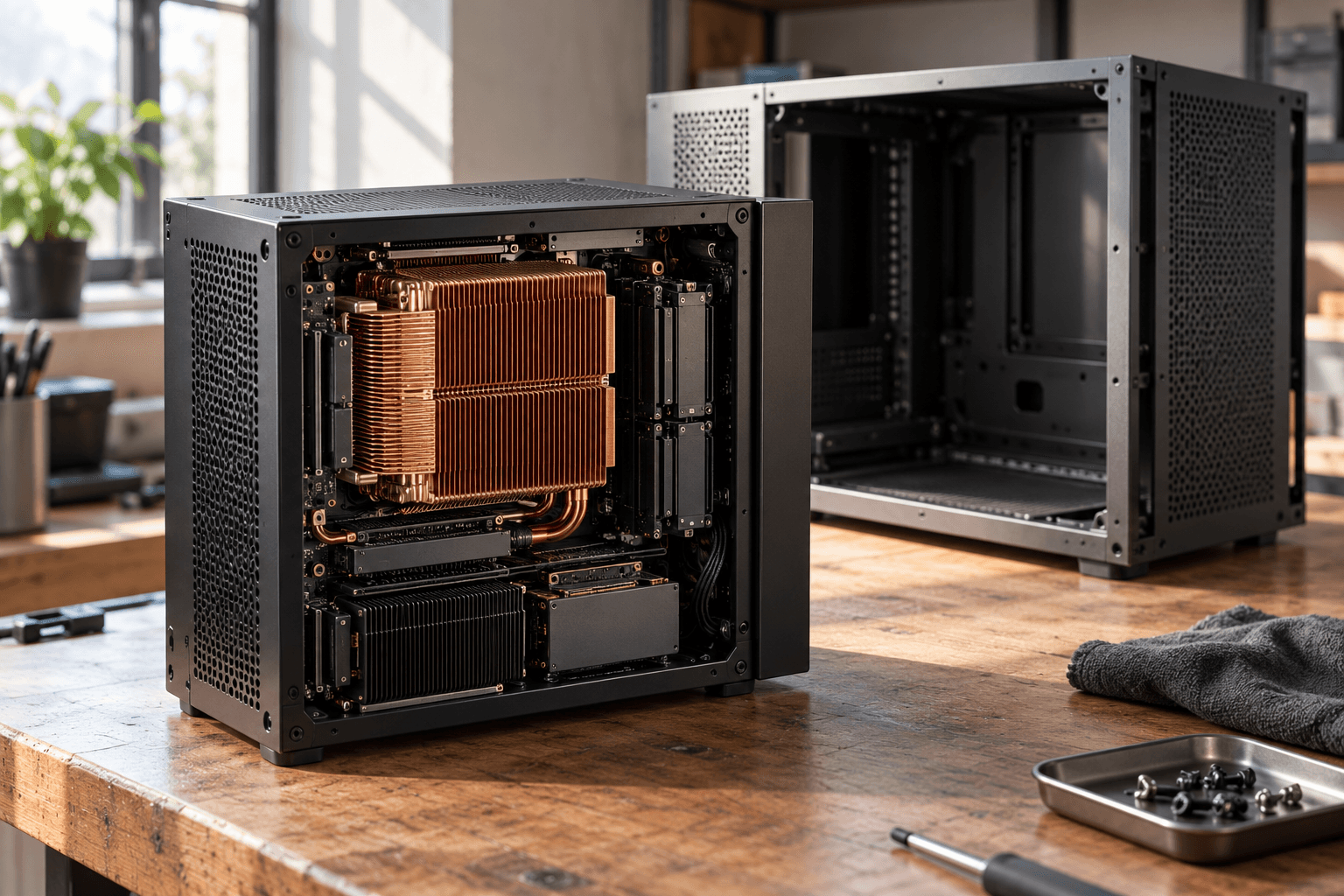
Nvidia has put a memory budget in a model's name. Nemotron 3.5 Bolt 74B-A9B 24GB promises a practical route to local agents, yet its published GGUF deployment card offers 28GB and 32GB recipes. That is not proof that a 24GB deployment is impossible. It is a warning against treating the label on the checkpoint as a complete specification for the application you intend to run.
The release deserves attention for exactly this reason. It exposes the engineering choices between a capable model and a usable product. A founder evaluating a local assistant needs to know what will fit, which configuration was measured and what work the system can finish. Parameter counts answer only part of that inquiry. The most useful material in this launch is not the claim that agents are getting faster. It is the documentation that lets a team inspect the conditions attached to that claim.
TechCrunch's October 19 report covers Nvidia's Thursday launch of Super VL and the Bolt family. Super VL and Bolt 74B were available, while the smaller E4B was still scheduled for later in the month. The distinction matters: a release announcement can contain both downloadable software and a roadmap. The independent report also places the launch within Nvidia's push for enterprise-owned models and local assistants. Its coverage is not an independent reproduction of the performance results. The technical claims examined here remain Nvidia's measurements and disclosures, not results from our own hardware tests.
Bolt starts with a larger model rather than a blank sheet. Nvidia's project description says its Star Elastic process compresses Super VL from 120 billion total parameters and 12 billion active parameters to 74 billion and 9 billion respectively. It chooses expert counts and intermediate widths within the network, then applies additional training to recover capabilities. That is a different proposition from simply downloading a smaller model and hoping it retains the behavior of its parent.
The next reduction is numerical. Nvidia says the routed and shared expert weights use an IQ2_XXS representation averaging 2.0625 bits per element, with other components using different precisions. Quantization-aware distillation then helps recover accuracy. The company reports 84 tokens per second on its stated AIPerf SPEED-Bench setup on RTX Spark. Neither that number nor the low-bit description should be read as a guarantee across machines. The engineering argument is that aggressive compression of a larger network can be worthwhile within a fixed memory allowance, not that compression has become free.
The actual Bolt deployment table makes the tradeoff concrete. Its 28GB recipe uses a 65,536-token context, one concurrent sequence and up to six draft tokens; the 32GB recipe expands context to 262,144 tokens with one sequence and up to seven draft tokens. The corresponding discrete-GPU recommendations are 32GB or more and 48GB or more. These are documented configurations, not an exhaustive catalog of everything an expert might make work. They are also more useful planning inputs than the model's name.
A team should therefore record its intended operating envelope before comparing downloads. Does the assistant handle one interactive request, or do several people share it? How much of a conversation must remain available? Will the test include the other applications expected to run on the machine? Those are proposed acceptance criteria, not claims about an unmeasured configuration. If the product requires a different envelope from the published recipe, that difference belongs in the experiment, rather than being quietly assumed away.
Super VL illustrates another reason to evaluate the deployed checkpoint instead of the family name. Nvidia's model card describes a hybrid of Mamba-2, mixture-of-experts and attention layers, with a vision encoder, accepting text, images and video and producing text. Its BF16 and NVFP4 comparison is particularly instructive. SWE-bench Verified is nearly unchanged, at 71.10 versus 71.07, but the offline WebVoyager result moves from 77.72 to 66.31. Nvidia says it held the non-model evaluation settings fixed for those comparisons.
That table is evidence against a blanket claim that lower precision preserves every capability equally. It is not evidence that every browser agent will suffer the same decline. A coding-oriented buyer and a browsing-oriented buyer could reasonably read the same table and prioritize different tests. The useful next step is to reproduce the behavior that matters to the product, including its failure cases, rather than turn an average impression of model quality into an operating assumption.
Nvidia's technical announcement describes optimizations beyond smaller weights. Multi-token prediction proposes several tokens for the main model to verify, and prefix caching reuses shared instructions, tool definitions and conversation history. Those techniques target repeated work during generation and repeated calls. The announcement's larger serving claim is also specific: up to eight times as many users and 85 percent lower first-token latency on 16 B200 GPUs, measured at 50 tokens per second per user. It is not a performance promise for the desktop Bolt configuration.
The customer examples need the same discipline. The technical post says inference cost for the Scale AI and Skydance workload will fall by a factor of 40, while Ramp expects higher throughput and lower latency. Those are attributed expectations in the source, not independently audited savings already realized across customers. They justify asking for a workload comparison. They do not establish what a different organization's deployment will cost, or whether its own specialized model will outperform a hosted alternative.
The Dynamo deployment documentation supplies some of the missing context for serving comparisons. Its optimization target replays a SWE-bench Pro agentic workload with a median input length of 222,076 tokens, median output length of 188 and a reported 99 percent cache-hit rate. The target includes more than 50 output tokens per second per user and median time to first token below five seconds. These are unusually specific conditions. A workload that does not share them should not inherit the results without measurement.
Even the topology labels need inspection. The documented B200 aggregated configuration uses four GPUs, while the three-prefill, two-decode configuration uses five. Comparing those rows without accounting for the resource difference would obscure the tradeoff. The recipes also require adaptation to cluster storage, scheduling and networking. The practical question is which complete configuration serves the team's trace satisfactorily, not whether splitting prompt processing from token generation is inherently superior. A published recipe is a starting configuration with assumptions, not a substitute for deployment engineering.
The commercial freedom is real but bounded by the license. OpenMDW 1.1 grants broad permissions for the supplied model materials, requires preservation of the agreement and applicable notices when those materials are distributed, and does not impose its own restrictions on generated outputs. It also disclaims warranties, including accuracy, and leaves the recipient responsible for other rights and necessary permissions. An open download should not be confused with a certification that every intended input, output or application is cleared for use.
For a product team, that separation belongs in the handoff between engineering and governance. Keep the exact license with the selected artifact and identify which additional materials the application will introduce. Someone still needs to review the permissions surrounding those materials. This is not an argument against open models. It is an argument for treating the ability to adapt and distribute them as a concrete capability with identifiable responsibilities, rather than a general assurance that all downstream questions have been settled.
Safety documentation describes a different boundary. Bolt's safety disclosure says Nvidia used a guard model to filter training content and applied least-privilege access during dataset generation and model development. Those are descriptions of the development process. They do not specify the authority a deployed assistant should receive over a customer's files, accounts or tools. A training-data safeguard and an application permission boundary address different problems.
My recommendation is to separate evaluation of answers from evaluation of actions. Start an agent with a deliberately narrow set of permitted operations and test what happens when it requests something outside that set. Require explicit authorization for consequential writes where the product warrants it, and preserve enough execution evidence to investigate a mistake. None of that follows automatically from a favorable benchmark score. It is additional product work, and should be budgeted alongside inference performance rather than postponed until after a pilot succeeds.
Local execution also needs a precise privacy claim. Nvidia's Bolt privacy disclosure says its synthetic-data prompts did not contain personal data and that user interactions were not used to train the model. It reports dataset review before release. The same disclosure says correction or removal is not possible with externally sourced data. These are vendor statements about model development and data handling, not an independent audit of every possible deployment.
Do not expand those statements into a promise about the complete assistant. Before calling a product private, inspect where its tool requests go, what its logs retain and who can retrieve them. Running the model locally addresses where that inference happens; it does not, by itself, describe the rest of the application's behavior. A privacy review should follow the information through the product the team actually assembled. That recommendation does not allege a leak in Bolt. It defines what remains unproven by a local-model label.
The purchasing and product decision should emerge from a small, reproducible comparison. Fix the checkpoint, runtime, context allowance, concurrency and task set. Measure completion quality alongside elapsed time and resource use. Include the effort required to review or repair rejected work. A fast answer that needs correction is not the same deliverable as an accepted result. Publish those conditions internally with the outcome so that a later configuration change does not silently invalidate the decision.
Nvidia has released enough technical detail to make that comparison more disciplined. The opportunity is to choose an agent configuration for a specific operating environment, then retain control over how it is adapted and deployed. The counterweight is the work of validating that choice. I would not authorize a broad rollout on the strength of a parameter count, a memory label or a vendor speed ratio. I would authorize the next test when the team can name the exact recipe, the tasks it must pass and the circumstances under which it will be rejected.
LaunchPad positionEvaluate the complete serving recipe and accepted-task quality. Do not turn a checkpoint label, vendor benchmark or local-inference claim into a guarantee about the finished agent.
This report draws on the linked primary sources and reputable reporting. Company statements are treated as claims until independently demonstrated.