A failed robot demonstration can still contain a perfectly good grasp. A successful one can contain a long, unnecessary detour. NEEDLEWORK asks what happens when the training pipeline stops treating either recording as an indivisible unit. Its contribution is not another collection campaign. It is a way to add short action sequences that connect useful parts of recordings already on hand, then train a policy on those connections alongside the original data.
The October 1 preprint comes from Juntao Ren and Shuran Song at Stanford and Yifan Hou at NVIDIA. Their algorithm, NEEDLE, produces encouraging results on two real manipulation tasks and several simulated benchmarks. These are the authors' experiments, not independently replicated results. This analysis draws on their paper, supplementary project materials and public repository. No independent reporting establishing the results was located. The paper should be read as a research submission, not a certified capability or evidence of conference acceptance.
The distinction between selecting good data and creating a usable connection is the heart of the work. Knowing that one recording contains a better continuation does not tell a robot how to get there. Two camera views can look promising while concealing an incompatible hand position or object arrangement. NEEDLE therefore separates two decisions: whether a connection would improve the recorded route, and whether a proposed set of actions is likely to make that connection.
It searches for three kinds of opportunity. A shortcut skips an inefficient section within a successful demonstration. A transplant connects a successful recording to a shorter successful continuation in another recording. A failure funnel connects a point in an unsuccessful episode to a successful one. These are different uses for imperfect data. The first removes a detour; the second combines complementary behavior; the third gives a failed episode a possible route toward completion.
The selection rule counts the length of the bridge as well as the remaining successful continuation. A shorter destination sequence is not useful if reaching it takes longer than finishing the original route. For successful source episodes, the combined route must be shorter. For failed sources, the method favors the shortest bridge-plus-continuation among accepted candidates. It retains at most one bridge per source observation. Visual features narrow the search, but similarity alone never establishes feasibility.
A goal-conditioned inverse dynamics model proposes the actions between two observations. A separate verifier estimates whether those actions reach the destination and which prefix of the sequence is sufficient. Both learn from short segments already present in the recordings. Those segments provide examples of a starting observation, an action sequence and its actual endpoint, including segments taken from episodes that ultimately fail. Episode-level failure does not erase the local evidence about what an action actually did.
The verifier's negative examples also deserve attention. A recorded action sequence can be paired with the wrong destination to teach the model to reject that particular connection. That does not establish that the destination is unreachable by every possible action. The distinction prevents a useful local test from being mistaken for a comprehensive model of the world. Acceptance thresholds are calibrated on held-out trajectories to favor low observed false-positive rates. That remains a statistical filter, not a formal proof of physical reachability.
NEEDLE uses camera images, robot proprioception and episode-level success or failure. It does not require privileged object state, new environment interaction for augmentation, or synthetic images between the bridge endpoints. Avoiding invented intermediate images is consequential: the training data contain proposed actions attached to observations that were actually recorded. The method is deliberately narrower than generating an entire imagined demonstration and treating every frame as reliable evidence.
That narrowness continues at the handoff. During policy training, a bridge can be attached to its source observation and to earlier recorded observations, with the original intervening actions preceding it. Training stops at the bridge endpoint. The target recording's remaining actions are not simply pasted onto the new sequence. The reached state may differ from the recorded target, and relative coordinate frames may not line up. The successful continuation still contributes through its own original training examples.
The original source actions and bypassed segments remain available. This is augmentation, not a cleanup operation that deletes every behavior judged inefficient. For builders, that is a useful design choice: an alternative route can improve supervision without erasing the situations covered by the old route. It also complicates implementation. The paper controls how the different training windows are sampled, and its ablations indicate that the proposed bridge actions matter beyond merely changing the weight of existing examples.
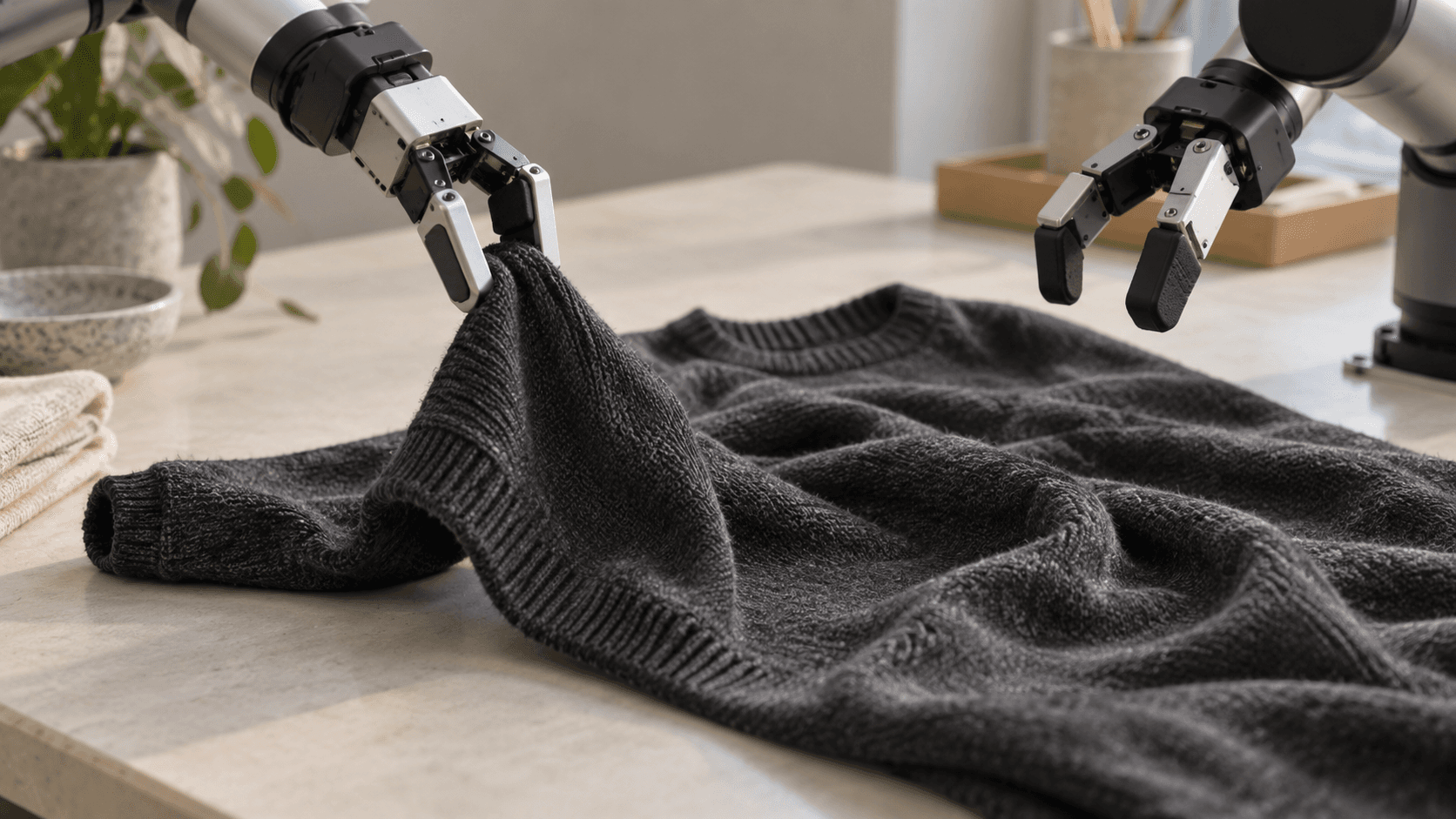
The real-robot setup uses a bimanual ARX-5 system for sweater folding and dish placement. Folding requires bringing both sleeves inward and then folding the bottom. The dish task includes pickup, a handover between arms, reorientation and insertion into a rack. The sweater dataset contains 108 successful and 78 failed demonstrations; the dish dataset contains 179 successful and 59 failed demonstrations. These are specific collections for specific tasks, not evidence of unrestricted household competence.
For each task, the authors compare NEEDLE with a diffusion-policy baseline and advantage-weighted regression, using 50 matched starting conditions per policy. They report 44 successful dish trials out of 50 and 48 successful sweater trials out of 50, or 88 and 96 percent. The improvements over the strongest baseline are 18 and 24 percentage points respectively. Their average is the headline 21-point improvement. It is not a 21 percent relative gain, and it should not be extrapolated to arbitrary manipulation tasks.
The project page provides the full set of 300 real evaluation trials, which is more useful for scrutiny than a highlight reel alone. It remains author-provided evidence; making videos available is not the same as independent replication. The paper describes matched resets using image overlays and human-marked outcomes and completion times. Those procedures make the comparison interpretable, while leaving the usual question for a prospective adopter: does the result survive a new collection, different starting conditions and another operator?
Speed requires a similarly careful reading. NEEDLE improves completion performance, but the advantage-weighted baseline has a slightly lower average completion time among successful dish trials. A method that succeeds less often can look quick if its hardest failures disappear from the timing calculation. The authors also examine completion under time budgets, which keeps the success question in view. The practical metric is therefore completed tasks within a deadline, not a blanket claim that every NEEDLE motion is faster.
In the Robomimic simulation comparison, the authors use Can, Square and Transport, with 40 successful demonstrations per task and 150 failed demonstrations available to methods that use them. They report an average improvement of 8.4 percentage points over the diffusion-policy baseline and 6.9 points over the strongest competing baseline on each task. The methods share the study's visual encoder and policy architecture. Some competitors are adapted to remove privileged information or annotations, so these results compare the implemented conditions, not every original system in every setting.
The checkpoint protocol is an important qualification. The Robomimic experiments use five training seeds and 50 evaluation starting states per seed, evaluating checkpoints every 25 epochs on the same fixed states. The reported result selects the best checkpoint success rate for each seed. Equal evaluation frequency helps the internal comparison, but those figures are not results from an untouched final test set. A deployment decision would benefit from separating checkpoint selection from a fresh evaluation rather than carrying the best-checkpoint number straight into a performance promise.
The verifier improves the method without making its name a guarantee. In a simulation diagnostic, the authors replay accepted bridges and measure how close they get to the intended physical state. About 61, 76 and 78 percent finish within five centimeters on Can, Square and Transport respectively. Ground-truth state is used for that diagnostic, not as an input to the stitching models. These figures show why a learned acceptance decision should not be confused with certainty that a physical connection will work.
Removing verification is much worse in one telling ablation. With the action proposal model unchanged and bridge counts matched, Transport policy success drops from 53.2 to 20.4 percent. The result supports filtering the proposed connections in this experimental setup. It does not prove that every accepted bridge is correct or that the same reduction would occur on another robot. The defensible conclusion is that proposal volume alone is a poor substitute for evaluating the proposed actions.
Already-strong demonstrations reduce the opportunity. On three near-optimal DexMimicGen tasks, NEEDLE's improvement over the diffusion-policy baseline ranges from zero to four percentage points. It ties that baseline on Threading, while advantage-weighted regression performs better on that task. This is a useful boundary, not an inconvenient exception to hide. If the recordings already offer efficient, coherent routes, there is less missing connectivity for this particular augmentation method to supply.
Nor are all manipulation problems reducible to a short bridge. The authors identify sustained contact, substantial object reconfiguration and actions requiring feedback within the bridge as limitations. The proposed segment is a short action sequence, not a newly demonstrated guarantee of continuous correction through difficult contact. That makes the condition of the dataset and the nature of the task central to deciding whether the approach is worth testing. More failures in an archive do not automatically mean more useful bridges.
The economics are also more specific than free data. The paper reports simulation inverse-model training taking roughly two to four hours, verifier training taking six to eleven GPU-hours, stitching about two hours and downstream policy training two to nine hours, mostly on a single RTX PRO 6000 Blackwell Server Edition GPU. These are reported research compute requirements, not a commercial cost model. The method moves work into offline model training and augmentation; the paper does not establish a dollar saving against collecting additional demonstrations.
The public repository now exposes implementation and workflow documentation, including separate steps for feature construction, model training, stitching and augmented-policy training. Its README specifies separately gated DINOv3 weights and notes that dependencies and datasets retain their own licenses alongside the project's MIT-licensed code. That is a concrete starting point for an engineering evaluation, not proof that a fresh installation reproduces the paper. We have not executed the repository or independently reproduced its measurements.
A sensible adoption test would preserve a logged-data baseline, hold out genuinely fresh starting conditions and count successful completions within a fixed budget. It would also record offline compute and operator time, rather than measuring the benefit solely in demonstration count. Difficult contact cases should be evaluated separately from straightforward local corrections. These are proposed acceptance criteria, not additional findings from the study. They follow from the particular places where the reported method is strongest and where its evidence stops.
NEEDLEWORK's most useful lesson is about the unit of value inside a robot dataset. An episode can fail while still showing exactly how to make a useful local transition. A successful episode can contain behavior worth bypassing without being worth deleting. Connecting those fragments is a harder problem than sorting recordings into good and bad piles. This paper offers a concrete, testable way to attempt it, with enough disclosed limitations to define what the next experiment needs to prove.
LaunchPad positionTest local data augmentation against a logged-data baseline on fresh starting conditions, and count both offline compute and successful task completion.
This report draws on the linked primary sources and reputable reporting. Company statements are treated as claims until independently demonstrated.